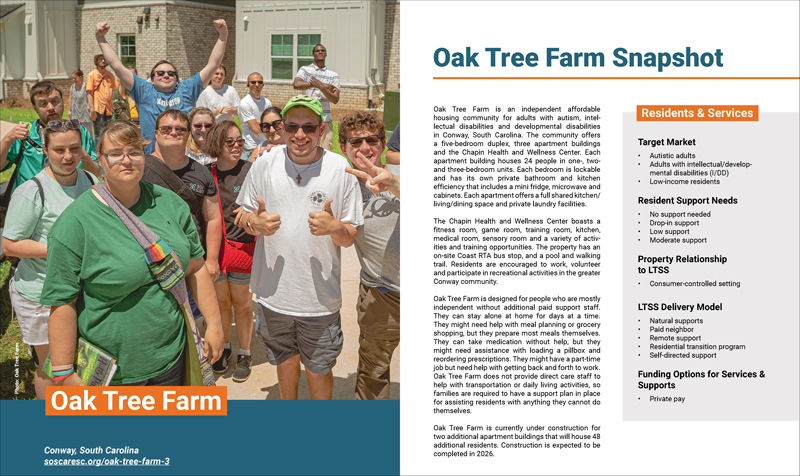
Sarah Pope, CEO of SOS Care, spent years watching families in South Carolina face an impossible choice: Keep their autistic adult children at home indefinitely or place them in the next available group home regardless of fit. As a parent, she knew this system was failing everyone. So, she acted by developing Oak Tree Farm—a tranquil neuro-inclusive planned community in Conway, South Carolina where adults with autism and intellectual/developmental disabilities (I/DD) can live with dignity and choice.1
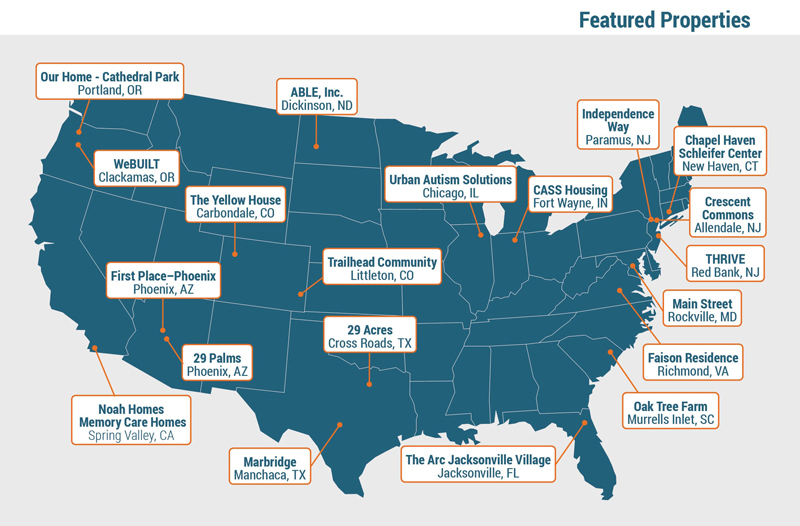
Map of “A Place in the World” properties across the U.S.
Oak Tree Farm offers more than apartments—it provides a vision of what’s possible. The community blends affordability with sensory-friendly design, and features supportive amenities like life skills training, recreation coordination, transportation assistance, on-site resident assistant for emergencies and shared spaces, including a swimming pool and community center. “We wanted to create a place where people could build real lives, not just fill beds,” said Sarah.
This kind of proactive planning is rare but essential. In 2023, 1.3 million people with autism and/or I/DD lived with family caregivers age 60 or older; another 1.9 million lived with caregivers ages 41 to 59.2 Many will outlive their caregivers, who often provide homes and primary support without formal backup plans. Without proactive planning, the default becomes emergency placements in adult foster care or group homes—or even homelessness.3
Meeting this challenge requires more than good intentions. It demands a shared language, a clear understanding of demand and proven models that communities can adapt. That’s exactly what A Place in the World: Fueling Housing and Community Options for Adults with Autism and Other Neurodiversities (APITW) offers.4 This comprehensive resource identifies specific recommendations to close the infrastructure gap in the U.S. and provides a framework to help local communities plan for the future instead of reacting to crisis.

Proactive Planning in Action
The recently published third edition of APITW (August 2025) establishes universal language that housing developers, service providers and local advocates can use to connect leaders committed to building new housing options in their communities. Private, public, nonprofit and philanthropic leaders collaborated to produce APITW, transcending sectors and helping stakeholders communicate what they need and want in housing and support.
The updated edition includes solutions for those with profound autism and high support needs, featuring options like de-escalation spaces, on-site clinical support and two-on-one staffing levels. The report serves both professionals and autistic adults with their support networks, offering a universal language with multiple categories and a Housing Market Guide featuring 20 examples from across the country. Practical worksheets help document needs to share with case managers and others to deliver home, and community supports aligned with bricks and mortar, forming a seamless connection.
Closing the Widening Housing Gap
The scale of unmet need is staggering. More than 8.38 million Americans have autism and/or I/DD yet planning for their housing needs does not exist at the national level.5 Every year, approximately 120,000 autistic youth exit high school,6 while state developmental disability systems add an average of only 8,200 new adults to residential services annually—for all adults with autism and I/DD.7 This growing gap means hundreds of thousands languish on waitlists.
The nation’s current housing stock does not match the realities of changing demographics in the U.S. Existing stock was largely created for nuclear families, which represent just 20% of today’s households.8 Housing costs have exploded while incomes have not kept pace. In South Carolina, a minimum wage worker would have to put in 125 hours a week to afford a one-bedroom apartment.9 For most autistic adults, access to affordable housing with cognitive accessibility and/or sensory-friendly design is out of reach.
The consequences are measurable and costly. Almost 50% of people experiencing homelessness live with some type of disability at a rate 2.5 times higher than that of the general U.S. population.10 The exact prevalence of I/DD within that population is unclear, but estimates range from 12% to 39%. Other autism-specific research estimates up to a 50% elevated risk of homelessness for autistic individuals.11
The Cost of Crisis Response
If an autistic adult is eligible for Medicaid-funded services, the “next empty bed” placement model is the norm, whereby a vacancy in a group home or adult foster care occurs for the next person on the waitlist when someone moves out or dies. For the individual, this can mean entering a setting with unsuitable peers, staff they don’t know, potential displacement to a new community, counties away, and routines upended after years of skill-building within a familiar environment.
This approach is traumatic and expensive. In South Carolina, for example, a group home placement averages $160,000 annually; receiving services in one’s own home in the community averages less than half that cost.12 Due to lack of housing options and planning alternatives, the former continues to be the more expensive and restrictive option.
This may seem like an impossible challenge for individual families, but you have more influence than you may realize. Community leaders like mayors, city councils or housing developers are often unaware of the problem let alone the solution.
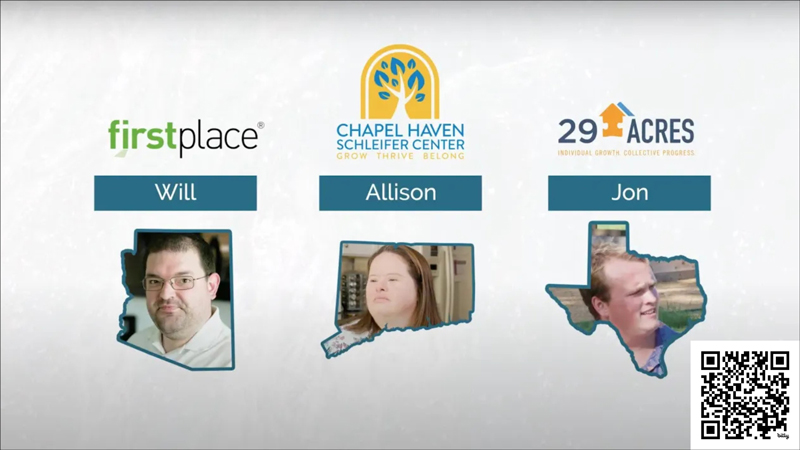
View films and clips from “A Place in the World: Fueling Housing and Community Options for Adults with Autism and Other Neurodiversities”
This is where you can step in and share APITW and films/clips describing how other communities have developed more options. Our 2021 ASN article may also be helpful: Increase Neuro-Inclusive Housing in Your Community: Here’s How!13
What Communities Want
Families and individuals know what they need and want. Communities can respond effectively through data. Our collection of APITW housing market analyses (HMA) identifies and document local gaps by combining surveys, stakeholder interviews and policy reviews to offer a thorough analysis of demand, preferences and barriers. (Refer to the accompanying article “Illuminating the Housing Crisis and Needs for Adults with Autism and I/DD” by First Place Global researchers Toyosi Adesoye, JD, MPA, and Avery Mickens.)
These preferences aren’t abstract—they provide clear direction planners can use. APITW’s planning tools help capture local demand and translate it into actionable information that leaders can use to develop optimum housing types, support models and funding strategies.
Equipped with Charleston and Columbia HMAs, Sarah is leading her state toward more responsive, data-informed solutions.14 They represent the opposite of the next empty bed approach, recognizing that people need more housing options, including appropriate support from the start.
Your Impact on Policy
As a citizen, you have real influence. Help your local leaders understand the challenges—and the solutions. When combined with local market data, APITW is a vital tool to help communities shift from a crisis response to proactive planning. The report includes specific recommendations to help local communities create policies that drive neuro-inclusive housing development.
Steps You Can Take Now
- Start with planning tools. Download APITW’s worksheets to learn about your housing and support options and familiarize yourself with the report.
- Engage your community leaders directly. Share the APITW report and videos with decision-makers—speak at planning meetings, contact local affordable housing developers, talk to your elected officials.
- Build your local network. Connect with families, service providers, developers and funders who share your vision for better housing solutions. Start meeting regularly to make connections and develop an action plan.
- Generate local data. Use APITW’s planning tools to identify specific housing types and supports people in your community need and want
- Work with others to develop a local APITW HMA.
A Call to Plan Ahead
Crisis response is costly, destabilizing and predictable. Proactive planning—grounded in local data and informed by proven models—offers choices while building stability and better outcomes for all.
A Place in the World offers autistic adults and their communities shared language, planning tools and real-world examples needed to act now. The opportunity is clear: Use available resources today to create a housing infrastructure for a future where autistic adults can flourish in their homes and community.

Denise D. Resnik is founder & president/CEO of First Place AZ/First Place Global, co-founder of Southwest Autism Research & Resource Center (SARRC) and the parent of an adult with autism.

Desiree Kameka Galloway is director of Autism Housing Network, a project of the Madison House Autism Foundation and lead consultant of Neuro-Inclusive Housing Solutions.
Email them at denise@firstplaceaz.org and desiree@neuroinclusivehousingsolutions.org.
Footnotes
- Oak Tree Farm – SOS Care
- US_8pg_accessible.pdf
- (PDF) Housing for Adults with Autism and/or Intellectual and Developmental Disabilities: Shortcomings of Federal Programs
- http://aplaceintheworld.org/
- How many people have IDD? | Residential Information Systems Project
- Loss in Services Precedes High School Exit for Teens with ASD: A Longitudinal Study – PMC
- US_8pg_accessible.pdf
- Making Room: Housing for a Changing America, a free publication from AARP and the National Building Museum
- Out of Reach: South Carolina | National Low Income Housing Coalition
- “The System Tends to Scoop You Up and Spit You Out and They’re Done With You”: The Intersection of Intellectual/Developmental Disability and Homelessness From the Perspectives of Service Providers – PMC
- (PDF) Autistic and without a home: a systematic review and meta-ethnography of the presence and experiences of homelessness amongst autistic individuals
- RISP State Profiles FY 2023 | South Carolina | State Profiles
- Increase Neuro-Inclusive Housing in Your Community: Here’s How! – Autism Spectrum News
- Housing Market Analyses – Global Leadership Institute