You may already know the center of a hurricane is called the eye of the storm. What you may not know is that while everything surrounding the eye is wild, swirling and out of control, the eye itself is curiously calm. It’s why meteorologists send planes into the eye, so they can observe and measure the extent and danger of the storm and act as needed.
I mention all this, because as a direct support professional who works closely with people with autism and other disabilities, “weathering storms” is part of my work. During these storms, I have discovered that like hurricane pilots, finding the eye can be a tricky place to get to, but a helpful place to be.
I remember once having to join one of my supported persons at one of her medical appointments. Her parents met us there and I was asked to wait outside the exam room. I noticed a shift in her attitude almost immediately.
Things soon turned from bad to worse.
While I was waiting as the appointment took place, someone came running out of the exam room, followed by a nurse calling for security. The supported person then stormed out of the room, agitated and screaming at the top of her lungs.
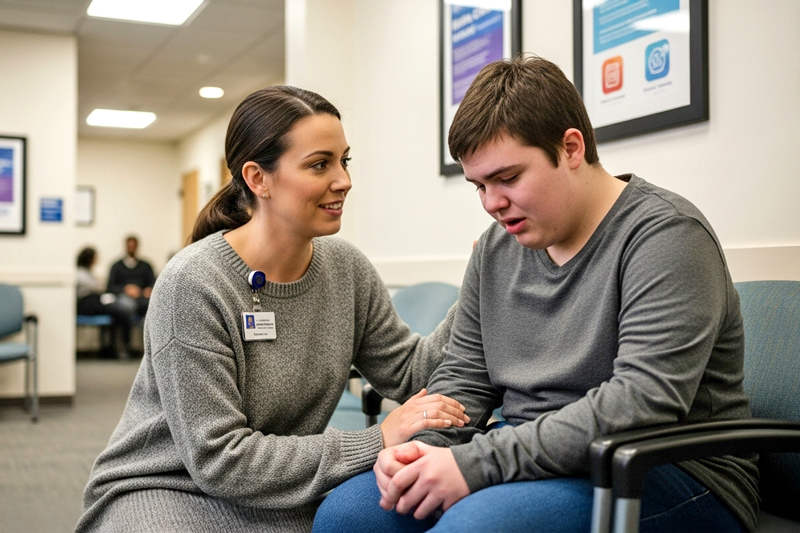
I quickly intervened to try and settle her down by speaking in a gentle, reassuring tone. A calm voice – perhaps as calm as the eye of the storm.
A mood shift quickly took place as she appreciated the distraction that refocused her to a seemingly different environment — even though we didn’t move at all. A calming voice and familiar presence proved to make all the difference.

Here’s another example of fostering safety and stability for one of my supported persons, though this time it happened over a longer period. In this case, the supported person was experiencing frequent behavioral episodes that led to emergency room visits, sometimes more than twice a week.
I sensed the cause of these sometimes-destructive outbursts were motivated by a desire for attention and sense of insecurity toward one of her peers. I then began to make a conscious effort to acknowledge her individually through one-on-one conversations and outings. And over time, the storms passed.
We’ve both learned so much about one another since we began working together almost a year ago. From my perspective, her self-confidence and more importantly, self-awareness, have never been in a better place. And listen to this: she hasn’t visited the ER since. That is real progress.
Dealing with difficult situations is an important part of my job, but don’t get me wrong: Like the weather itself, storms come and go. Oftentimes, the sun shines brightly. Indeed, most of my workdays are pleasant and affirming.
I love the social events and recreational programs, where our supported persons are encouraged to participate. And when they do, that’s progress, too.
I love the days where we celebrate milestones, anniversaries and achievements big and small. Where daily tasks like bathing, dressing and cooking are attained. Where confidence is boosted, self-esteem built, and greater independence realized. And when all that happens, that’s the best progress of all.
Of course, progress isn’t always linear. Advances are sometimes met by setbacks. A good day may be followed by a bad day. But no matter the weather, I am here for them. And always — even in the most trying times — there are opportunities for growth.
And that growth is not just for them, but also for me. I’ve learned so much from my supported persons, as well as from my CP Unlimited colleagues and others in the field. I am grateful for the professional training and development opportunities that prepare me to weather any incident or circumstance, as well as recruitment campaigns like #MoreThanWork that make me optimistic about the direct professional workforce today and into the future.
Most importantly, I’ve learned that if I focus on building trust, encouraging small behavior change and offering genuine praise and encouragement, I can really help my supported persons progress to independence. Even during storms, if I manage to stay in the eye.
In closing, I want to talk about “support” and “progress,” two words I’ve used several times during this piece.
When I talk to friends and family about the work I do, the first word that often comes to their minds is “support.” And it’s true: providing support is central to my work. The word is even in my title.
But support is not the word I choose to best describe my work. For me, that word is “progress.”
You see, support is what I do. But progress is what I seek.
Progress can be more difficult to ascertain during a particular moment but rather takes place over time. Sometimes in the middle of a storm.
But if I do my job right, we all get to fly home to a safe, secure and affirming environment.

Mervalyn Lamey Ingram, is a Direct Support Professional at CP Unlimited. To learn more, visit www.cpunlimited.org.