Across many countries, systems supporting individuals with intellectual and developmental disabilities (IDD) are experiencing significant pressure. Workforce shortages, increasing service demand, and funding constraints have created fragile service environments that test providers, policymakers, and families alike. While these issues are widely recognized within the field, translating system challenges into effective, sustainable policy reform remains a continual challenge.
Advocacy in developmental disability services is frequently fragmented. Providers may advocate alone, families and self-advocates organize grassroots efforts, and legislators receive competing views. Without coordination, even strong advocacy efforts struggle to produce lasting change. (van den Brink et al., 2021)
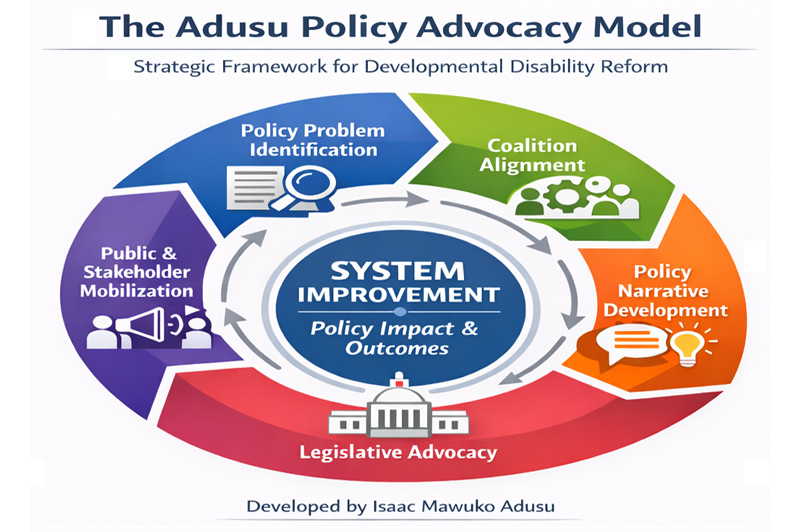
The Adusu Advocacy Framework was developed as a strategic model to address these challenges and deliver specific benefits. It provides a clear structure that enhances collaboration, unifies advocacy efforts, and increases the likelihood of lasting policy change. By aligning stakeholders, using evidence-based messaging, and supporting coordinated engagement with policymakers, the framework helps turn system challenges into sustainable policy solutions that strengthen disability service systems and improve outcomes for individuals with developmental disabilities.
Advocacy efforts benefit from clear, strategic direction. The framework offers a practical roadmap for organizations, advocacy groups, and coalitions aiming to influence policy reform in complex service systems.
The Requirement for Strategic Advocacy in Disability Services
Developmental disability service systems operate at the intersection of healthcare, social services, and public policy. (McLean & Koenig, 2025). Because many services rely heavily on public funding and administrative supervision, policy decisions directly affect the stability and supports available to individuals with disabilities (Topping et al., 2020, pp. 2482–2499).
Service systems face ongoing workforce shortages, particularly in direct support roles (ANCOR, 2025). Increasingly complex needs require specialized supports and well-trained staff. Providers also experience financial pressures that threaten sustainability. (Centre for Inclusive Employment, 2025). These problems can cause service disruptions, long waits, and reduced access to specialized care (Karpman et al., 2024).
While stakeholders often understand these problems, meaningful reform requires more than identifying system weaknesses. Effective policy change depends on coordinating advocacy efforts, sharing compelling policy narratives supported by credible evidence, and engaging policymakers in a structured, strategic manner. (Cullerton et al., 2018).
Purpose of the Adusu Advocacy Framework
The framework advances policy reform by aligning stakeholders around shared goals and coordinated strategies. At its core, the framework seeks to:
- Strengthen collaboration with service providers, advocates, and community stakeholders.
- Translate service system challenges into clear and compelling policy narratives.
- Promote strategic engagement with policymakers and public leaders.
- Promote policy solutions that improve long-range sustainability of the service system.
The framework emphasizes a system-level approach, requiring broad, coordinated action for sustainable reform instead of focusing on isolated concerns.
Core Principles of the Framework
The Adusu Advocacy Framework is guided by several principles that support effective policy engagement.
System-Level Advocacy: Advocacy should address structural challenges across the entire service system, not just individual organizations. Policymakers respond more urgently when they recognize broader implications of system instability.
Coalition Alignment: Coordinated advocacy increases the likelihood of policy success. When providers, families, advocates, and leaders agree on priorities and messaging, their collective voice is stronger (Goldman et al., 2016).
Evidence-Based Policy Messaging: Effective advocacy uses credible data. Workforce statistics, outcomes, and economic analyses strengthen arguments and show policymakers the real impact of decisions.
Human-Centered Narrative: Data alone rarely drives change. Advocacy should highlight the lived experiences of people with disabilities, families, and professionals to humanize policy discussions and illustrate the true impact of challenges (Stončikaitė, 2026).
Sustainable Policy Solutions: Advocacy should focus on long-term structural improvements rather than short-term fixes. Policies that enhance workforce stability, improve funding, and support provider sustainability help build more resilient service systems (OPWDD, n.d.).
Strategic Pillars of the Framework
The framework guides advocacy through interconnected stages, from problem identification to measurable policy outcomes.
Policy Problem Identification: The first stage involves identifying institutional obstacles affecting service delivery. This requires gathering relevant data, analyzing workforce and service trends, and documenting deficiencies in access or quality. A clear understanding of system challenges enables advocates to define policy goals and establish a strong foundation for reform.
Coalition Alignment: After identifying challenges, stakeholders develop shared advocacy priorities. Providers, advocacy groups, families, and leaders coordinate messaging and strategy to present a unified voice and agenda.
Policy Narrative Development: A clear, convincing narrative influences decision-makers. Narratives must describe the problem, its impact, and evidence-based solutions, converting complex challenges into policy priorities.
Legislative and Policy Engagement: Engagement with legislators is essential to the framework. Advocates should communicate clearly with elected officials and public leaders, providing briefings, testimony, and policy analyses that explain the importance of proposed reforms. Effective engagement emphasizes education, collaboration, and presenting actionable solutions.
Public Awareness and Stakeholder Mobilization: Public awareness demonstrates community support. Media, outreach, and education raise awareness and participation in advocacy.
Policy Outcome Monitoring: Advocacy continues after reform. Oversight ensures that new policies lead to improvements. Monitoring results such as employee retention and service access informs future advocacy.
The Advocacy Impact Pathway
The framework uses a structured process to move advocacy toward concrete results:
System Challenge Identified → Coalition Alignment → Policy Narrative Development → Policy Engagement → Public Advocacy → Policy Reform → System Strengthening.
This pathway ensures that advocacy progresses beyond problem recognition toward sustainable system improvements.
Likely Outcomes of the Framework
When implemented effectively, the Adusu Advocacy Framework offers several key benefits. It fosters stronger cooperation among stakeholders, improves communication between service providers and government officials, and increases the likelihood of policy revisions that address structural issues. The framework supports stable funding, robust workforce initiatives, and broader access to services for individuals with developmental disabilities. These benefits create a more supportive environment for lasting improvements.
Ultimately, the framework’s benefits include fostering service systems that are more resilient, equitable, and adaptable to changing community needs. Its planned approach helps ensure improvements are not just enacted, but sustained over the long term, resulting in better outcomes for individuals and families.
Conclusion
As developmental disability service systems continue to evolve, the need for coordinated policy advocacy will remain essential. Workforce issues, funding constraints, and rising service demand require thoughtful, strategic policy engagement from stakeholders across the field.
The Adusu Advocacy Framework offers a model for turning community concerns into policy action. By combining coalition work, data-informed advocacy, and storytelling, it provides an organized path to reforms that strengthen systems and improve lives. Sustainable change rarely comes from isolated advocacy. It happens when communities act with clarity, coordination, and strategy to influence the policies shaping their service systems.

Dr. Isaac Mawuko Adusu, DHA, MSNPM, is a Policy Advocate, Assistant Vice President of Adult Services at Seven Hills Foundation, Rhode Island, and an internationally recognized nonprofit leader in intellectual and developmental disabilities (IDD) and behavioral health, specializing in workforce transformation, community-based care, and organizational innovation. He can be contacted at IAdusu@sevenhills.org or ikemawuk@gmail.com.
References
Association of Community Rehabilitation Educators and Providers (ANCOR). (2025). The state of America’s direct support workforce crisis 2025. https://www.ancor.org/resources/the-state-of-americas-direct-support-workforce-crisis-2025/
Centre for Inclusive Employment. (2025). Resource collection. https://www.centreforinclusiveemployment.au/resources/332944
Cullerton, K., Donnet, T., Lee, A. & Gallegos, D. (2018). Effective advocacy strategies for influencing government nutrition policy: a conceptual model. International Journal of Behavioral Nutrition and Physical Activity 15. https://doi.org/10.1186/s12966-018-0716-y
Goldman, S. E., Burke, M. M., Mason, C. Q. & Hodapp, R. M. (2016). Correlates of Sustained Volunteering: Advocacy for Students with Disabilities. Exceptionality 25(1). https://doi.org/10.1080/09362835.2015.1064420
Karpman, M., Zuckerman, S., Gonzalez, D., & Kenney, G. M. (2024, March 14). Barriers to accessing medical equipment and other health services and supports within households of adults with disabilities. Urban Institute. https://www.urban.org/sites/default/files/2024-03/Barriers%20to%20Accessing%20Medical%20Equipment%20and%20Other%20Health%20Services%20and%20Supports%20within%20Households%20of%20Adults%20with%20Disabilities.pdf
McLean, K. J. & Koenig, J. (2025). Health disparities persist for adults with developmental disabilities: NHIS insights, 1999–2018. Health Affairs Scholar 3(4). https://doi.org/10.1093/haschl/qxae158
New York State Office for People With Developmental Disabilities (OPWDD). (n.d.). Equity, accessibility, and sustainability. https://opwdd.ny.gov/equity-accessibility-and-sustainability
Stončikaitė, I. (2026). Beyond stigma and biomedical frameworks: Humanizing dementia care through narratives. Journal of Aging Studies, 76, Article 101397. https://doi.org/10.1016/j.jaging.2025.101397
Topping, M., Douglas, J. M. & Winkler, D. (2020). Factors that influence the quality of paid support for adults with acquired neurological disability: scoping review and thematic synthesis. Disability & Society 35(12), pp. 2482–2499. https://doi.org/10.1080/09638288.2020.1830190
van den Brink, A., Elbers, W., & Ibrahim, A. F. (2021). Fragmented yet together: the disability movement in Sierra Leone. Disability & Society, 36(7), 1035–1052. https://doi.org/10.1080/09687599.2020.1782174