Group homes often serve as critical places for individuals with developmental disabilities, like autism spectrum disorder (ASD), who require specialized support and care (JEDU Care Services, n.d.). The individuals responsible for this support, known as Direct Support Staff, work on the front lines, implementing individualized plans for Positive Behavior Support (PBS) and ensuring safety through various interventions. Among those interventions is a technique known as physical management. This term, often misused, refers to the controlled and ethical use of human power to prevent people from harming themselves or others during a crisis. However, research suggests that frontline staff struggle to strike a balance between safety, dignity, and emotional well-being that is inherent in the use of physical management.
Why Safety Care Requires Physical Management
Strategies to prevent injury to individuals and staff during behavioral crises are encompassed in what is termed safety care. Physical management is sometimes necessary when less restrictive interventions fail to de-escalate potentially dangerous situations (Allen et al., 2013). For individuals on the autism spectrum who may exhibit self-injurious or aggressive behaviors, physical management can be a last-resort intervention to maintain safety and ensure the welfare of all individuals present (Matson & Boisjoli, 2009).
Studies have shown that when physical management is used correctly within a positive behavior support framework, risk of injury can be reduced, and behavior will be improved over the long term (Carr et al., 2002). Physical management is employed in a manner guided by ethical and legal standards. This means it is used only when necessary and in the least restrictive way possible (National Autism Center, 2015).
Challenges Faced by Group Home Direct Support Staff
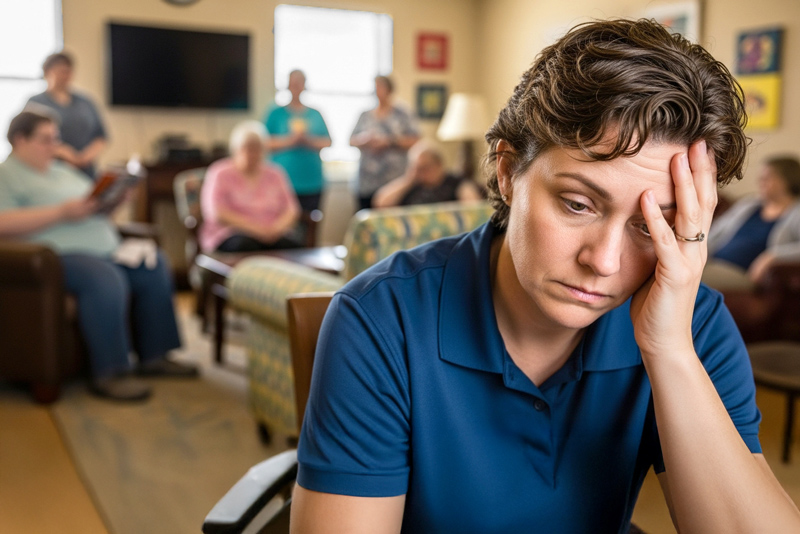
The physical management used by DSS serves an essential but often challenging role. First, restraining or guiding individuals in a condition of mental distress can labor staff to the point of injury or fatigue (Rose et al., 2011) Second, staff often feel considerable emotional and psychological trauma from engaging in physically demanding interventions with DSS; guilt, fear, and even moral distress are not uncommon (Duxbury & Whittington, 2005).
DSS often reports inadequate training and support for managing complex behaviors safely (McDonnell et al., 2015). Crises are unpredictable, and the high-stress environment contributes to staff burnout and high turnover rates (Braddock et al., 2015).
Trauma and Emotional Impact on Direct Support Staff
The trauma that DSS experience is multifaceted. Physical interventions can trigger post-traumatic stress symptoms, particularly when staff feel ill-prepared and improperly supported (Sullivan et al., 2012). Emotional exhaustion and compassion fatigue are common, and these can detract from staff well-being and job satisfaction (Figley, 2002).
To tackle this, organizations need to prioritize the type of care that considers trauma when serving not just their clients but also their staff (Knight, 2015). Allowing access to various forms of counseling, from the traditional, one-on-one types to group and peer counseling to the right kind of debriefing after an incident.
Making Direct Support Staff Work Meaningful
To make DSS work more meaningful, it is necessary to understand their role and, even more importantly, to provide opportunities for professional growth. DSS not only need to be educated, but they also need to be educated in a way that empowers them to make informed decisions. Those decisions should be made in conjunction with the care planning process, using a model that recognizes both the contributions of DSS and their empowerment as essential components of the plan’s success. Empowering staff through ongoing education, involvement in care planning, and acknowledgment of their contributions fosters job satisfaction and resilience (Robertson et al., 2017).
Essentially, when reflective practice is implemented and an attitude of respect is promoted, staff morale is enhanced, and their feelings of isolation are reduced.
The Role of Frontline Group Home Managers
DSS relies heavily on frontline managers to integrate behavioral support plans and safety care techniques. If the DSS is to function effectively (and that is the hope behind all these efforts), managers must serve in precisely three key capacities:
(1) They must provide clear guidance.
(2) They must ensure that multidisciplinary teams communicate effectively.
(3) They must ensure that team members have received the training necessary to perform their assigned roles.
Effective managers provide clear guidance, ensure adequate training, and facilitate communication between multidisciplinary teams (Hastings et al., 2013).
Managers can champion tools that reduce the need for physical management by staff. This can be accomplished by implementing a few environmental modifications and a series of proactive cleaning strategies (Carr et al., 2002). They also play a pivotal part in ensuring that staff well-being is at the forefront of the staff-managerial relationship. Ensuring staff well-being involves maintaining good communication between staff and managers; it requires mutual effort on both sides to ensure it happens.
Conclusion
The necessary yet challenging component of safety care in group homes for individuals with autism is physical management. Direct Support Staff (DSS) have a tough job, and this Job Analysis describes the demanding physical and sometimes traumatic emotional components of the mantle of responsibility carried by DSS. Besides the Work Environment issues described above, DSS has the physical demands of the job and the emotional trauma that too often is a part of the job that we want to change for the better. For us, a better path forward combines trauma-informed practices with clearly defined and meaningful role descriptions.

Isaac Mawuko Adusu, DHA, MSNPM is a Policy Advocate and Assistant Vice President of Adult Services at Seven Hills Foundation, Rhode Island. For more information, contact Isaac Mawuko Adusu, DHA, MSNPM, at IAdusu@sevenhills.org, ikemawuk@gmail.com, or (774) 823-7151.
References
Allen, D., Hutchinson, A. M., Brown, R., Livingston, P. M., & User-Centred Care Group. (2013). User experience and care quality in aged care: A systematic review. International Journal for Quality in Health Care, 25(6), 682–693.
Braddock, D., Hemp, R., Rizzolo, M. C., Tanis, E. S., Haffer, L., & Wu, J. (2015). The state of the states in developmental disabilities. American Association on Intellectual and Developmental Disabilities.
Carr, E. G., Dunlap, G., Horner, R. H., Koegel, R. L., Turnbull, A. P., Sailor, W., … & Fox, L. (2002). Positive behavior support: Evolution of an applied science. Journal of Positive Behavior Interventions, 4(1), 4–16.
Duxbury, J., & Whittington, R. (2005). Causes and Management of Patient Aggression and Violence: Staff and Patient Perspectives. Journal of Advanced Nursing, 50(5), 469–478.
Figley, C. R. (2002). Compassion fatigue: Psychotherapists’ chronic lack of self-care. Journal of Clinical Psychology, 58(11), 1433–1441.
Hastings, R. P., Allen, D., Baker, P., & Gore, N. J. (2013). Staff stress and coping strategies in intellectual disability services: A review of the literature. Journal of Applied Research in Intellectual Disabilities, 26(1), 1–12.
JEDU Care Services. (n.d.). About us | Developmental disability services in Bowie, Maryland. https://www.jeducareservices.com/developmental-disability-services-about-us
Knight, C. (2015). Trauma-Informed Social Work Practice: Practice Considerations and Challenges. Clinical Social Work Journal, 43(1), 25–37.
Matson, J. L., & Boisjoli, J. A. (2009). The relationship of challenging behaviors to severity and symptoms of autism spectrum disorders. Journal of Developmental and Physical Disabilities, 21(4), 357–367.
McDonnell, A., Hardiman, E., & McCallion, P. (2015). Staff training and development in intellectual disability services: A review of the literature. Journal of Intellectual Disabilities, 19(3), 195–210.
National Autism Center. (2015). National standards report. Retrieved from https://www.nationalautismcenter.org
Robertson, J., Hatton, C., Emerson, E., & Baines, S. (2017). Staff training and development in intellectual disability services: A review of the literature. Journal of Intellectual Disabilities, 21(1), 3–15.
Rose, J., McGuire, B., & Evans, D. (2011). Staff injuries in intellectual disability services: A review of the literature. Journal of Applied Research in Intellectual Disabilities, 24(3), 243–252.
Sullivan, C. M., Rumptz, M. H., Campbell, R., Eby, K. K., & Davidson, W. S. (2012). Retaining participants in longitudinal community research: A comprehensive protocol. Journal of Applied Behavioral Science, 38(2), 258–276.