At the beginning of my eighteenth year in teaching, I found myself reflecting deeply on what contributes to effective educational practice. I questioned not only whether I was good at what I do, but also how I could meaningfully evaluate my own professional competence.
After the birth of my son in November 2015, like many parents, my perspective shifted. My commitment to teaching remained strong, but the balance between professional responsibility and being a new parent became increasingly challenging.
In 2018, when my son Jamie was diagnosed with autism at age three, I had already been lecturing for eight years. Despite completing professional SEND training, it quickly became clear that my understanding of autism had been surface-level. Lived experience became my most powerful professional development tool.
Jamie, now 10, has diagnosed autism, sensory processing disorder, and suspected ARFID. His main challenges involve food, unexpected changes to routine, loud noises, and navigating unfamiliar environments. Like many autistic children, he often masks anxiety by copying peers’ behaviour.
This personal journey intersects sharply with a wider national picture. One in seven children in England is now estimated to be neurodivergent, including autism, ADHD, and dyslexia. Autism remains the most common primary need recorded in EHCPs, representing 31.3% of all plans. This prevalence means the needs of learners like my son are no longer marginal – they are central to today’s classrooms [gov.uk] [beyondautism.org.uk].
Early in my career, differentiation was a prominent expectation, yet I often struggled to understand how it could be meaningfully applied across wide ability ranges. In hindsight, I was differentiating all along, but my planning was still centred on the 80–90% rather than the most vulnerable 10%.
My approach changed considerably in January 2024 when I joined North Herts College after 15 years at my previous institution. This transition gave me space to reflect and coincided with Jamie’s growing needs. I began flipping my planning in favour of the 10%.
This shift mirrors national data: EHCP numbers rose 11% between January 2024 and January 2025, reaching 638,745, with 127,902 aged 16–19 – our FE demographic. FE now educates over 88,000 young people with EHCPs, a 5% rise year-on-year. This growing complexity means FE cannot rely on approaches designed for “most” learners [natspec.org.uk].
Many of the strategies I use now stem directly from the way our family supports Jamie: preparing for everyday activities, building predictable routines, and reducing anxiety through clarity. Research shows this isn’t unique – during the pandemic, loss of routine was a major driver of anxiety for neurodivergent children, more so than policy decisions or restrictions themselves [ucl.ac.uk].
This led me to ask: Would all learners benefit from increased structure and routine, even those without a neurodivergent diagnosis?
Learners frequently ask what we are doing today, tomorrow, or next week. Their desire for predictability mirrors what I see in my own home.
What have I implemented?
When planning activities for my lessons, my initial consideration is always “How will this work for Jamie?” – a thought process that often happens subconsciously.
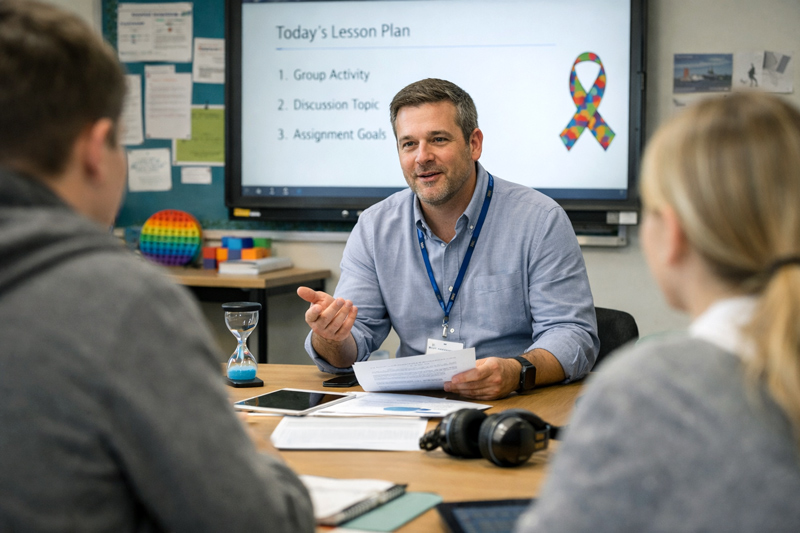
From September, I establish clear ground rules in the classroom and maintain them consistently, as this provides structure and supports positive behaviour. Visual prompts within PowerPoint presentations highlight learning outcomes and link directly to the tasks set.
A starter activity is displayed as students arrive, enabling the lesson to begin promptly, with late arrivals integrating seamlessly into the activity via the designated seating plan. Seating arrangements may vary but are always communicated to students in advance.
Information from EHCPs, along with any prior learner knowledge gained through learner progressions, is used to inform the initial creation of seating plans. These plans are then reviewed and adjusted throughout the first term as friendship dynamics and group relationships become more evident.
For me, it’s important that lesson activities are time-bound and supported with a visual timer on the interactive board. Tasks are broken down into smaller, manageable components – task A, task B, and extension activities where appropriate. Clear guidance is provided so learners understand expectations and next steps. The end of each activity is signalled with a visual or audible cue. The activity is structured with a clear beginning and end.
A scheduled group break at the midpoint of the session provides an opportunity for students to reset, particularly those who may feel overwhelmed and benefit from a moment of recalibration. This time also allows learners who remain in the room to ask questions or seek clarification in a quieter environment.
In November 2025, I introduced PowerPoint subtitles during classroom delivery following observation of a colleague during a CPD session. This has been particularly well received by my Level 2 group, and I believe it supports comprehension, especially for learners who may find my northern accent challenging!
In January 2026, I adopted a new approach to using Microsoft Teams with Level 2 sport. The day before each lesson, I send a message to the group outlining the plan for the upcoming session. This includes whether we will be working on individual assignment targets, engaging in practical tasks, or covering specific theoretical content. I also provide a brief overview of the activities involved. In my experience, this advance communication reduces anxiety, improves learner engagement, and helps students arrive prepared and ready to learn. Is this time consuming? Yes, but I have seen the benefits.
Conclusion
In an educational landscape increasingly driven by data and progress indicators, it’s easy to lose sight of the human experience behind our learners. But the data now aligns with what lived experience has taught me:
- Neurodivergence is common, rising, and central to FE.
- Anxiety is widespread across all learner groups post-pandemic.
- Structure, clarity, and routine benefit everyone – not just the neurodivergent.
The small adjustments we make – visual prompts, consistent routines, advance communication, structured tasks – are not simply supportive measures for a minority. They are practices that benefit all learners navigating education.
A more inclusive approach to design (UDL) and learning environments for all creates a more enjoyable learning experience and improved outcomes. As both a lecturer and a parent, I have seen firsthand how transformative thoughtful preparation can be.

To contact the author, email davechapman14@yahoo.co.uk.
References
Beyond Autism. Statistics – Understanding Autism. Accessed February 2026.
Department for Education (DfE). More support for neurodivergent children in mainstream schools. GOV.UK, 29 May 2025.
Natspec. Key Facts 2025 – Specialist FE Data Report. January 2025.
UCL Institute of Education. Global study finds government pandemic policies did not impact neurodivergent children’s anxiety. 28 July 2023.