Becoming a parent is an experience that reshapes people’s lives. For autistic mothers, it can bring joy but also create a unique set of challenges. Understanding of autistic women’s experiences is increasing, but autistic women remain under-diagnosed and under-researched. Parenting information tends to assume that people with disabilities, including autism, lack the ability to parent or provide adequate childcare (Lockington and Gullon-Scott, 2025).
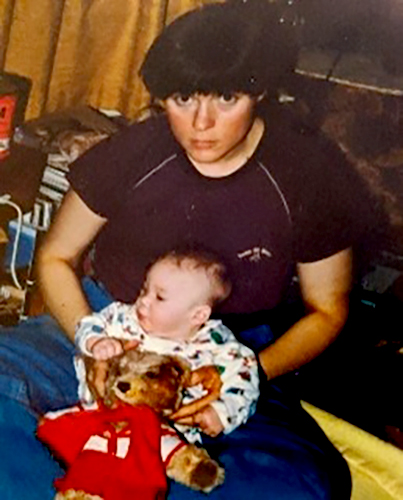
The author with her son.
Pregnancy
As a child, I longed for a baby. When I got pregnant, I cried—for hours. Tears of joy? Maybe, but that’s not how I remember it.
Some women suspect they’re pregnant within the first week of gestation, but most don’t know until the 4th to 8th week. Physical changes start early, but signs such as nausea, sore breasts or a missed menstrual period are not unique to pregnancy (“10 Early Signs of Pregnancy”, 2025).
Early emotional signs include mood swings, heightened emotions, and increased irritability, generally caused by estrogen and progesterone fluctuations. The Mom-to-be may be excited, but also anxious, overwhelmed, and prone to tears (Westgate, V., 2025).
Compared to Neurotypical women, whose pregnancy experiences are well-documented, less-often studied autistic women have a high risk of prenatal depression and anxiety: 60% vs. 12% in the general population (Pohl, Crockford, Blakemore, Allison & Baron-Cohen, 2020). The combination of pregnancy changes and navigating a medical system less accommodating of Autistic cognitive and executive function differences, can exacerbate stress and anxiety (Westgate, 2025).
For me, loneliness and isolation made pregnancy difficult. I was 900 miles from home and family, and my husband’s job demanded long hours. Left alone to adjust to marriage with little to do beyond domestic chores was emotionally taxing. I don’t tolerate heat well, and my second trimester during a particularly hot summer.
Coping with physical discomfort, emotional volatility and mental health professionals who seemed unsure how to support me, I wanted to reverse time and just be a child again.
Common Pregnancy Challenges
The physical and emotional changes of pregnancy are well-documented. Any new mother is at risk of depression, anxiety, and other mood disorders due to rapid drops in estrogen and progesterone after childbirth. Mood swings, self-doubt and tearfulness (“baby blues”) combined with sleep deprivation and stress, can trigger more severe conditions like postpartum depression, postpartum anxiety, even postpartum psychosis (PPP) (Cleveland Clinic, 2022).
Postpartum psychosis is a psychiatric emergency that can develop suddenly in the first weeks after childbirth, causing hallucinations, delusions, confusion, and paranoia. These conditions produce hopelessness, difficulty bonding with the baby, changes in appetite or sleep, and thoughts of self-harm or harming the baby (Cleveland Clinic, 2022).
Most pregnant women experience nausea a.k.a. “morning sickness”, aches, pains, fatigue, food cravings, heartburn, fatigue, leg cramps, joint swelling, etc., but autistic mothers may find such symptoms particularly bothersome (“10 Early Signs of Pregnancy”, 2025).
Participants in Autistic Women’s Experiences of the Perinatal Period, (Westgate, Sewell, Caramaschi & O’Mahen, 2025) “[S]eemed more prone to sensory difficulties during their pregnancy… [that] make daily life more difficult.” Ordinary tasks (e.g., housework, grocery shopping) become more challenging, and previously learned coping skills may prove ineffective.
“One woman felt that the more severe nausea she experienced was linked to existing sensory sensitivity to smell.” (Hampton, Man, Allison, et al., 2023, as cited in Westgate, et al., 2025) Changing body shape may also be an issue. “With my body changing shape, my centre of gravity…and balance changing…I have to figure out new ways of moving and being in my body” (Hampton, et al., 2023, as cited in Westgate, 2025).
Interoception and Proprioception
Hampton et al., 2025 reported that some autistic mothers found the internal sensation of fetal motion and kicks intolerable. “’When he (baby) started moving inside me it was unbearable…I used to describe it as having an alien in me’ (Talcer, Duffy & Pedlow, 2023 as cited in Westgate, 2025). Another woman likened having the fetus inside her to ‘an invasion of privacy (Gardner, Suplee, Bloch & Lecks, 2016, as cited in Westgate, 2025).
I empathize with autistic women’s distress at the frequent, intimate touching by healthcare providers. Sensory difficulties often resulted in a poor birth experience. ‘I think the perception and lived experience of my son’s birth was made worse by [autism], specifically sensory processing difficulties. The cut of the scalpel, the touch of the doctor’s cold hands, the noises I kept hearing’ (Lewis, Schirling, Beaudoin, Scheibner & Cestrone, 2021, as cited in Westgate, 2025).
For me, touch can leave tactile afterimages that linger for days.
Stimming—a self-soothing method—helped some women to alleviate the sensory overload. But stimming, like other autistic behaviors, may still elicit negative reactions from medical providers leading to the autistic patient feeling devalued or “weird” (Nicolaidis et al., 2014) Awareness and understanding within the medical field is increasing but is not universal.
Childbirth
My emotional memories of childbirth are still bitter. I experienced ‘false labor’ prior to my son’s birth, and intense pains two weeks later. I was met by many of the same staff upon returning. I wasn’t yet “Officially” Autistic, but the nurses thought that the symptoms suggesting imminent childbirth were abnormally intense.
They may have viewed my behavior as histrionic—overly dramatic. I was a week or two overdue but not adequately dilating. My OBGYN was anxious to go home but didn’t want to subject me to another hospital trip. He induced labor, and roughly 10 hours later, my son was forcibly yanked from me in a brutal medical tug-of-war. I screamed for 24 to 36 hours afterwards.
I could not hold him, change him or feed him. Not because I didn’t want to, but because I shut down. Doctors diagnosed Postpartum psychosis and didn’t want to discharge me. Accepting responsibility for the baby, my husband took time off. I clung to my favorite stuffed animal, over which a Social Worker publicly laughed. A psychiatrist demanded to know whether, when the baby cried, would I hug him…or that toy.
Knowledge and Understanding of Autism in Women: Positive Experiences
I’m not suggesting autistic women can’t experience joy in motherhood. But studies I came across were generally anecdotal and involved limited numbers of participants. Perhaps the best analysis I found concluded that autistic women develop strong bonds, intense connections, and a wide range of shared experiences with their children. But most experienced difficulties less-often reported by non-autistic mothers, including the need to cope with provider’s misunderstandings (Lockington and Gullon-Scott, 2025).
Findings also attest to the need for medical education on how autism manifests in adults, including behaviors we use to mask our reality. Furthermore, providers need to know that there’s often a mismatch between our emotions and facial expressions. That we have intense sensory needs during pregnancy, and that their difficulty taking our needs and perspectives into account frequently result in extreme negative consequences for autistic individuals.
“Motherhood Isn’t What I Expected”
Sleep Disruption – Sleep difficulties, already common in Autism, are exacerbated by the need to be on-call for baby-duty, day and night. Disrupted sleep further impacts mental and physical health, making it even harder to be present and responsive as a parent.
Self-Care and Regulation – Parenting disrupts self-regulation and self-care routines, again leading to sensory and emotional dysregulation. The sensory needs of the autistic parent and baby may be mismatched, and autistic mothers often hesitate to request help out of fear that their ability to parent will be questioned. Connecting with other new parents can offer validation and reduce isolation, but socialization comes with its own cognitive challenges.
Strategies, Support Systems, Advocacy and Professional Understanding – It’s crucial for autistic mothers to advocate for their needs, especially with healthcare professionals. And creating manageable routines for daily tasks, such as meal preparation, can help address executive function challenges. Visual supports, shared calendars, and chore charts can provide structure and reduce overwhelm.
Conclusion
Becoming an autistic new mother involves handling a complex array of sensory, emotional, and social experiences. From sensory overload and executive dysfunction to social isolation and mental health risks, our challenges are substantial. Yet autistic mothers also display remarkable resilience, forming deep and meaningful connections with their children, and demonstrating profound dedication (Krekorian Hanish, 2024).
By advocating for our needs, establishing supportive routines, and fostering understanding within relationships, autistic mothers can create nurturing and supportive environments. To ensure these mothers receive the affirmation and resources they deserve, it’s essential that healthcare professionals nurture compassion and awareness, and society in general learns how to support us.
An important element of self-advocacy is sharing to educate others. We want professionals to understand and accommodate us, so it’s imperative that we inform them of our needs. In Autistic People’s Perinatal Experiences I (Hampton, et al, 2023), women were asked whether they had disclosed their autism diagnosis to a healthcare provider involved in their perinatal care.
Nearly half of respondents replied “Not Applicable” because they hadn’t yet been diagnosed Autistic. Only 13% informed their doctor. The vast majority disclosed nothing believing, “…my doctor wouldn’t know what to do with [the] info,”.
It’s not mandatory to disclose disability needs in professional settings, “No one will know that our bodies and brains process the world differently [unless/until] we’re willing to explain how our brains and bodies process things differently. We get to “choose how much to share, when, and with whom” (Neff, 2022).
But some disclosure is essential to raising autism awareness and achieving acceptance.

Annie Kent, MA, spent two decades working in public sector disability, mental health, and infectious diseases advocacy and education. Diagnosed with three closely related types of neurodiversity, a lack of awareness and understanding led to burnout and retirement from the field. She remains an active advocate, learning and engaging personally and remotely with several Autism and ADHD organizations and Forums. Email Annie at ajollymo@lakeheadu.ca.
References
“10 Early Signs of Pregnancy.” Health, Wellness and Protection, Johns Hopkins Medicine, 18 Mar. 2025, www.hopkinsmedicine.org/health/wellness-and-prevention/10-early-signs-of-pregnancy#:~:text=When%20do%20pregnancy%20symptoms%20start,reach%20out%20to%20your%20gynecologist. Accessed 19 Nov. 2025.
de Bellefonds, Colleen. “9 Early Pregnancy Signs before You Miss Your Period.” What to Expect, 29 July 2025, www.whattoexpect.com/pregnancy/symptoms-and-solutions/early-signs-of-pregnancy-before-missed-period/
Hampton, S., Man, J., Allison, C., Aydin, E., Baron-Cohen, S., & Holt, R (2023). A qualitative exploration of autistic mothers’ experiences I: Pregnancy experiences. Autism, 27(5), https://pmc.ncbi.nlm.nih.gov/articles/PMC9340136/#:~:text=During%20childbirth%2C%20autistic%20people%20should,autistic%20and%20non%2Dautistic%20mothers
Hampton, Sarah, et al. “A Qualitative Exploration of Autistic Mothers’ Experiences II: Childbirth and Postnatal Experiences.” Autism, vol. 26, no. 5, 4 Sept. 2021, p. 136236132110437, https://doi.org/10.1177/13623613211043701
The Heller School for Social Policy and Management, The National Research Center for Parents with Disabilities, heller.brandeis.edu/parents-with-disabilities/publications/advice-for-professionals/advice-autism-spectrum.html#:~:text=Download%20PDF-,Introduction,with%20being%20an%20autistic%20parent. Accessed 19 Nov. 2025.
Krekorian Hanish, Kiley. “Autistic Motherhood and Daily Life | Neurodivergent Insights.” Neurodivergent Insights, 21 Feb. 2024, neurodivergentinsights.com/autistic-mothers. Accessed 28 Nov. 2025.
Lockington, Deanne Christie, and Fiona Gullon-Scott. “The Lived Experiences of Autistic Mothers: A Systematic Review and Thematic Synthesis of Qualitative Evidence.” Autism & Developmental Language Impairments, vol. 10, 1 Mar. 2025. National Library of Medicine, pmc.ncbi.nlm.nih.gov/articles/PMC12246537/, https://doi.org/10.1177/23969415251343850. Accessed 27 Nov. 2025.
Neff, M. A (2022, January 14). The Bachelor, Self-Disclosure, and Self-Advocacy | Neurodivergent Insights. Neurodivergent Insights. https://neurodivergentinsights.com/lets-talk-the-bachelor/?srsltid=AfmBOooaA9_qGoLd7K5QKDxNGmoQSfYsNxVjtDZuEQqrAxpNqJcaIti5
Nicolaidis, C., Kripke, C. C., & Raymaker, D (2014). Primary Care for Adults on the Autism Spectrum. Medical Clinics of North America, 98(5), 1169–1191. https://doi.org/10.1016/j.mcna.2014.06.011
Pohl, A. L., Crockford, S. K., Blakemore, M., Allison, C., & Baron-Cohen, S (2020). A comparative study of autistic and non-autistic women’s experience of motherhood. Molecular Autism, 11, 3. https://doi.org/10.1186/s13229-019-0304-2
Westgate, V., Sewell, O., Caramaschi, D. et al. Autistic Women’s Experiences of the Perinatal Period: A Systematic Mixed Methods Review. Rev J Autism Dev Disord (2024). https://doi.org/10.1007/s40489-024-00461-2