
I didn’t start as a systems guy. I started as a dad in denial, with no roadmap, no acronyms, and no patience for policy. Then our family hit rough water. Puberty flipped the table, literally. Supports vanished just when we needed them most. Person-centered practice became paper-centered bureaucracy.
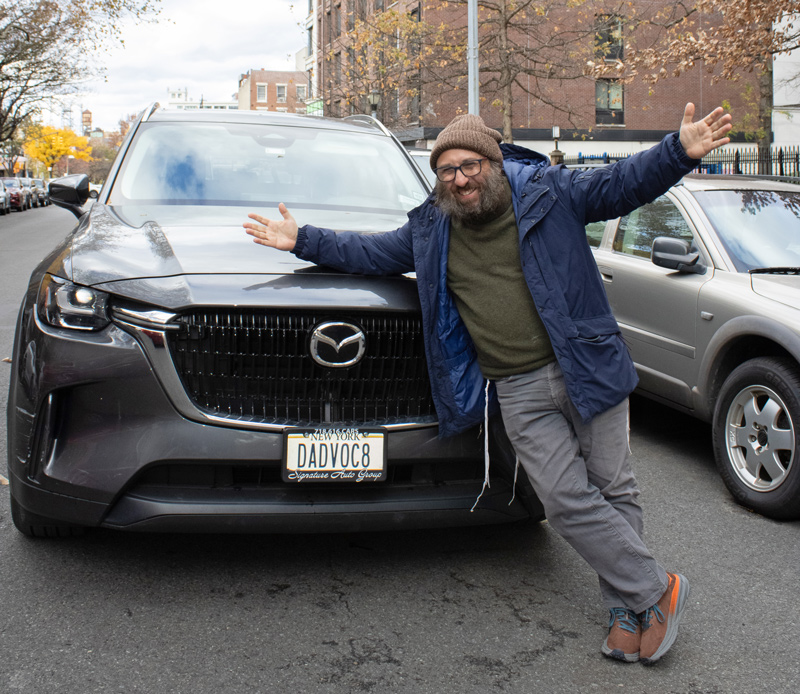
Rabbi Simcha Weinstein proudly showing off his “Dadvocate” license plate.
That’s how a reluctant parent becomes a family peer advocate and, eventually, someone who delivers statewide training for peers, families, and caregivers. People, okay, mostly me, call me the dadvocate. Yes, I have the podcast and even the license plate.
Being chosen to serve as a parent panelist on several OPWDD–NCCC webinars was something I took very seriously. It gave me the chance to bring both my lens and lived experience to statewide conversations, to air frustration and angst in a strength-based way. That ability took years to develop. Peer work taught me how to share strategically, not reactively, and to turn emotion into impact.
These webinars brought together providers, OPWDD staff, and cross-systems agencies in education, health, behavioral health, and provider organizations. The sessions focused on a tough but necessary topic: identifying and addressing disparities in disability supports and services.
The partnership between the New York State Office for People with Developmental Disabilities (OPWDD) and Georgetown University’s National Center for Cultural Competence (NCCC) is a multi-year effort to strengthen equity, inclusion, and cultural and linguistic competence across New York’s developmental-disability system. Led by Professor Tawara Goode, NCCC’s Disability Disparities Framework asks a key question: Disparities in what? — in availability, accessibility, acceptability, quality, and utilization. That framework gives us a shared language for tough conversations and a roadmap for change.
During panel prep, I was encouraged to “keep it real.” Speaking truthfully, and staying grounded while doing it, felt like real progress.
When the System Starts to Sink
When our son was little, we lived in Disney World of early intervention, supported by a community overflowing with services. Then puberty hit and everything changed overnight. Behaviors escalated. Suddenly there were no schools, no camps, no workers, no case manager.
One meltdown landed him in a pediatric psychiatric unit. I soon realized many of the young people there, nearly a third by my count, were autistic or had intellectual and developmental disabilities. Doctors admitted they weren’t trained in ID/DD, even as they wrote prescriptions. It felt like a post-modern Willowbrook, not out of cruelty, but because systems were never built for whole-person care.
Even the most dedicated professionals are trapped in imperfect structures. Different offices mean different case managers, which leads to duplication and confusion. Scopes are too narrow for whole-person care, and interdisciplinary teamwork is rare. Meanwhile, medical systems drown in Medicaid-billable progress notes that document the lack of progress. For ID/DD and neurodivergent youth, these gaps can be life-threatening.
We all believe in self-determination, voice, choice, and independence. But when a teenager wears diapers not because of incontinence but because someone missed a colitis diagnosis, that isn’t self-determination. Not a “behavior issue,” but a systems failure. Saying a child needs a colonoscopy isn’t overstepping, it’s common sense.
Self-Advocates, Families, and the Icky In-Between
We talk a lot about self-advocacy, and rightly so. People with disabilities must be at the center of their own story. But for parents of individuals with higher support needs, our role often looks different. We’re not their voice, we’re their amplification. And sometimes we’re the decision-makers, a responsibility we take seriously. Many parents are also self-advocates; the lines don’t always fall neatly.
Speaking up for our loved ones, whether they’re seven or seventy, isn’t about speaking over them. It’s about ensuring they’re heard in rooms that still lack captions for their lived experience. And, practically speaking, it’s about making sure other people do their part so our loved ones can have a real quality of life. We’re driven by family bonds, and yes, bound by law, to step in when systems fall short.
Small Failures, Big Messages
On the panel, I shared one small but telling story. A young man we’re close with lives in a group home. His cable went out months ago. DSPs couldn’t fix it. I tried. The house manager was called, but the family had no line to senior leadership. Meanwhile, he burned through his small allowance downloading movies online.
It’s “just cable,” until you remember that self-determination starts with choosing what you watch in your own living room. And as of this writing, the cable still isn’t fixed. That’s what we do as parents and caregivers, we keep calling, we keep showing up, and we don’t stop.
From Collaboration to Compliance
Families built these systems out of love and necessity long before Medicaid professionalized the field. Medicaid and managed care changed everything, mostly for the better, but as compliance grew, collaboration shrank.
Many provider agencies that began as family start-ups now operate like large corporations, sometimes with family members in executive roles. That success is real, but it can create distance. Compliance replaced connection. And when meeting policymakers or sitting on state committees, it can get blurry, who’s speaking as a parent, who’s lobbying, and who’s paid to keep the system running? It isn’t malicious, but it does get icky, especially when intersection, conflict of interest, and codependency all collide.
We’re often consulted after decisions are made. We talk about being data-driven, but what about the people who can’t fill out surveys? Their voices never make the spreadsheet. That’s not inclusion; it’s a blind spot disguised as rigor.
That’s why I push for built-in family voice: parent circles, peer supporters, and family advisory councils with real authority. If care coordinators must engage families, providers should too. Providers ask families to advocate for funding, and we do, but we can also be partners in quality, safety, and equity.
You can’t call the Justice Center for a broken cable. But if you never fix the cable, don’t be surprised when the Justice Center gets called.
Seeing the Whole System
This work can’t fall solely on OPWDD. It crosses every system, education, employment, healthcare, housing, addiction, juvenile justice, transportation, and even cyber safety. Families like mine navigate them all, often juggling more case managers than actual cases.
My interactions with OPWDD and other system leaders have been caring, candid, and deeply human. There’s been real listening and a willingness to look through the lived-experience lens. It’s not perfect, but it’s progress.
The OPWDD–NCCC partnership shouldn’t end when the grant does. It should spark long-term system change, more listening sessions, more practical tools, and more lived experience at every planning table.
So, here’s my ask: stop treating families as a risk factor and start treating us as a resource, or better yet, a partner.
That young man and his cable are still waiting. And we’re still here, trying to get back into the very rooms we once built out of love and necessity. We’re not asking for a seat at the table after the design is done; we’re asking to be part of the blueprint.
When families and providers fall back in love, paper-centered becomes person-centered, and, if we do this right, truly people-centered.

Simcha Weinstein is a best-selling author, syndicated columnist, and the Community Engagement and Inclusion Coordinator at Families Together in New York State. He is also the founder of the Jewish Autism Network, a grassroots initiative, and serves as the Brooklyn lead for NYADD—the New York Alliance for Developmental Disabilities. Dubbed “New York’s Hippest Rabbi” by PBS, Simcha lives in Brooklyn, New York.



Rabbi Weinstein: Great information, thank you for what you are doing to start trying to get the actual lived knowledge into the lacking and disorganized “system”. I would imagine that NYC has decent services, but still the cliff that appears in the teen and young adult years is shocking. In my small metropolitan area, services other than some for young kids are almost non-existent and public schools are fully unequipped. Energy is spent making it look like parenting failures and a problem kid rather than trying to get real help and real accommodations built into the system (or lack of system, really). It is overwhelming. I am going to check out your podcast. Thank you for what you are doing!