This article has been republished with permission from Neurodiversity Press. The original article, published on August 13, 2025, can be viewed at www.neurodiversitypress.com/2025/08/13/hey-adhd-girls-like-me-box.
Gina Moravcik, a speech-language pathologist who works with autistic adults, shares how her experiences with ADHD and boxing have shaped her approach to therapy, self-regulation, and personal growth. While her journey began in the ring, the lessons she learned—about confidence, resilience, and navigating unfamiliar challenges—translate directly to supporting neurodivergent adults. In this article, Gina explores how physical training, courage, and persistence can empower not only herself but also the autistic clients she serves.
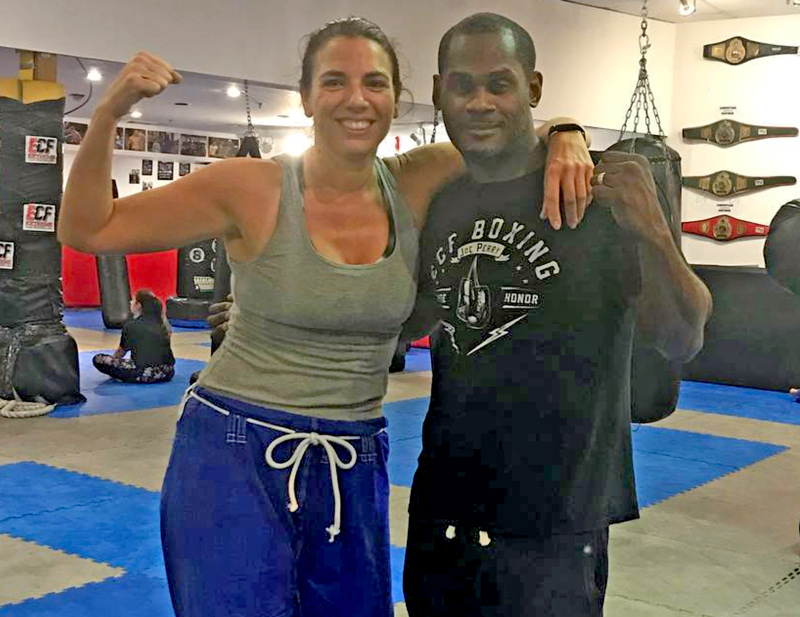
Gina Moravcik with her trainer Joe
My name is Gina Moravcik. I’m the mother of two great boys, and I work on Long Island, NY as both a school speech language pathologist, and in a private practice I own working with adults on the autism spectrum. I have ADHD myself. Oh, and I box. It just works. Let me tell you why…
Have you ever found yourself in a place, or with people that at first glance, scared the crap out of you? But who, over time, became like a second family? Well, this is exactly how I felt the first day I walked into an MMA gym with my then-young sons. Everyone seemed so serious; so intent on punching, throwing, or choking the person in front of them. And then there I was, with my two little boys, watching them in fear thinking “What did I just get us into?” People there probably thought I looked lost. But every time thereafter, when I stepped on the mats, that fear morphed into awe, and gratitude, maybe pride, perhaps even security, and definitely excitement. The people we trained with became our friends, our teachers, and our fiercest defenders. I hope everyone in life, especially neurodiverse brothers and sisters, take such a leap, as I did, at least once in their lifetime, so that they surprise themselves and find great reward.
1. How Does Boxing Positively Influence My ADHD?
In a world where I was constantly told to sit quietly, smile, and be polite, this ADHDer, (diagnosed as an adult) instantly fell in love with Mixed Martial Arts (MMA), and more specifically, boxing. My MMA training included boxing, jiu-jitsu, Muay Thai, and judo. I am confident in my ability to protect myself–whether standing upright or grappling on the ground. How many women feel that?
Like many of us with ADHD, I process information best when I’m in motion—Some of my best ideas and conversations happen while I’m moving. Well, boxing feeds that need perfectly–it’s dynamic, strategic, and deeply engaging. It allows me to hyperfocus like nothing else. I’ve trained my brain to link breathwork with movement, to memorize multi-step combinations, and to respond to real-time stimuli with precision. While verbal instructions alone often get lost in translation, a six-step combo that I’ve been taught to use in the ring? I remember that easily.
Boxing has significantly improved my timing, coordination, and reflexes. My hyperactivity—once something I was told to suppress—became an asset. On the mat, my energy is powerful. It helps me regulate, reset, and let off steam in a deeply satisfying and productive way (making me, dare I say it, athletic and competitive). This was a brand-new way for me to see myself.
Once the bell rings to start a round, there’s no time to overthink or hesitate—both common pitfalls for many ADHDers, me included. Boxing has sharpened my decisiveness on and off the mat. My hyperactivity and energy now serve as gifts, helping me slow down my racing thoughts and engage in deep self-regulation. Tension flows out of my body, leaving behind the ability to move around very light on my feet, and to reposition myself as often as necessary.
Standing across from my sparring partner—man or woman—I am not “just a girl.” I’m 5 feet and 10 inches of power, focus, and unapologetic fierceness. Boxing has taught me to temper impulsiveness with patience, control, and strategy. I’ve become more observant of body language, timing, and deception, and more in touch with vulnerability and courage.
Boxing has made me more observant of others’ movements and more intentional with my own. In the ring, I’ve learned lessons about humility and resilience that spill over into every area of my life.

Gina at the Philadelphia Museum of Art in front of the Rocky Balboa statue.
2. How Does Boxing Positively Influence My Confidence?
Before boxing, the only fitness activity I had ever committed to was CrossFit–and, in true ADHD fashion, I eventually got bored. I craved more variety, more challenges.
Ironically, I started training in jiu-jitsu, Muay Thai, and boxing to help my sons build confidence as they took to the mat. As a mom and a therapist, I wanted to lead by example. I couldn’t ask them to face discomfort and fear if I wasn’t willing to do the same. If my two young boys saw their mom on the mat battling, surely, they could too.
What I didn’t expect was how empowered I’d feel in the process.
As a tall kid, I had always felt awkward, a giraffe in the gym class. But in boxing, my height and reach became advantages. I sparred confidently with both men and women, realizing I wasn’t too “gentle” or “reserved” to throw powerful punches. My beloved coach, Joe Perry, of First Battalion MMA in Lynbrook (plug!), saw a fighter in me that I hadn’t seen in myself. The moment a sparring partner laughed through a body shot and said, “Damn, that was solid,” I felt something shift. I began to see myself as strong, skilled, and capable. That confidence extended far beyond the mat. I began mentoring new members in the gym, guided by Coach Joe, who quietly believed in my ability to lead without ever needing to say it aloud.
As a woman, I believe in being able to protect myself, and boxing gave me that power. My confidence grew in every aspect of life as I began to view myself through a different, stronger lens. Confidence in the ring became confidence in life.
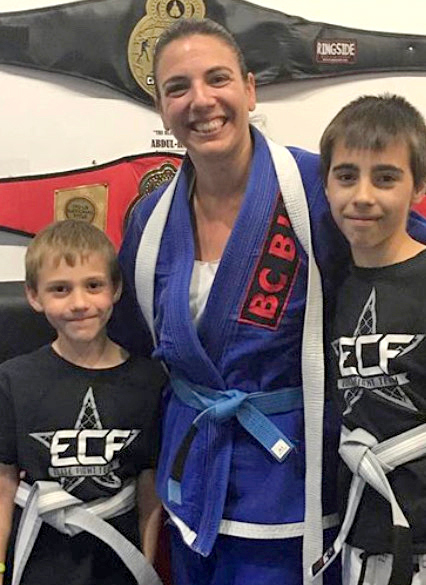
Gina with her sons
3. How Does Boxing Inform My Work?
Boxing forces you to get comfortable with discomfort. As a neurodivergent speech-language pathologist, I am constantly asking clients to do just that; to stretch themselves into spaces that feel unfamiliar, or intimidating, in order to grow. That requires bravery, effort, and vulnerability. It’s hard work.
In boxing, as in therapy, you take a hit; and hopefully you get back up and keep going. You make mistakes, but you learn from them. You constantly hone your skills. As a speech-language pathologist, I see striking parallels between boxing and communication:
- Both require turn-taking
- Both involve careful timing
- Both demand practice, reflection, and adaptation
- Both teach resilience
The communication goals my clients set (with my support) are no different than boxing drills. Whether targeting verbal or nonverbal skills, there are repetitions to learn, practice rounds, feedback loops, and the eventual ability to self-monitor and self-correct.
In many ways, boxing is a conversation, well-timed and completely dependent on action and reaction. Just like in conversation, boxers take turns. They communicate through motion and timing, aiming to avoid “gassing out” too soon.
Boxing has taught me the courage it takes to be vulnerable and keep showing up, whether in the ring or a therapy room. It has helped me extend grace to myself and loosen my grip on perfectionism. That has made me a better clinician, parent, and person.
4. What Was the Worst Beating I Took–and Why Didn’t It Traumatize Me (as Many Might Expect)?
People often assume that taking a hit in boxing is traumatic, especially for women. But honestly? The worst shots I’ve taken taught me the most. The two worst hits I’ve ever taken came from an older gentleman, and a relentless 5’2″ redhead with no quit in her. Warren, a senior accountant, was trying to teach me how to hide my punches, or how to mask the intention in my face, in my chest, and in my jab prep. He also taught me not to rely so heavily on reading my opponent’s facial expression, something I had done often early in training. He emphasized keeping my chin down, always protecting myself, and snapping my jab before my opponent had time to block.
How did he teach me? By repeatedly jabbing me in the mouth. Luckily, he held back the follow-through just enough that it was more of a lip-tingle than a bleed.
The other memorable shot came from the redhead, a dear friend and fellow sparring partner, affectionately known as “Shortcake.” A southpaw with ferocity and laser focus, caught me one Tuesday night with a clean hook to the jaw (on a day I’d foolishly forgotten to put in my mouthguard). I smiled through it and silently prayed for the bell to ring. And I spent the next three or four days on a diet of yogurt, pudding, applesauce, and protein shakes.
Unfortunately, the cumulative toll of jiu-jitsu and judo left me with some injuries, particularly to my knees, that forced me to take a break from groundwork. Even during my recovery, I wrapped my knees and pushed through. I had accomplished what I set out to do: I built the confidence to defend myself if I were ever on the ground. Mission accomplished. While I miss triangle chokes, armlocks, and grappling, they served their purpose. I switched to a southpaw boxing stance to protect my injured leg and returned to my traditional stance once I healed. When you love something deeply, you find a way to make it work for you.
Those hits didn’t traumatize me–they sharpened me. They made me more aware, humbler, and more determined. In our gym, when someone lands a clean shot, we say, “Good hit–that’s your shot.” There’s mutual respect. There’s camaraderie. Every round, every opponent teaches us something.
Boxing taught me to never underestimate anyone. To work both stealthily and skillfully. To stay calm and confident under pressure.
In the words of my coaches, Joe and Taj: “Be prepared, never scared.”
Gina-Marie Moravcik is the neurodivergent owner of Sunrise Speech and Language Services for Adults, and the mother of two young men. She was diagnosed as an ADHDer in her twenties and couldn’t have been more relieved to begin to embrace her hyperactivity, which had often been negatively commented upon. Her hands-on experiences with her sons led her to learning and loving MMA and more specifically boxing. Her training has lasted for 8 years, and she has no plans of stopping.