For decades, conversations about autism and adulthood have been centered on building independence through goals, interventions, and structured curricula (Bouck & Joshi, 2015). Yet when autistic self-advocates describe independence, they do not speak in terms of compliance, readiness checklists, or program outcomes. They speak about power, choice, and the fundamental right to direct their own lives, even when the systems around them assume otherwise (Fayette & Bond, 2018). Their voices remind us that independence is far more than a functional skill; it is a matter of human dignity, self-determination, and full participation in community life.
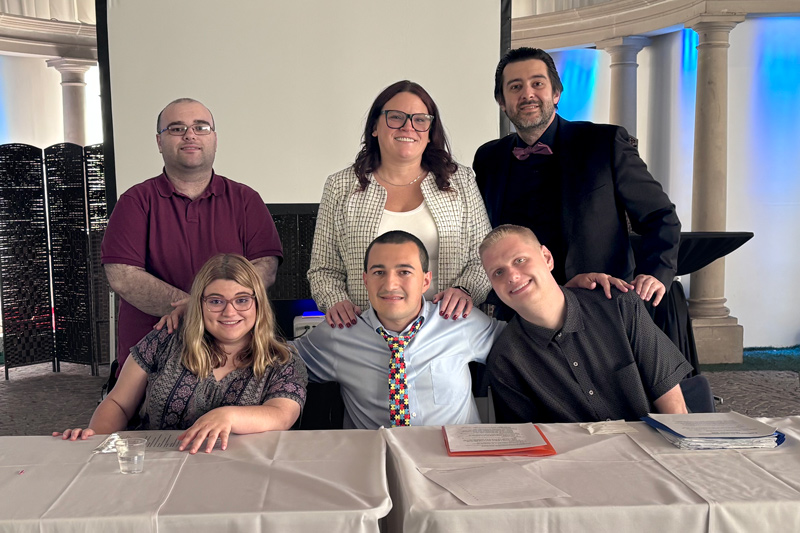
Interview Participants – Top Row: Stephan Hunt, Jamie Arnold, Eric Rosen. Bottom Row: Samantha Remi, Matthew Rosen, and William Irvine
Across five interviews with autistic young adults, a very different and far more authentic definition of independence emerged. For them, independence is not a box to be checked on a transition plan but a lived experience, one shaped by pride, fear, trial and error, and the deep desire to be recognized as capable. Their narratives illuminate four interconnected themes: independence as part of personal identity, the essential role of supportive relationships, the weight of external barriers that restrict autonomy, and the coping strategies each person develops to carve out a self-directed life. Together, these themes paint a portrait of independence rooted not in compliance, but in autonomy, advocacy, and the right to lead one’s own life.
Independence as Personal Identity
For some, independence represents freedom, though Stephan captured the complexity of that freedom by mapping it as an emotional equation: “Independence = Financial stability, Financial stability = Peace, Financial stability = Freedom, Independence = Freedom, Freedom = Choices, Choices = Consequences, Consequences = Stress, Independence = Stress.” His statement embodies a core principle of disability justice: autonomy is liberating, but it is also labor. It requires risk, support, and the freedom to make mistakes, just like any adult. For Matthew, independence is not defined by perfection, but simply by “Being trusted to do things on my own,” which further captures the essence of self-determination.
William describes learning from his parents and from school, but with independence, it is important to take those lessons forward and build autonomy. To him, “Independence is taking what you learned from school and your parents, and for the extra stuff, you have to pick it up on your own.” In each version, independence is self-defined, and something lived, not taught.
The Essential Role of Supportive Relationships
Supportive relationships emerged as a cornerstone of independence across all interviews, shaping not only what these autistic young adults learned but also how confidently they came to see themselves as capable. Families are often described as the first and most consistent champions of autonomy (Codd & Hewitt, 2021). Samantha stated, “My family never sheltered me from the world; they never let me use my diagnosis as an excuse to not face my fears.” William states that,” My family supported me by finding programs that meet my need for freedom and independence.” These familial relationships offered trust, modeling, and encouragement, laying groundwork for self-confidence and self-advocacy.
Equally significant were the roles of co-workers and workplace supervisors who recognized strengths and provided opportunities for growth. Stephan described how “Staff have encouraged and praised me for the potential of my side projects,” highlighting the way positive reinforcement fuels his independence. Eric recalled feeling nervous when he was first given the responsibility of onboarding new employees in the HR department. That changed when a coworker stepped in with reassurance and a clear system to follow. “She gave me the confidence to do it. She showed me how, let me make mistakes, and I learned from them. Now I run multiple meetings a week using the system she taught me.” These moments illustrate how professional relationships can empower autistic individuals by offering meaningful, real-world tasks.
Friends and peers contributed a different but equally critical form of support: acceptance. Samantha emphasized how her friends “look past my quirks and treat me the same as everyone else,” demonstrating the importance of social connections that affirm identity rather than highlight difference. Others described mentors and community program facilitators who helped them practice skills, build social confidence, and take safe risks, all core components of self-determination.
Taken together, these accounts make one theme unmistakably clear: independence does not develop in isolation. It grows when individuals are surrounded by people who believe in their potential, offer encouragement rather than control, and create space for autonomy to flourish. The voices of these self-advocates show that supportive relationships are not optional on the journey toward independence; they are the foundation on which self-determination is built.
External Barriers
Independence is also shaped by barriers that have little to do with autism itself and everything to do with the environments autistic individuals must navigate. When participants described their challenges, they pointed not to personal deficits but to systemic obstacles, low expectations from others, limited opportunities, anxiety triggered by stressful settings, and support systems that are often more rigid than responsive. These external constraints create roadblocks that can make independence feel earned twice over: first through skill development, and again through navigating a world that questions their capability.
For Stephan, the most significant barrier was not a lack of ability but a lack of belief from others. “Sometimes I feel like I am just surviving rather than growing,” he shared, revealing the emotional toll of constantly pushing against assumptions. Matthew expressed a similar frustration: “Sometimes, not everyone thinks I can do the stuff that I do alone.” Their reflections point to a universal theme across stories, the weight of being underestimated, even in moments when they have already demonstrated competence.
William highlighted a different but equally powerful challenge: advocating for himself. “A big barrier I face is speaking up for my needs and wants,” he explained. “I have difficulty with confidence, and I see rejection and decline before I even ask the questions.” His experience underscores how independence depends not just on skill, but on systems that welcome and respect self-advocacy.
Taken together, these accounts reveal that the most significant barriers to independence are not internal, but structural and social. The self-advocates in these interviews have the desire, potential, and skills to lead self-directed lives, but independence becomes possible only when the world removes its barriers, listens to their voices, and believes in their capabilities.
Developing a Self-Directed Life
Participants developed a wide range of individualized strategies to navigate the obstacles they encountered, approaches that were creative, often self-invented, and tailored to each participant. All five self-advocates described learning best through observation, creating reference points, practicing tasks in “mock” environments, and building confidence through trial and error. Stephan explained that “tapping into my creativity allows me to build a pathway that’s uniquely my own,” underscoring the role of innovation and problem-solving in his independence. Samantha detailed the tools she relies on to manage anxiety: a fidget toy, therapy, writing, and music, emphasizing that “emotional regulation is self-determination.” Her goal is not to erase anxiety, but to maintain control and autonomy despite it.
Rather than resisting supports, the participants re-engineer them, choosing what is helpful, and refusing to let their independence be defined solely by programs or systems. The futures they imagine are deeply ordinary yet deeply meaningful: living in a home of one’s own, obtaining a driver’s license, securing a better job, attending college, reducing reliance on state-funded supports, or simply being trusted to make decisions without second-guessing. Stephan captured this vision clearly: “Better financial stability, a higher position that I can handle, and being in my own home where I can be who I am freely.” Eric shared a similarly grounded dream: “Hopefully own a home with my future wife, have the white picket fence, and continue exploring things on my own.”
These aspirations are not unrealistic; they are life plans rooted in empowerment, intention, and action. The participants’ reflections call for support systems that honor individuality rather than impose uniform expectations. As Stephan put it, “The solutions to your problems need to be what works for you,” a powerful rejection of one-size-fits-all approaches and a reminder that true independence must be shaped by the person, not the program.
These are not lessons from a curriculum. They are lessons learned from lived experience, lessons rooted in advocacy, autonomy, and self-direction. Taken together, these voices challenge the way schools, workplaces, and service systems often talk about independence. Independence does not mean doing everything alone. It means having authority over your own decisions. It means being trusted, not tested. It means choosing your goals, even when they are inconvenient for others. It means access to risk, not just protection from it.
Most importantly, independence means having the right to define independence for yourself. To honor that right, professionals and policymakers must move beyond teaching independence and instead share power. They must replace barriers with opportunity, replace assumptions with respect, and replace “readiness” models with self-determined decision-making. Because in the end, the most powerful advocacy these self-advocates offer is also the simplest:
“Just let me try.”

For more information, please contact Jamie Arnold, Director of Educational Services, at jarnold@eden2.org. To learn more about Eden II Programs and the continuum of services we provide, visit www.eden2.org. Follow Eden II on social media for updates and resources: Facebook: @eden2programs, Instagram: @eden2programs.
References
Bouck, E., & Joshi, G. (2015). Does curriculum matter for secondary students with autism spectrum disorders: Analyzing the NLTS2. Journal of Autism and Developmental Disorders, 45, 1204-1212. http://dx.doi.org/10.1007/s10803-104-2281-9
Codd, J., & Hewitt, O. (2021). Having a son or daughter with an intellectual disability transition to adulthood: A parental perspective. British Journal of Learning Disabilities, 49, 39-51. http://dx.doi.org/10.1111/bid.12327
Fayette, R., & Bond, C. (2018). A qualitative study of specialist schools’ processes of eliciting the views of young people with autism spectrum disorders in planning their transition to adulthood. British Journal of Special Education, 45(1), 5-25. http://dx.doi.org/10.1111/1467-8578.12203