In the late 1960s, a little girl carried a book under her arm—a simple gesture that masked a constant search for calm. She moved through the world as if following a quiet cadence, attuned to subtleties others didn’t notice: a hint of a smile, the tension behind a voice, the pattern of people’s movements. These details formed a language she understood instinctively.
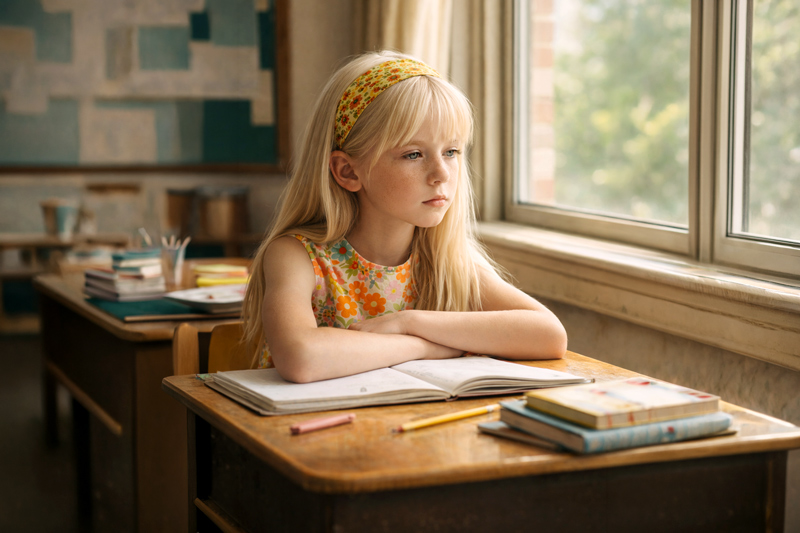
Patterns offered safety; they made sense when people did not.
At home, dolls lined up on the bed were not toys—they were steady companions. Their symmetry comforted her. Numbers, shapes, and repetitions created a predictable world when reality felt overwhelming. At school, careful observation became a survival strategy: mirroring classmates’ reactions, studying expressions, rehearsing gestures—small, deliberate ways to move through a world not built for her.
Everyday social interactions could accumulate before she had time to recover, leaving her tense and overloaded.
Empty chatter, small talk, and sudden questions pressed in on her until crowded rooms felt suffocating. Eating lunch in the cafeteria was a daily effort to find calm in a noisy, chaotic space. Teachers labeled her too quiet, too sensitive, painfully shy—but those words missed the truth. Quietness was not absence; it was attention. Sensitivity was not weakness; it was perception.
Each school day felt like a series of obstacles, a steady effort to stay regulated.
Bells rang.
Lockers slammed.
When school felt too loud and fast, she found refuge at the water’s edge. She would spend hours there, feeling the cool sand under her fingers, noticing the smooth and rough textures of rocks and shells, and hearing the steady pulse of the waves. The movement of the water helped her body settle. In those moments, the chaos of the cafeteria and the pressure to perform faded, replaced by a calm she could carry with her long after leaving the shore.
Girls like her were largely invisible in the 1960s and ’70s. Boys were more often assessed, diagnosed, and supported; girls who were quiet or mimicked well went unnoticed. Sensitivity was labeled insecurity. Stillness was labeled difficulty. Many learned early to hide, comply, and perform just to get through the day. These strategies were not flaws; they were adaptive and resilient.
Her traits—attentive observation, pattern recognition, deep empathy, and an ability to sense unspoken intention—were gifts disguised as challenges. Counting, aligning, and repeating offered self‑soothing, a personal code of calm.
Supportive adults and educators are essential. Recognizing different learning styles and ways of processing allows children to thrive at their own pace. By honoring curiosity, attention to detail, and the need for quiet observation, teachers and caregivers can help children move from surviving to fully participating in life.
Today, understanding has grown. Depth, focus, and noticing subtle patterns are ways of experiencing the world—ways that bring insight, creativity, and connection. When adults make space for these differences, children do more than survive—they belong.
The little girl in the late 1960s carried her book, lined up her dolls, counted her world into order, and noticed what others missed. That way of being persists, quietly powerful, waiting to be seen, understood, and supported by the adults who love and guide them.

Sandra Astrid Cooper is a writer and illustrator based in Newport, Rhode Island. Her work centers on seeing people as they truly are — without labels, sentimentality, or pretense — and honoring the dignity of overlooked lives. To contact the author, email astrid.creative.studio@gmail.com.
References
McCrossin, R. (2022). Finding the true number of females with autistic spectrum conditions: Biases and underdiagnosis.
Belcher, H. L., Morein‑Zamir, S., Mandy, W., & Ford, R. M. (2022). Shining a light on a hidden population: Diagnostic disparities in females with autistic traits.
Fan, M. S. N., Li, C. H. W., & Ho, L. L. K. (2023). Nature-based interventions for children: A systematic review and meta-analysis of health-related outcomes.
Li, D., Larsen, L., Yang, Y., Wang, L., & Sullivan, W. C. (2019). Exposure to nature for children: Emotional, sensory, and social benefits.