Every morning at First Place–Phoenix, a supportive housing property in Midtown Phoenix, Arizona for adults with autism and/or intellectual/developmental disabilities (I/DD), residents head out with determination and hustle. Some volunteer. Some hold part-time or full-time jobs. Others are still searching for the right fit: a workplace where they can use their strengths and be accepted for who they are and what they offer.

Director of Employment and Workforce Development Natasha Grant Holmberg works with a jobseeker participating in Be Ready℠, First Place AZ’s job readiness program.
Their journeys are shaped by more than resumes and interviews. They are shaped by the systems meant to support them—and the policies that too often fall short.
Despite decades of progress in disability rights, adults with developmental disabilities continue to face disproportionately high unemployment and underemployment. National data show that only about 22% of people with disabilities are employed, with a labor force participation rate around one-third of that for people without disabilities (U.S Bureau of Labor Statistics, 2024). Among individuals with developmental disabilities, the numbers are grimmer: only around 10% of working-age adults are in competitive integrated employment (Winsor et al., 2021). These statistics are not just numbers; they mirror the daily experiences of individuals eager to contribute but who are locked out by system barriers.
To better understand these challenges, we conducted structured interviews with First Place–Phoenix residents and carried out a comprehensive review of federal and state disability employment policies in partnership with Kristi Eustice, Senior Research Analyst at Arizona State University’s Morrison Institute for Public Policy. Using a mixed-methods approach, we analyzed residents lived experiences alongside current policy to identify existing gaps and opportunities for narrowing the divide.
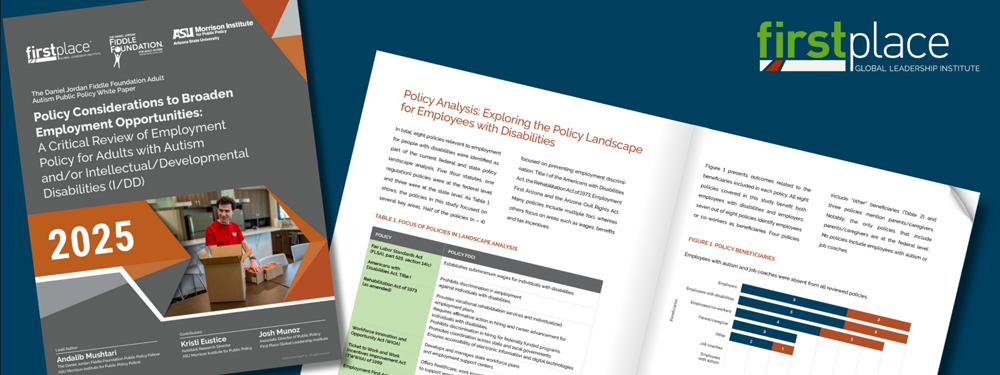
The Daniel Jordan Fiddle Foundation Adult Autism Public Policy White Paper, authored by Andalib Mushtari with contributions from Kristi Eustice and Joshua Munoz.
Grounding Policy in Community Voices
Employment barriers become real and urgent when heard through personal stories. First Place–Phoenix residents shared insights that reflect national trends. Many described difficulties finding jobs that match their interests and abilities. “The hardest part is finding a job you actually like, not just the one that will hire you,” said one resident. Research supports this: Adults with autism and/or I/DD are more likely to thrive and stay in jobs aligned with their strengths and interests (Harmuth et al., 2018).
But even the right job match isn’t enough without a supportive work environment. “Having someone who understands my disability can help me keep a job,” shared another resident. Several emphasized the importance of trained job coaches or empathetic supervisors. In one case, a job coach helped a resident in their role, but a lack of supervision and accommodations ultimately led to unsafe conditions and job loss. Current policies often limit funding needed to support hiring, onboarding and continued training, underscoring missed opportunities to position individuals for long-term success.
Transportation was another common barrier. “I worry about being late or not making it to work because of the bus,” said one resident. He now volunteers instead of working, afraid that unreliable public transit and frequent medical appointments could interfere with employment. Nationally, 10% of unemployed people with disabilities cite transportation as a primary barrier (U.S. Bureau of Labor Statistics, 2025) and only 21% of unemployed adults with autism had independent transportation (Pfeiffer et al., 2024). Yet, most policies overlook transportation planning.
Workplace culture also determines when someone stays or leaves. One resident described being supported by a supervisor who provided needed accommodations: “It makes you feel like you’re not a burden.” In contrast, others experienced bullying, unfair treatment or job assignments that caused physical strain. One resident left their job due to depression and isolation but now finds fulfillment volunteering at an animal shelter. These stories reflect a core truth: Work culture and inclusion matter as much as compliance with employment laws.
Based on a 2020 U.S. Department of Labor survey, fewer than 30% of companies have formal disability inclusion goals (Schweizer et al., 2022). Current policies focus on non-discrimination but rarely include broader inclusion strategies. Many individuals with autism and/or I/DD, particularly those with higher support needs, including profound autism, co-occurring conditions or limited spoken language—also face additional challenges or pursue different goals altogether. For some, meaningful engagement may look like building life skills, focusing on health and routine or participating in their communities in non-employment ways. Those outcomes are just as important. But for anyone who does want to work, systems and policies must be ready to meet them with individualized, inclusive support.

A First Place–Phoenix Resident volunteers at a local animal shelter with Tom Ortega, Director of the Mulzet Center for Expression at First Place Global.
Five Key Gaps in & Recommendations for Employment Policy
Our analysis of current federal and state employment policies for individuals with disabilities uncovered five critical gaps and opportunities for immediate policy action.
1. Diverse support needs are overlooked – Federal and state policy fails to reflect the wide range of support needs among individuals with autism and/or I/DD (Mushtari et al., 2025). Individuals with higher support needs, including those with profound autism, severe intellectual disabilities and co-occurring behavioral or medical challenges—are frequently excluded from policy design and implementation.
Recommendation: Develop flexible employment policies that explicitly acknowledge diverse support needs. Whether through customized employment, supported self-employment or part-time roles, we must expand opportunities aligned with individuals’ abilities and interests.
2. Job coaches and onboarding support are absent – Employment policy rarely addresses the importance of matching individuals with the right job or providing early-stage support like onboarding and orientation (Mushtari et al., 2025). Most policies don’t include job coaches, who are vital for success in the workplace.
Recommendation: Establish standards and funding streams for job coaching and onboarding support. Coaches should be trained to support individuals with a range of support needs and play a role in job matching, accommodation planning and long-term workplace navigation.
3. Hiring processes remain inaccessible – Traditional application processes and interviews often exclude individuals with autism and/or I/DD. Time-limited assessments, online-only forms and increasingly common video-recorded interviews fail to capture an individual’s true abilities. Autistic candidates are overwhelmingly rated less favorably in conventional interviews despite matching qualifications (Flower et al., 2021).
Recommendation: Integrate assistive technology and strengths-based evaluations into hiring policies. Encourage or require accommodation by default, embed job coaches during hiring and offer options like work samples or job trials versus interviews alone.
4. Transportation is an afterthought – Transportation to and from work remains a major barrier, especially in regions where public transit is underdeveloped or unavailable. Only two of the eight policies we reviewed addressed transportation; both were federal (Mushtari et al., 2025).
Recommendation: Treat transportation as a core element of state disability employment policy. States should align transit schedules with job hours, expand paratransit options and support rideshare or employer-sponsored transport models.
5. Inclusion must go beyond legal compliance – While half the policies we reviewed prohibit discrimination, few promote proactive inclusion (Mushtari et al., 2025). True inclusion requires cultural shifts in hiring, training, communication and day-to-day practices.
Recommendation: Promote inclusive workplace policies that go beyond legal requirements. These include co-worker training, universal design in communication and disability-inclusion initiatives. Policies can borrow from Universal Design for Learning (CAST, 2018) to foster accessible, respectful and flexible environments.
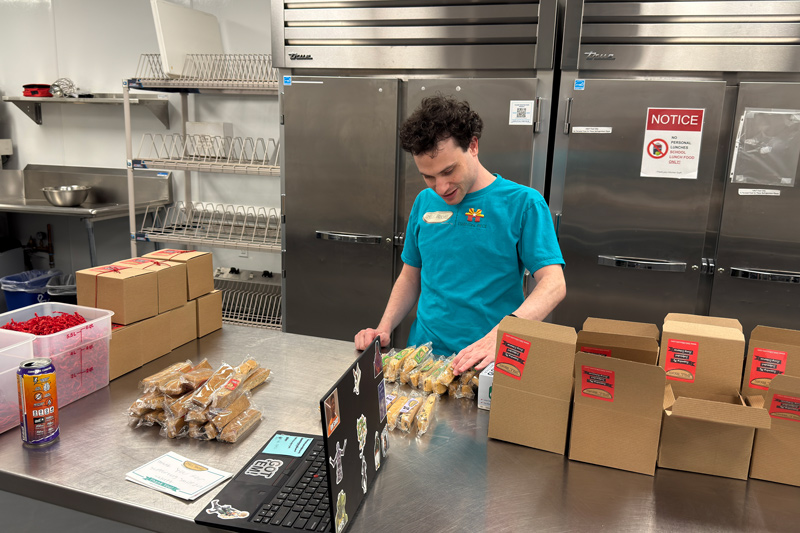
A First Place–Phoenix resident packages SMILE® Biscotti while participating in a program that combines hands-on skills, entrepreneurship and community engagement.
Moving Forward
These gaps are not abstract. They are daily challenges for people ready and willing to work. The lived experiences of First Place–Phoenix residents demonstrate both the promise of meaningful employment when systems align and the consequences when they do not. This is a call to action.
For public officials, service providers and advocates, now is the time to strengthen employment pathways for adults with autism and/or I/DD. This entails investing in job coaching, rethinking hiring, offering accommodation from the start, improving transportation and expecting workplaces to do more than simply comply with the law.
It also means recognizing that employment is not the only valid outcome. Individuals with significant disabilities may choose to focus on life skills, well-being and social inclusion in myriad ways—and all choices are valid. For those who want to work, policy must grasp and accept an individual’s current situation, perspective or level of understanding and tailor a supportive approach to opportunity accordingly.
At First Place–Phoenix, more than 80% of residents are employed or volunteering—illustrating what is possible when support systems function effectively and expectations are high.
By turning lived experience into action and closing longstanding policy gaps, we can create a workforce that welcomes the full spectrum of human talent and potential.

Andalib Mushtari explores how public policy can better support employment pathways and inclusive systems for adults with autism and/or I/DD. Drawing from more than 15 years of international policy experience, his work focuses on advancing data-informed solutions that remove systemic barriers and promote equity across housing, healthcare and employment. For more information about The Daniel Jordan Fiddle Foundation, visit djfiddlefoundation.org. Email Andalib at andalib@firstplaceaz.org.

Joshua Munoz leads initiatives that bridge lived experience with systems-level reform to improve outcomes for individuals with autism and/or I/DD. His work centers on inclusive employment, healthcare access and housing innovation, with a focus on advancing policy reflecting the needs and strengths of individuals across the spectrum and lifespan. For more information about the First Place Global Leadership Institute, visit firstplaceglobal.org. Email Joshua at josh@firstplaceaz.org.
References
CAST (2018). Universal Design for Learning Guidelines version 2.2. Wakefield, MA: CAST. http://udlduidelines.cast.org
Flower, R. L., Hedley, D., Spoor, J. R. & Dissanayake, C. (2021). An employee’s perspective on autistic adults’ employment: A comparative study using the theory of planned behavior. Research in Developmental Disabilities, 111, 103885. https://doi.org/10.1016/j.ridd.2021.103885
Harmuth, E., Silletta, E., Bailey, A., Finley, J. & Barbic, S. (2018). Barriers and facilitators to employment for adults with autism: A scoping review. Annals of International Occupational Therapy, 1(1), 31–40
Mushtari, A., Eustice, K. & Munoz, J. (2025). Policy consideration to broaden employment opportunities: A critical review of employment policy for adults with autism and/or intellectual/developmental disabilities (I/DD). The Daniel Jordan Fiddle Foundation Adult Autism Public Policy White Paper. First Place Global Leadership Institute; the Arizona Board of Regents for and on behalf of Arizona State University and its Morrison Institute for Public Policy at the Watts College of Public Service and Community Solutions. https://firstplaceglobal.org/policy/fiddle-fellowship/#fiddle-fellows
Pfeiffer, B., Song, W., Davidson, A., Salzer, M., Feeley, C. & Shea, L. (2024). Transportation use and barriers for employed and unemployed autistic adults. Autism in Adulthood, 6(2), 241–246.
Schweizer, H., DeCarlo, M., & Shapiro, M. (2022). Policy solutions for the benefits cliff facing workers with disabilities. Center for American Progress.
U.S. Bureau of Labor Statistics. (2024, February 22). Persons with a disability: Labor force characteristics—2023 (USDL-24-0349). U.S. Department of Labor. https://www.bls.gov/cps
Winsor, J. E., Butterworth, J. & Boone, J. (2021). National snapshot of employment outcomes for people with intellectual and developmental disabilities. Institute for Community Inclusion.