Family activities often extend beyond the home and into the community. Participation in community events can be an important part of family life. Leisure activities such as joining a team, enrolling in a class, or developing a hobby provide opportunities for individuals to engage with their communities. Additionally, participation as a spectator can be a socially valid and accessible entry point to community belonging. This may include attending sporting events, theatrical performances, music concerts, and school-related events (e.g., science fairs), allowing loved ones to come together and cheer on a family member. Many leisure activities also involve attending events as a family, which creates opportunities to spend quality time and share memorable experiences. These experiences can strengthen family cohesion and support learning about cultural traditions and practices through active engagement (e.g., attending religious services or community celebrations).
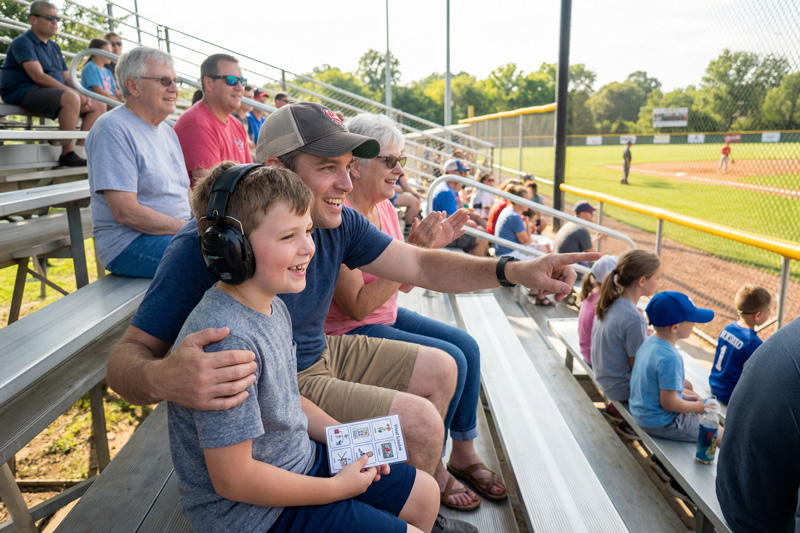
However, some of these events can be very loud, crowded, overwhelming, or confusing for an individual with autism spectrum disorder (ASD), which may make participation difficult and stressful for both the individual and their family members. Participation as a spectator may be particularly difficult when an individual lacks the skills needed to manage the demands of these environments.
Community participation can be challenging for many individuals with autism due to a combination of individual skill demands and environmental barriers. These may include difficulty tolerating loud or crowded environments, challenges waiting for extended periods, difficulty following changing social expectations in public settings, and challenges with planning or organizing outings. Participation may also depend heavily on family members to arrange transportation, prepare for events, and provide support during activities. A systematic review by Cameron et al. (2021) identified several barriers that limit community participation for autistic adults. Although many adults participated in activities such as visiting museums, movies, and parks, attendance at live sporting and community events was reported less frequently, with approximately 25% of the studies reviewed reporting participants attending these types of events within the previous 1–3 months, suggesting that public spectator events may present additional participation barriers.
Fletcher-Watson (2015) described his experience of an autism-friendly theatre performance, often referred to as a relaxed theatre performance. Relaxed theatre performances address several skill challenges that can make attending live events difficult for individuals with autism, including tolerating loud or unpredictable noises, waiting or remaining seated for long periods, and navigating crowded or unfamiliar environments. Accommodation such as visual guides before the event, reduced sound and lighting intensity, warnings before loud effects, flexible audience movement, and access to quiet spaces help reduce these demands. These supports are typically absent in mainstream performances, where sensory conditions, seating expectations, and audience rules remain fixed. While environmental accommodations can support participation, another important step is identifying meaningful goals and the skills needed to help individuals engage successfully in these settings.
A practical starting point involves identifying and teaching the specific skills required to attend and stay engaged in these settings. Prior to teaching specific skills, it is important to first develop meaningful goals. Practitioners may also use structured assessment tools to identify goals that are meaningful, appropriate for the individual, aligned with family values, and achievable. For example, Gerhardt and Bahry’s (2023) Meaningful Goal Guide: An Open-Ended Interview Tool for Practitioners (MGG) can be used to guide goal development. The following questions have been adapted from Gerhardt & Bahry (2023) to help identify skills that support participation in community spectator events:
- How does my child communicate their wants and needs while out in the community?
- How well is my child understood by others outside the immediate family?
- How does my child communicate socially, or for any reasons beyond wants/needs?
- What are some things that my child might find difficult to tolerate or accept?
- Are there behaviors my child engages in that may be inappropriate in certain settings, potentially dangerous to themselves or others, or that make it difficult for our family to participate in community events?
- Does my child demonstrate the safety skills needed to participate safely in community events (e.g., staying with caregivers, responding to safety instructions, and communicating if separated)?
- Does my child respond to basic instructions that may keep them safe? (e.g., “stop,” “stay with me,” “come here”, “no”)?
- How does my child communicate when they want to refuse something, leave an activity, or take a break?
- What activities does my child enjoy watching or participating in?
- What types of community events would I like my child to be able to attend with our family?
- How well does my child tolerate others being physically close to them or sharing space with them?
- Does my child show interest in shared activities with family members or peers?
- What types of social experiences seem to make my child happiest?
Once meaningful goals are established, participation in spectator events can be supported by systematically teaching the component skills that help individuals tolerate and engage in these environments. Isenhower et al. (2025) developed an assessment that considers an individual’s preferences and activity engagement when identifying appropriate leisure activities. The authors evaluated an individual’s leisure preference profile across several phases by examining key components of leisure activities, including social interaction versus no interaction, stationary versus movement, and electronic versus nonelectronic activities. Activities that aligned with the individual’s preference profile resulted in higher engagement and fewer problem behaviors.
Parents and practitioners can begin by targeting waiting and endurance skills, such as remaining seated or standing in a designated area while the event is underway. These behaviors can be shaped gradually by starting with short durations (e.g., watching brief sports clips at home) and systematically increasing the length of time the child remains engaged. Strategies such as providing praise or small preferred items when the child remains seated or waits for longer periods, the use of visual or auditory timers, and scheduled brief breaks can help build tolerance for longer events.
A second set of skills involves proximity and safety, including staying within a predetermined distance of a caregiver, responding reliably to name calls, and walking safely through busy environments. These behaviors can be practiced during everyday outings (e.g., parks, shopping centers) using clear rules, prompting, and reinforcement for staying within the defined boundary.
Spectator events also involve social participation cues, such as clapping, cheering, or using quieter voices at appropriate moments. These responses can be taught through modeling, rehearsal, and prompting while watching games or performances at home, with reinforcement provided for joining in during appropriate moments. Finally, children may benefit from learning coping and self-management strategies for handling noise, crowds, and other environmental demands.
Practitioners can teach functional responses such as requesting a break, moving to a quieter area, or independently using ear protection, often through functional communication training and rehearsal prior to the event. Preparing for events by identifying quieter spaces, bringing sensory supports, and practicing these responses in advance can help children to participate in the events for longer periods.
Preparation can increase the likelihood of successful participation in community events. Strategies include selecting shorter events, choosing to sit near exits to allow easy access to breaks, and previewing the environment or event schedule so the child knows what to expect. Bringing preferred items may help maintain engagement during waiting periods. Scheduling planned breaks and gradually increasing the duration and complexity of outings can help build tolerance for the demands of larger community events.
In conclusion, developing goals that are meaningful and aligned with the values of the individual and the family, identifying the skills needed, and teaching those skills step by step can increase opportunities for family outings, community involvement, and spectator participation. When the prerequisite skills required for community events are taught and practiced, individuals may be better able to access and sustain participation in these settings. Importantly, spectator activities should not be viewed as passive experiences. Attending sporting events, concerts, school performances, or community celebrations allows individuals to participate alongside family members and peers in shared cultural and social experiences. Teaching the skills that supports this reframes spectator participation as active, meaningful engagement in community life and can expand opportunities for families to participate in these events together.

Madhura Deshpande, PhD, BCBA-D, is the Clinical Director at Proactive Behaviour Analysts and an alumna of Endicott College. She can be reached at [email protected].

Tamara A. Bannon, MSW, BCBA, LMSW, LBA (NY, NJ), is a doctoral student and an adjunct professor at Endicott College. She can be reached at [email protected].
References
Cameron, L. A., Borland, R. L., Tonge, B. J., & Gray, K. M. (2021). Community participation in adults with autism: A systematic review. Journal of Applied Research in Intellectual Disabilities, 35(2), 421–447. https://doi.org/10.1111/jar.12970
Fletcher-Watson, B. (2015). Relaxed performance: audiences with autism in mainstream theatre. Scottish Journal of Performance, 2(2). https://doi.org/10.14439/sjop.2015.0202.04
Gerhardt, P. F., & Bahry, S. (2022). Meaningful goals and the autism spectrum disorder: A guide to developing functional, contextualized goals for children and adults. Woodbine House.
Isenhower, R.W., LaRue, R.H., Budge, J.L. et al. A Component-Based Leisure Activity Assessment for Adults with Autism Spectrum Disorder: A Preliminary Investigation. Behav Analysis Practice (2025). https://doi.org/10.1007/s40617-025-01071-y