Whenever I have had a big change coming, I tell myself “I can handle this.” I have always been good at problem-solving, at figuring things out methodically. Moving away from home for the first time to live at a program for young adults with autism? No problem – I was prepared to learn everything from job hunting to budget planning. I was organized, prepared, and confident that my attention to detail would carry me through just like it always had.
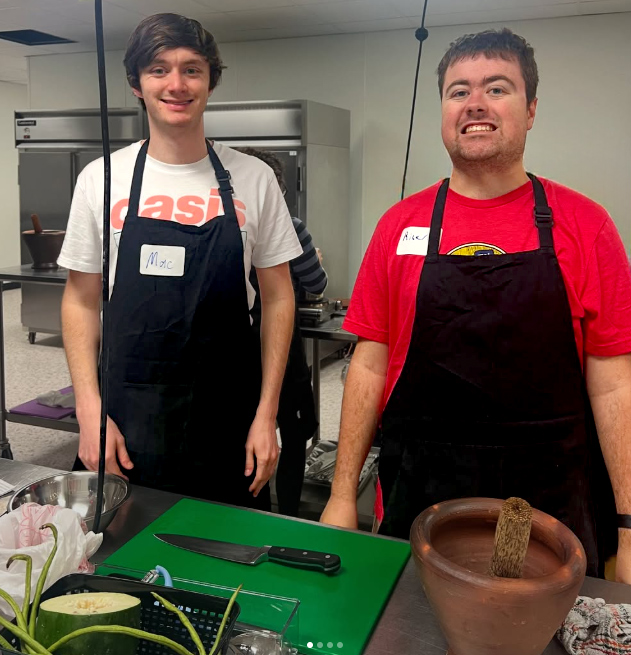
During cooking class at LifeWorks, Riley discovered that breaking down complex tasks into manageable steps—like following a recipe—became a valuable strategy for navigating all kinds of life changes.
What I didn’t anticipate was how differently my autistic brain would react to change, even when I thought I was ready for it. All my careful planning couldn’t prepare me for the sensory overload of a new place to live, a schedule of curriculum plus taking on a new job, or the changes that came from losing my familiar routines and support systems. After a few weeks, my “I’ve got this” attitude crumbled into “I have no idea what I’m doing.”
If you’re reading this as someone on the spectrum facing a major life transition, or if you’re a parent watching your autistic young adult navigate changes like this, I want you to know that my initial confidence wasn’t wrong, it just wasn’t complete. We absolutely can handle major changes, but we need to approach them differently than neurotypical people do. The strategies that work for everyone else won’t necessarily work for us.
What helps me is to remove myself from what is changing my emotions in the moment. Feeling overwhelmed? I know I need to physically step away and give myself room to breathe — even if it’s just going to the bathroom for five minutes of quiet, stepping outside for fresh air, or finding a corner where I can put in headphones. Sometimes “removing myself” means mentally stepping back by focusing on my breathing or doing a quick grounding exercise where I name five things I can see, four I can hear, three I can touch and so on.

From learning to manage overwhelming transitions to earning tournament ribbons, Riley’s journey shows that success comes in many forms when you find strategies that work for your brain.
For autistic brains, this pause is crucial because we often need more processing time than neurotypical people. When emotions spike during transitions, our executive functioning can shut down, making it impossible to think clearly or make good decisions. By creating that buffer, whether it’s physical space, sensory relief, or just buying myself time—I give my nervous system a chance to regulate before I continue.
It is important to recognize the warning signs before you hit that point of feeling completely overwhelmed. For me, it’s when sounds start feeling too loud or when simple decisions suddenly feel impossible. That’s my cue to step away, not to continue to push through. I used to think stepping away was giving up, but I’ve learned it’s the most productive thing I can do.
I love everything about cars; how they work and how they look, as well as working on them, and making them look better. When I learned that a job became available at Cheetah Car Wash near campus where I was enrolled in a two-year program. I was excited to be around so many different types of cars. I used the skills I learned to help me be successful at something I really enjoy. It was hard initially, and scary to take on something new. I managed that by planning for success from the start and looking forward to what success would mean. Ultimately, I thought about how good I would feel after trying something new and all the types of cars I would get to see. That became my favorite part of the job.
What I didn’t realize at the time I started at the car wash or even when I moved into my apartment at the two-year program, and I have come to see now, is that initial success set me up for future endeavors as well. After two years at Cheetah Car Wash, I have moved on to a new role as produce associate at Sam’s Club. I was successful at the two-year program at LifeWorks for Autism and the car wash, so I know I will see success at the new job and other endeavors I try.
Major transitions will always be challenging for those of us on the spectrum, but they’ve also taught me some of my most valuable lessons. There’s a quote from Alanis Morissette that is my personal mantra: “When pain brings you down, don’t be silly, don’t close your eyes and cry, you just might be in the best position to see the sunshine.” Every transition I’ve navigated has ultimately led me to a better understanding of myself and what I need to thrive. The sun is always there—sometimes I just need to adjust the approach to see it.
Riley Smith of Cave City, Kentucky, just completed two years at LifeWorks for Autism in Bowling Green, Kentucky, a two-year living and learning community to teach independent living to young adults with autism. Now living on his own, he works as a produce associate at Sam’s Club.