Jaipur did not feel like an ending. It felt like a checkpoint. When I got posted to Jaipur Military Station in December 2023, we had already lived through thirteen years of vast experience. My first book, Autism and Me, had traced that journey — from denial to diagnosis, from confusion to acceptance. Jaipur was where that volume had paused.
But life does not pause where books do. For a family raising a child on the autism spectrum, relocation means more than unpacking furniture. It means rebuilding an ecosystem — school, therapy, medical care, sleep, sensory needs, and daily schedules — often on a war footing.
Before we arranged curtains, we identified intervention centres. There is a quiet urgency to such decisions. Progress in neurodevelopment can be cumulative but fragile; when rhythm collapses, gaps can widen quickly. After a few visits and evaluations, we settled into a workable structure. Our son, Addwik, would attend a special school in the morning and, post-lunch, engage in pre-vocational training. The schedule was deliberately planned to give his day shape and predictability.
For a while, it worked beautifully. Mornings unfolded with measured efficiency. Afternoon vocational tasks provided structured repetition — sorting, organizing, and assembling. These were not merely occupational exercises. They were cognitive anchors. Progress in autism rarely announces itself. It accumulates in stillness.
Then came the first interruption. It began with irritation in his right eye. As a physician, I initially recognized what appeared to be a manageable eyelid infection. It settled, and we resumed our rhythm. Three weeks later, the eye swelled dramatically. An eye specialist diagnosed peri-orbital cellulitis and advised close monitoring. In hospital corridors I was the doctor calculating dosage and reviewing progression. At home I was the father watching discomfort eclipse routine.
Illness in a neurodivergent child can affect far more than the organ that is visibly unwell. Pain, inflammation, disturbed sleep, and the disruption of familiar routines may all alter engagement and tolerance. After the infection resolved, something lingered. Tasks that earlier required two prompts now required five. Irritability increased. Engagement diminished. To an untrained eye it might have appeared purely behavioural; to me, it felt biological as well as behavioural.
When summer vacations began in June 2024, we temporarily withdrew him from afternoon vocational sessions. It was not defeat but recalibration. Progress is not measured by how much work we can make a child perform; sometimes it is measured by whether he can do it calmly and sustainably. There is a military principle that has guided many operations: consolidate before advancing. We were consolidating.
Then sleep began shifting, almost imperceptibly. Ten-thirty became eleven. Eleven became midnight. We initially attributed it to adolescence, since teenagers commonly experience a shift toward later sleep and wake times. But what unfolded in our home was not a mild drift. At eleven-thirty, light would glow beneath his bedroom door. At midnight, movement. At one in the morning, a low vocalization. At two, still awake. On some nights he was hardly sleeping at all; on others, his sleep was repeatedly interrupted.
Morning became fragile terrain. Waking him felt cruel when he had fallen asleep only shortly before school, and when he did wake, he appeared exhausted. Appetite fluctuated. Afternoon tolerance narrowed. Tasks once completed with quiet engagement now felt burdensome. The architecture we had rebuilt was loosening.
Sleep is not an isolated biological function. When it is disrupted, attention, mood, behaviour, and daytime functioning can all be affected. Sleep problems are also common among autistic children and adolescents. Current clinical guidance emphasizes first looking for coexisting medical or medication-related contributors and using behavioural sleep strategies; melatonin may be considered in appropriate cases when these measures are insufficient, with attention to dose, quality, and potential adverse effects.
Knowing this as a physician did not make the nights easier as a father. I could explain circadian rhythms, but I could not command melatonin to rise. There is a peculiar helplessness in watching someone you love struggle with an invisible cycle. One night I stood outside his door longer than necessary, listening. The house was quiet except for the refrigerator’s faint hum and the rhythmic ticking of the wall clock. Inside, he was awake. I wondered what wakefulness felt like from within his mind. Restlessness? Sensory discomfort? A loop of thoughts he could not articulate? Or simply a nervous system unable to disengage?
Sleep is not obedience. It is biology. That changed the questions we were asking. Instead of seeing every difficult behaviour as something to suppress, we began asking what the body might be communicating. Sleep, pain, sensory load, illness, hunger, fatigue, and environmental unpredictability can all influence how a person copes and participates. Research also recognizes significant emotion-regulation challenges among many autistic children and adolescents, although the mechanisms and individual patterns vary widely.
My wife handled the nights with characteristic steadiness. Screens were eliminated well before bedtime. Lights were dimmed. Evening routines tightened into predictable sequences — dinner, bath, quiet activity, low lighting. Some nights these helped. Many nights they did not. Fatigue accumulates invisibly. For the child, it may erode regulation. For parents, it erodes resilience. Military training prepares you for long hours without sleep, but operational deprivation has a defined mission, a beginning and an end. This was different. By the third consecutive week of fractured nights, I felt something unfamiliar — not despair, but erosion.
I began analysing Addwik’s daytime behaviour through a different lens. Irritability, shorter attention span, and increased vocalization could not automatically be labelled “regression.” Sleep deprivation itself could be contributing. In consultation with appropriate medical guidance, we approached melatonin cautiously rather than as a casual sleep aid. Evidence suggests that melatonin can reduce sleep latency and improve some sleep outcomes in autistic children, but it is not a universal answer, and long-term safety data remain limited.
The first noticeably better night did not arrive with celebration. It arrived as silence. At one in the morning, I woke instinctively and checked the clock. Still silent. It was the first uninterrupted stretch in weeks. But sleep architecture does not reset overnight. Some nights improved; others regressed. We adjusted timing, reduced evening stimulation further, and deliberately strengthened morning light exposure and daytime activity. Gradually, over weeks, the night began relinquishing its hold. Bedtime stabilized closer to eleven, then ten-thirty. Morning waking required less persuasion. Daytime irritability softened. Engagement returned.
The correlation was difficult for us to ignore: regulation had followed rest. What those months taught us was not merely the importance of sleep, but the hierarchy of needs in neurodevelopment. Families understandably chase skill acquisition — speech clarity, vocational capacity, academic benchmarks. Yet biological stability can determine how available a child is for learning. Without sleep, therapy may fragment. Without sleep, patience thins. Without sleep, the nervous system remains on guard.
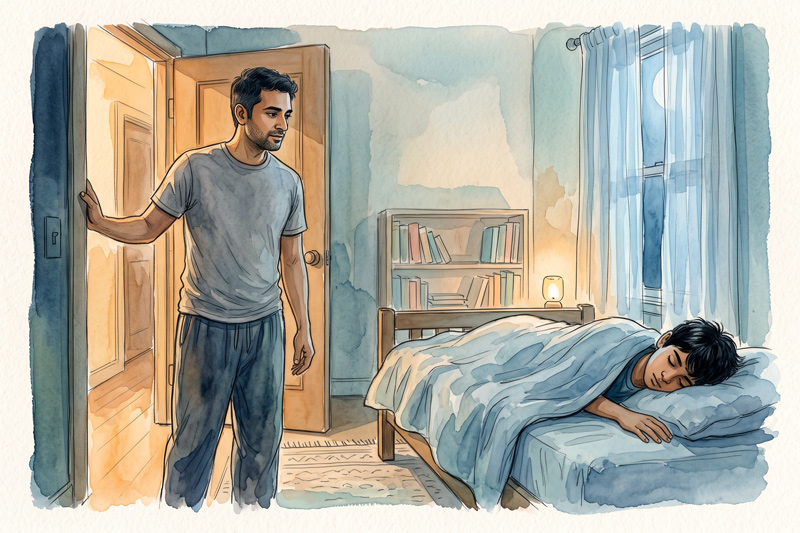
One night, long after stabilization had begun, I found myself awake while he slept. Moonlight filtered through the curtains. His breathing was slow and even. I stood at his doorway and understood something that had eluded me before. Autism is not a battle to be won. It is a life to be understood.
I still want Addwik to communicate more clearly. I still want him to acquire skills, become increasingly independent, and find his own best possible expression. Acceptance has never meant giving up on improvement. It means pursuing improvement without making love conditional upon achievement.
The long nights taught us to look beneath surface disturbance — to ask what the body required before demanding what the mind could produce. In the dark, stripped of institutional charts and clinical titles, I was simply a father listening for breathing. Progress is rarely loud. It builds silently through repetition, patience, and the refusal to give up. Sometimes strength is quieter — the act of standing beside your child in the dark, waiting without surrender for the light.

Lt Col (Dr) Amit Kumar, MBBS, is a serving officer in the Army Medical Corps, India, and can be reached at [email protected] or +91 8826220568.
References
Lugo-Marín J, et al. Emotion regulation and emotion dysregulation in children and adolescents with autism spectrum disorder: A meta-analysis of evaluation and intervention studies. Journal of Affective Disorders. 2024.
Mammarella V, Breda M, De Gennaro L, Bruni O. Sleep disturbances and sensory processing and integration in children and adolescents with autism spectrum disorder: A systematic review. Sleep Medicine Reviews. 2026; 88:102302.
Mazefsky CA, Herrington J, Siegel M, et al. The role of emotion regulation in autism spectrum disorder. Journal of the American Academy of Child & Adolescent Psychiatry. 2013;52(7):679–688.
Nogueira HA, et al. Melatonin for sleep disorders in people with autism: Systematic review and meta-analysis. Progress in Neuro-Psychopharmacology & Biological Psychiatry. 2023; 123:110695.
Williams Buckley A, Hirtz D, Oskoui M, et al. Practice guideline: Treatment for insomnia and disrupted sleep behaviour in children and adolescents with autism spectrum disorder. Neurology. 2020;94(9):392–404.