An Unexpected Beginning
Until last August, autism was a word I could spell but knew very little about.
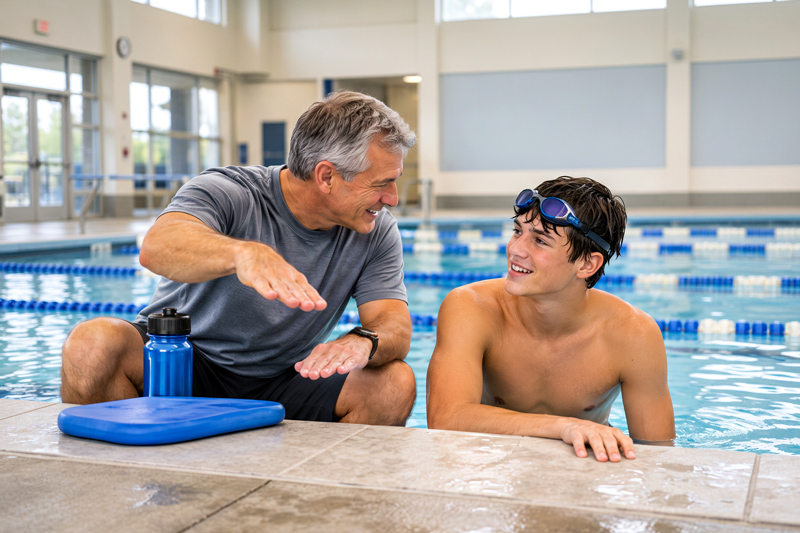
That all changed last August. I’ve been swimming most of my life and am a trained Masters swimmer. One morning, I went to my local lap pool and noticed a young boy in the next lane. His freestyle stroke looked as though he was wrestling with the water — and losing. I asked him if he would like some swimming tips. He looked me over for seven or eight seconds and gave me a resounding “No!” I said to myself, “Mind your own business.”
Unknown to me, the boy’s mother was sitting about five feet away. She walked over to her son and said, “Why don’t you listen to the gentleman?”
She introduced herself and her son, Brooks (a fictional composite). She told me he was autistic, about to turn 13, and a member of his school’s swim team. She also explained that he had experienced bullying from some of his teammates, mostly from losing races.
An Unexpected Swimming Lesson
I introduced myself to Brooks and began explaining the freestyle stroke. I told him to recover his arm with his elbow bent and higher than his hand, then reach forward and enter the water smoothly. For his legs, I suggested keeping them relaxed near the water’s surface, kicking from the hips with a small, steady splash. For breathing, he needed to rotate his head to the side in coordination with his body rotation, take a quick breath, and exhale through his nose or mouth while his face was underwater. I swam one lap to demonstrate the technique and then asked Brooks to try it. I wasn’t sure what to expect, but he immediately applied what I had demonstrated. I was genuinely surprised by how quickly he understood the instructions and translated the demonstration into action. He didn’t need repeated explanations; he simply watched, understood, and applied what I showed him.
For the next three days, I met him at the pool at 9 a.m., and we worked on his technique. We were developing a friendly relationship. By the fourth day, I noticed something different. Brooks was beginning to look directly at me when we talked. I interpreted this as a sign that he was becoming more comfortable with me. It was a wonderful feeling and an important moment in our developing relationship.
That weekend, Brooks had a swim meet. I told him I believed he would do well in his freestyle event and suggested we celebrate his efforts with ice cream the following week. The next Tuesday morning at 9 a.m., I saw Brooks and his mother at the pool. Brooks had two ribbons around his neck, each with a medallion attached. He told me he had won his freestyle event by the length of the pool, and his relay team had also finished first. I was delighted for him. More importantly, he had something to feel proud of.
Discovering a Common Interest
As our relationship developed, I learned that Brooks and I shared an interest in maps and geography. I asked him to bring his U.S. road map to the ice cream and yogurt shop, where we planned to meet at noon. When I arrived, Brooks and his mother were already sitting there. His mother and I decided not to order anything, while Brooks selected an ice cream with all the toppings he wanted. After some conversation, I asked him to open his road map. We spent the next 40 minutes exploring geographical points of interest. I asked him questions, including:
- What are the two northernmost states? (Alaska and Minnesota)
- What are the two southernmost states? (Hawaii and Florida)
- What state is closest to Russia? (Alaska)
- What state has the longest coastline? (Alaska)
- What state borders only one other state? (Maine)
- What U.S. state is closest to mainland Africa? (Maine, surprisingly!)
- What two states border eight other states? (Tennessee and Missouri)
- What state was once its own nation? (Texas)
- Which country lies directly south of Detroit, across the Detroit River? (Canada)
I could tell Brooks was enjoying this learning exercise. His mother was even learning a few things herself about the United States. After this informal geography lesson, I realized something important: a mentor doesn’t need to be an autism specialist or an educator. A mentor can be a coach, neighbor, family friend, volunteer, or someone who simply enjoys helping young people develop. When mentoring minors, appropriate parental involvement, safety precautions, and clear boundaries are essential.
What I Learned About Mentoring
Looking back, I realized that a mentoring relationship doesn’t develop overnight. Trust comes from consistency, patience, and showing genuine interest. I learned to enter Brooks’ world and recognize that mentoring should be based on a teenager’s interests and willingness to participate. The important lesson is that mentoring isn’t about expecting a teenager to adapt to the mentor. It’s about finding common ground, recognizing individual interests, and creating opportunities for the teenager to succeed.
Over time, I learned to respect Brooks’ personality, preferences, and communication style. I became a better listener, learning not to immediately correct or judge, but instead to encourage him through questions that promoted independent thinking.
While my experience with Brooks is only one story, I wondered whether research supported what I was observing firsthand. The answer appears to be yes. A 2016 study, Expanding Horizons: A Pilot Mentoring Program Linking College/Graduate Students and Teens With ASD, examined a program involving nine autistic teenagers, ages 13–18, paired with trained young adult mentors. The participants met weekly for six months. Researchers reported encouraging improvements in self-esteem, social anxiety, and quality of life, as well as greater social connectedness. The authors emphasized that the small sample made the findings preliminary.
More recently, a March 2026 study in the Journal of Autism and Developmental Disorders, titled A Pilot Randomized Controlled Trial of the Autism Mentorship Program, examined 24 autistic teenagers, ages 14–18. Thirteen participated in a program offering 23 weekly online mentoring sessions with autistic adult mentors. Researchers reported improvements in self-esteem, perceived social support, and engagement, although they emphasized that larger studies are needed to establish the program’s effectiveness. These studies reinforce an important idea: meaningful mentoring relationships can provide opportunities for personal development, confidence, and social connection.
A Two-Way Learning Experience
Mentoring isn’t about preparing an autistic teenager to become someone else. It’s about helping that teenager discover who they are, recognize what they can accomplish, and develop the confidence to pursue their own future.
Sometimes, an adult who believes in a young person can have an influence that lasts a lifetime. I hope swimming continues to open doors for Brooks, whether that means competing in college or simply enjoying a sport that has become a source of confidence, accomplishment, and friendship.
Perhaps the biggest surprise was discovering that I wasn’t the only one doing the mentoring. Brooks taught me patience, the importance of listening, and the value of seeing the world from someone else’s perspective.
I may have started out teaching him how to swim, but along the way, Brooks taught me something even more valuable: understanding often begins when we are willing to see the world through someone else’s eyes.
Brooks is a fictional composite based on experiences with autistic young people. His name and identifying details have been changed.
This article is part of my continuing interest in autism and helping autistic individuals recognize and develop their potential. I have previously written five articles for Autism Spectrum News covering swimming and autism, hiring autistic professionals, helping organizations recognize autistic strengths, and preparing autistic teenagers for adulthood. Readers interested in my other articles can visit my author page on Autism Spectrum News and explore my previous contributions.
Ronald Smith has over four decades of experience as a Senior PM/Program Manager. He retired from IBM having written four books and over 100 articles on project management and the systems development life cycle (SDLC). He’s been a member of the Project Management Institute (PMI) since 1998, which has a membership of about 3 million professionals worldwide. From 2011 to 2017, Ronald was an Adjunct Professor for a Master of Science in Technology and taught PM courses at the University of Houston’s College of Technology. Teaching from his own book, Project Management Tools and Techniques – A Practical Guide, Ronald offers a unique perspective on project management that reflects his many years of experience. Besides writing, he swims five times a week to keep in shape. Lastly, in the Houston area, he has started up two Toastmasters clubs and does voluntary work at various food banks to help people facing hunger.
References
1. Curtin, C., Humphrey, K., Vronsky, K., Mattern, K., Nicastro, S., & Perrin, E. C. (2016). Expanding Horizons: A Pilot Mentoring Program Linking College/Graduate Students and Teens With ASD. Clinical Pediatrics, 55(2), 150–156. https://doi.org/10.1177/0009922815588821
2. Hudock, R. L., Gunlicks-Stoessel, M., Zhang, J., Zhou, H., Congreve, A., Williams, S., Petricek, C., Goldberg, E., Austin, J. D., Hokland, A. J., Khan, L., & Weiler, L. M. (2026). A Pilot Randomized Controlled Trial of the Autism Mentorship Program. Journal of Autism and Developmental Disorders. https://doi.org/10.1007/s10803-026-07272-w