As a parent of a neurodivergent (ND) child, unsolicited advice and recommendations become a part of everyday life. If your child struggles with atypical sensory response as 90 percent of individuals with autism do (Balasco et al., 2020), a loved one may advise you to just avoid the place. The coffee shop is too loud? Avoid it. Unbearable lighting at the supermarket? Avoid that as well. However, certain environments, such as schools, are critical to your child’s academic and social-emotional development. A student’s absence from their learning environment hinders them from receiving an equitable education in the company of their peers. Schools and classrooms that lack evidence-based design foundations place students with autism at greater risk for not reaching their true potential.
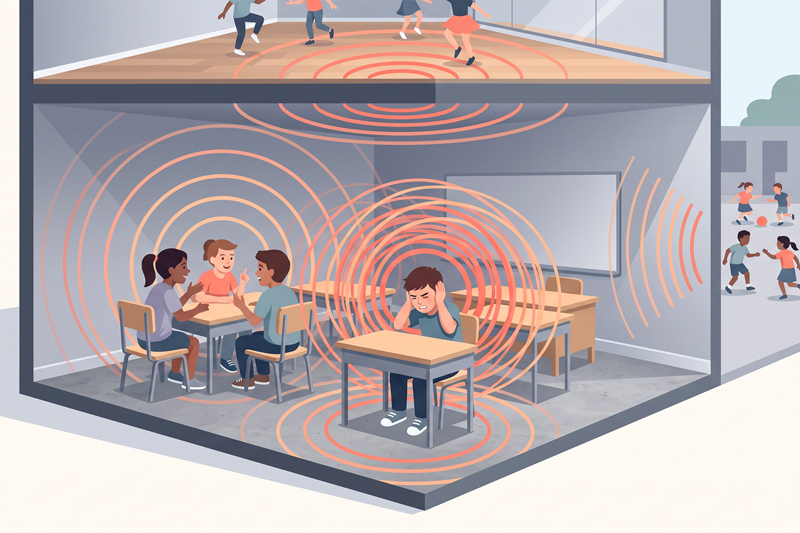
Years ago, I worked on a design for a school’s multi-purpose building which included science classrooms as part of the building’s design programming. Due to a series of site restrictions, the science classrooms were bound to have numerous acoustical issues. They were located directly below a dance class and were adjacent to a noisy outdoor quad. The construction budget was stretched thin, and the district was anxious to reduce cost. As part of our value-engineering exercise, the district ordered the design team to remove the high-quality sound-absorbent floor finishes from the science classrooms. In their absence, a bare and acoustically reflective concrete floor remained. In retrospect, I should have pushed back on the district’s demands. Sometimes it requires multidisciplinary knowledge and lived experience to develop better foresight. Drawing from my educational background now in architectural design and neurodivergence, I frequently observe the detrimental effects of poorly designed classroom environments.
A space intended for education and growth becomes the barrier to learning. A student with hyperacusis (see footnote #1) may become easily distracted or distressed in a classroom setting where acoustics were not properly addressed by the architecture team. Poor classroom acoustics can lead to excessive background noise and reverberation. As a result of the aversive acoustical stimuli, a neurodivergent student may exhibit physical and psychological symptomologies such as headaches, ear pressure, anxiety, or anger (Danesh et al., 2021; Williams et al., 2021; Froedtert & the Medical College of Wisconsin, 2025). Classroom environments devoid of appropriate sensory-related considerations also impede a student’s concentration, behavior, and ability to understand speech (American Speech-Language-Hearing Association, n.d.), which in turn may prevent students from participating fully in a free and appropriate public education as mandated by the Individuals with Disabilities Education Act (IDEA).
During school observations I have witnessed my son rushing to run out of his classroom. It always occurred when the noise levels became too loud. The cacophony of sounds overwhelmed his senses and reduced critical time spent in the classroom. Sensory processing challenges are multidimensional and are unique to each individual. A neurodivergent student may experience a combination of hypo- and hyper-sensitivities that vary throughout their lifetime. Challenges in sensory processing are not only limited to the auditory domain. Hypo- and hyper-sensory reactivity also extend to additional domains such as the tactile (touch), gustatory (taste), olfactory (smell), visual (sight), proprioception (awareness of your body’s position within space), vestibular (sense of balance), and interoception (body’s own internal signal) (Brandt et al., 2024).
Architects often lament that the design team is stretched thin. And it’s true, we usually are. We’re always in survival mode, racing towards the next deadline. There is never enough time, money, or resources to dedicate to learning a complex subject matter, such as neurodiversity, that is outside our usual area of interest. The grossly inadequate funding received for construction projects forces school districts to reduce or eliminate programs and critical building components. It doesn’t take effort to generate excuses for why we do not design for the neurodiverse. Our own failure as an industry positions ND students at risk because we cite uncontrollable circumstances as an excuse for our ill-informed design decisions.
During my undergraduate studies in architecture, environmental psychology was not a mandated course. It still isn’t today. The complexity of a human body’s response to the physical environment warrants greater attention by architects and designers. At times we are too focused on creating “money shots” so that our projects can be featured in glossy magazines. But what about the human experience of a space? What’s the point of a beautiful school if it inadvertently excludes certain students from accessing it?
The IDEA encourages schools and districts to provide evidence-based practices (EBPs) for all students included under its jurisdiction, including students on the spectrum. Educators are encouraged to utilize evidence-based teaching methods that have undergone extensive methodological and systemic review. A program or a teaching method considered to be an EBP has demonstrated empirical evidence for a particular intervention. A similar principle should also be applied to the field of architecture. Evidence-based design decisions should be utilized in all spaces intended to support and educate the neurodivergent student. There is a growing body of research examining what environmental modifications are necessary to produce the best outcomes for neurodivergent students. Design conversations should include how we can address atypical sensory responses, cognitive differences, executive functioning, and perceptual processing. When designers obtain a comprehensive understanding of neurodivergence, we can be one step closer to creating truly inclusive and welcoming environments for all students.

Ani Manuk, Inclusive Environment Specialist and Advocate at Uplift Design Studio, is an interior architectural designer with over 10 years of experience designing education (K-12, higher education) and healthcare spaces (medical office buildings, behavioral health). After her son’s autism diagnosis, she began to understand how the built environment was not designed for the needs and challenges of neurodivergent individuals. In response to her growing fascination with the subject of autism and neurodivergence, she left her corporate job to enroll in graduate school at Columbia University to pursue a master’s degree in Developmental Disabilities. She recently graduated and is currently working on building a consulting practice that seeks to uplift neurodivergent individuals through evidence-based neuroinclusive design practices within the field of architecture. For more information, email [email protected].
Footnote
- Hyperacusis is “a rare hearing disorder where sounds others perceive as normal seem uncomfortably – and often unbearably – loud.” – Cleveland Clinic, 2026
References
American Speech-Language-Hearing Association. Retrieved October 26, 2026, from https://www.asha.org/practice-portal/professional-issues/classroom-acoustics/
Balasco L, Provenzano G, Bozzi Y. Sensory Abnormalities in Autism Spectrum Disorders: A Focus on the Tactile Domain, From Genetic Mouse Models to the Clinic. Front Psychiatry. 2020 Jan 28;10:1016. doi: 10.3389/fpsyt.2019.01016. PMID: 32047448; PMCID: PMC6997554.
Brandt et al., (2024) Human senses and sensors from Aristotle to the present. Front. Neurol. 15:1404720. doi:10.3389/fneur.2024.1404720
Danesh, A. A., Howery, S., Aazh, H., Kaf, W., & Eshraghi, A. A. (2021). Hyperacusis in autism spectrum disorders. Audiology Research, 11(4), 547–556. https://doi.org/10.3390/audiolres11040049
Froedtert & Medical College of Wisconsin (2025). Sound sensitivity (hyperacusis) https://www.froedtert.com/sound-sensitivity-hyperacusis
Williams, Z. J., Suzman, E., & Woynaroski, T. G. (2021). Prevalence of decreased sound tolerance (hyperacusis) in individuals with autism spectrum disorder. Ear & Hearing, 42(5). https://doi.org/10.1097/aud.0000000000001005