At seventeen, my son on the autism spectrum has taught me something profound: understanding another person does not always require changing him. Sometimes, it is about changing the way we listen.
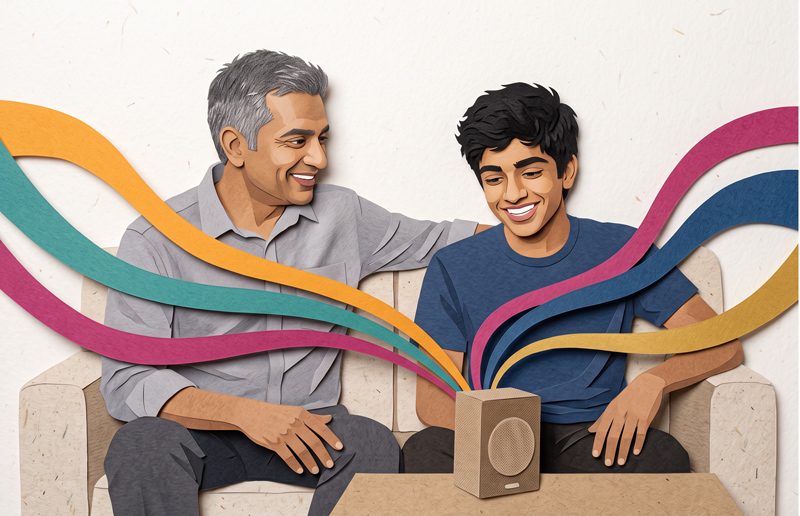
Music helped me understand this.
Addwik’s musical preferences have always fascinated me because they refuse to fit neatly into any pattern I can recognize. I have tried to understand the intricate workings of his mind. Therapists, educators, and doctors have assessed him in different ways. But if you truly want to know Addwik, do not ask for a clinical diagnostic report. Ask for his playlist. That is where his true personality lives.
The challenge, of course, is that his playlist makes absolutely no sense to the conventional ear. Or perhaps it makes perfect sense—just not to the rest of us. Most people organize music into neat, predictable categories. Addwik completely rejects such discrimination. In his world, a deeply spiritual devotional bhajan can peacefully coexist with hard rock. A soulful qawwali can be followed immediately by a loud Punjabi dance track powerful enough to wake an entire neighborhood. One moment our house is filled with the tranquil, spiritual calm of bhajans. The next, the legendary Chamkila (legendary Punjabi singer) arrives with the subtlety of a military assault. Just when everyone recovers from that sonic shock, Michael Jackson moonwalks into the room. And before you can even process that transition, Nusrat Fateh Ali Khan takes over, reminding us that some voices do not merely enter the ears—they enter the soul. There is no warning. There is no pattern. There is certainly no algorithm capable of understanding it. Spotify’s engineering team would probably resign in frustration. His playlist travels effortlessly between decades, languages, cultures, and genres. Jagjit Singh (Ghazal legend) sits comfortably beside heavy EDM. George Michael shares space with raw regional folk music. Madonna appears without notice. Bollywood classics drift in unexpectedly. Hard rock collides with soft instrumentals. And somehow, in a way that only Addwik understands, it all works.
For a long time, I searched for a pattern.
Was it the rhythm? The beat? The voice? Repetition? Was there some sensory quality connecting these apparently unrelated forms of music?
As a doctor, I looked for patterns, symptoms that lead to a differential diagnosis; an observation demands an explanation. As a father, I unknowingly carried some of that instinct home. If my son repeatedly chose something, surely there had to be a reason I could decipher. Perhaps there was. But perhaps I did not always need to. That realization took years. Addwik’s expressive communication has remained limited, although his receptive understanding is much better. When your child cannot always explain what he feels, you gradually learn to read everything else—his eyes, movements, expressions, silences, choices, and reactions.
You start interpreting beyond speech. Music gradually became part of that language. His playlist choice itself tells me something important: This means something to me!
And that is more than enough.
Beyond Spoken Words
For much of our journey with autism, communication naturally remained associated with speech. Every new word mattered. Every spontaneous expression became a milestone. Like many parents, we celebrated what could be heard. Over time, however, I began noticing how much my son was saying without speaking. His eyes told me when something was not right, his movements revealed restlessness, his silence carried meaning. Even the way he responded to a familiar sound or piece of music could sometimes communicate more than a sentence. There was sensation long before there were words. This is where Addwik’s relationship with music challenged some of my own assumptions.
There are ordinary sounds that can bother him, yet there are forms of music that he actively seeks and enjoys. Initially, this appeared contradictory to me. If sound could overwhelm him, how could music sometimes bring such visible pleasure? Slowly, I understood that I was again trying to interpret his sensory world through mine. A sound that arrives unexpectedly and a sound he chooses for himself may not be the same experience. One may intrude; another may comfort. One may overwhelm; another may invite participation.
Perhaps rhythm matters. Perhaps familiarity matters. Perhaps control matters. Or perhaps something entirely different is happening within him that I may never fully understand.
The important change was that I stopped requiring a complete explanation before respecting his preference.
Not Everything Needs to Be Decoded
Parenting a child with limited expressive communication naturally makes one observant. A change in behaviour may be communication. A withdrawal or a sudden reaction may have a reason that is invisible to everyone else.
So, we learn to look beneath behaviour. That remains important. But somewhere along the way, I realised there is a subtle difference between trying to understand our children and trying to explain everything about them. In my effort to understand Addwik, I sometimes turned even his preferences into puzzles.
Why this song? Why today? Why again? Why does something I would never have associated with him suddenly captivate him?
Music gradually taught me to leave some of those questions unanswered. I do not need to understand why a qawwali moves him on one evening and Punjabi music excites him on another. I do not need a neurological explanation for why a bhajan catches his attention or why Michael Jackson suddenly enters his musical universe. These choices belong to him. There is dignity in allowing them to remain his. That has been an important transition for me—from asking, why does he like this? to sometimes simply saying, He likes this.
The difference appears small. For me, it represents years of learning.
Redefining Progress
When Addwik was younger, I measured progress largely through acquisition—a new word, a completed task, an instruction followed, a skill acquired. Those milestones still matter. We continue to work towards greater communication, confidence, and independence. But as he has grown, my understanding of progress has widened. Sometimes progress is clearly visible. At other times, it is quieter—a greater willingness to participate, a quicker recovery after becoming overwhelmed, a new preference expressed independently, or simply the confidence to make a choice.
The outside world may not recognise these as milestones. A parent often does. And sometimes the progress is not entirely in the child. Sometimes it is in us.
Perhaps I have progressed when I no longer feel compelled to correct every behaviour that appears unusual to me, when I can appreciate a preference without turning it into a therapeutic objective, or when I can sit beside my son and share a piece of music without needing him to explain why he loves it.
That realization has changed my understanding of acceptance. Acceptance does not mean giving up on improvement. We will continue helping Addwik develop whatever skills can make his life more comfortable and independent. But helping him grow is different from continually trying to make him resemble everyone else.
Acceptance should not mean giving up on improvement, and improvement should never mean demanding conformity.
From Inclusion to Belonging
We speak frequently about inclusion in autism. It is an important word, and society has travelled a considerable distance to reach it. But I increasingly wonder whether inclusion is the final destination. Inclusion can still imply that there is an established world into which someone different is being accommodated. A classroom includes an autistic child. A workplace includes a neurodivergent adult. A social gathering makes adjustments so someone can participate. All of that matters. But belonging goes further. Belonging begins when the person no longer feels that his presence requires explanation. My son should not have to justify why one sound disturbs him while another brings him joy. His musical choices do not have to conform to what I expect from a seventeen-year-old. Nor do those preferences need to reveal some extraordinary hidden talent before they become worthy of respect.
He does not have to be a musical savant. He does not have to turn his love for music into an achievement. He can simply enjoy it. Perhaps that is one of the quietest forms of acceptance.
For parents, this realization is not instantaneous. Seventeen years of raising my son have not made me an expert on everything he experiences. If anything, they have made me more conscious of how much I may never completely know.
But they have changed the questions I ask. Earlier, I often wondered: How do I bring him closer to our world?
Increasingly, I find myself asking: Have I spent enough time entering his?
His world has its own rhythm. Sometimes that rhythm arrives through a soulful qawwali. Sometimes through a spiritual bhajan. Sometimes through Punjabi dance music. Sometimes through Michael Jackson.
I may never fully understand the connection between them. And perhaps I no longer need to. I can sit beside him. I can watch what makes his face change. I can notice what brings him joy. I can respect a preference without demanding an explanation for it. For a father who spent years trying to decipher everything, that has been a profound lesson.
Understanding another person does not always require changing them. Sometimes, it requires changing the way we listen.
And perhaps that is the moment when inclusion quietly becomes belonging.

Lt Col (Dr) Amit Kumar, MBBS, is a serving officer in the Army Medical Corps, India, and can be reached at [email protected] or +91 8826220568.