Being able to do a job and being able to explain that ability in an interview are not the same thing. Someone may be excellent at solving technical problems, growing plants, organizing information, or helping customers, yet struggle when asked to describe those strengths in an unfamiliar conversation.
For some autistic job seekers, the difficulty is not a lack of motivation or potential. Open-ended questions, unexpected follow-ups, and uncertainty about what an interviewer wants can create additional demands. Research has identified the interview itself as a barrier and shown that changing how questions are asked can help candidates communicate their abilities more effectively. [1, 2]
That distinction matters to our work at Neurodiverse Technologies. I co-founded the company with Vanderbilt researcher Dr. Nilanjan Sarkar to help move research into practical tools for everyday independence. NAVIS, our interview-readiness application, addresses one part of that journey: giving people opportunities to prepare before an important employment conversation. [3, 4]
The goal should not be to make someone appear less autistic. It should be to help them express what they know, what they can contribute, and what they need to succeed.
A Place to Practice, Not a Test of Worth
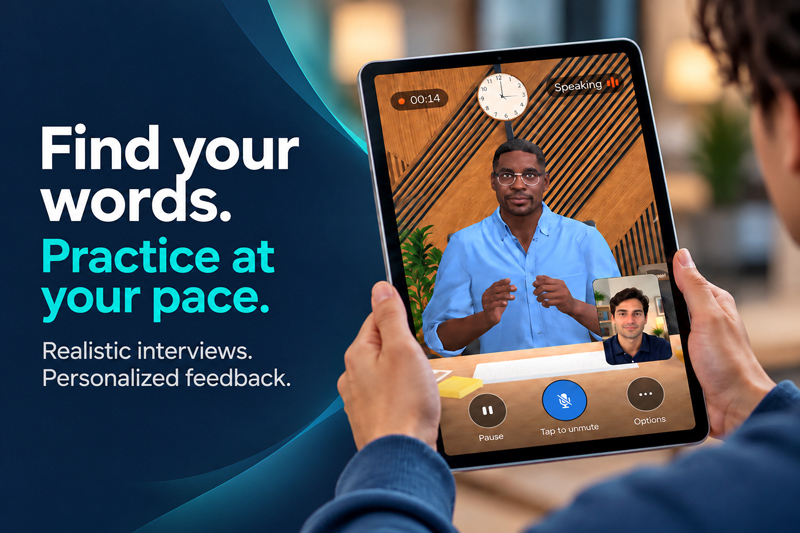
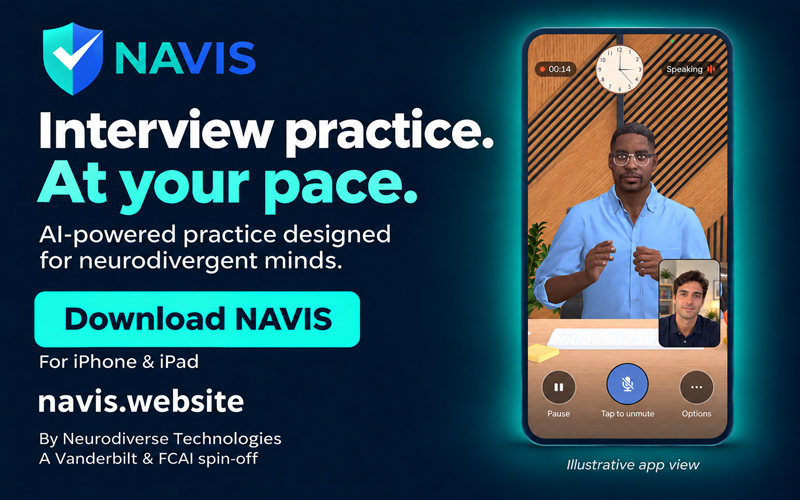
NAVIS allows users to practice with a virtual interviewer, respond to questions and adaptive follow-ups, and review personalized feedback. Available for iPhone and iPad, it offers repeatable sessions and a history of previous interviews. Its purpose is preparation, not making hiring decisions or determining someone’s professional worth. [4, 5]
A useful practice session should leave someone with a manageable next step. Rather than simply being told to “sound more confident,” a learner might work on describing one specific example, explaining their own contribution, or making the outcome clearer. NAVIS includes practice with the STAR structure: Situation, Task, Action, and Result. [4]
Consider a hypothetical applicant who helped a community garden track watering schedules. Initially, they might say only, “I helped with the plants.” Practice could help them explain the problem, the system they created, and what changed. The experience already exists. The task is finding a way to communicate it.
For a coach or educator, I would suggest choosing one skill at a time, discussing whether the feedback feels useful, and then practicing with a person. AI feedback should be a starting point for reflection, not a verdict. A learner should be able to question a suggestion and decide whether it fits their experience.
The Science Behind the Approach
NAVIS has its roots in Vanderbilt University’s Career Interview Readiness in Virtual Reality research platform, known as CIRVR. Work in the Robotics and Autonomous Systems Lab explored adaptive, individualized interview practice and ways of helping participants and support professionals understand the interview experience. This work connects with the Frist Center for Autism and Innovation’s focus on neurodivergent talent and workforce participation. [2, 3, 4]
In a study published in Assistive Technology, Adiani and colleagues reported a feasibility evaluation involving 23 autistic participants. CIRVR combined simulated interviews with information from spoken interaction, gaze, facial expressions, and physiological responses. The findings suggested potential for individualized training; they were not evidence that the commercial NAVIS application improves employment outcomes. [6]
Separate research supports the broader approach. A randomized study by Smith and colleagues involved 71 autistic transition-age young people. Forty-eight received virtual interview training alongside their usual school-based pre-employment services; 23 received those services alone. The training group showed better interview skills, lower interview anxiety, and greater access to employment. That study evaluated a different program, not CIRVR or NAVIS. [7]
These distinctions are essential. Evidence for virtual interview practice provides a rationale for development, but it does not automatically establish the effectiveness of every application. Research on particular groups of autistic participants also cannot be assumed to apply equally to every neurodivergent person. NAVIS’s impact on real interviews, employment, and longer-term participation needs its own evaluation.
A Wider Range of Possibilities
Interview preparation should not confine people to a narrow list of supposedly suitable careers. NAVIS offers an expanding library of job-specific scenarios across skilled trades, professional work, and technical fields. Its playful categories, Fun & Fiction, Fun & Stars, and Fun & Super Heroes, provide imaginative settings for practicing how to explain an idea, describe a strength, or discuss teamwork. [4]
These settings are an invitation, not a prescription. Some people will prefer a realistic interview for a specific vacancy; others may enjoy beginning with an unexpected scenario. What matters is whether the experience helps the individual engage with practice that serves their own goals.
Employers Have a Part to Play
Supporting candidates must not become an excuse to leave recruitment unchanged. In a study involving 25 autistic and 25 non-autistic adults, Maras and colleagues found that adapted interview questions improved the quality of responses, particularly for autistic participants. Adaptations made the requested information more explicit, broke questions into clearer parts, and provided written questions. [1]
Preparation and accessibility should therefore move together. Employers can examine whether a question reveals relevant skills or simply rewards familiarity with interview conventions. I would encourage clear expectations, room to process questions, and appropriate opportunities to demonstrate practical ability.
The aim is not to train every applicant into the same communication style. It is to make it easier for different people to show what they bring. A preparation tool should support that aim, not replace an employer’s responsibility to consider how its own process creates barriers.
Independence Is a Connected Journey
At Neurodiverse Technologies, we describe our broader direction as a Platform for Independence. NAVIS focuses on interview readiness, while SANDI addresses driver readiness. Our ambition is to connect research-informed tools with the different situations in which people want greater choice and participation. [8]
For us, independence does not mean doing everything alone. It means having more agency, with the support that makes sense for the individual. Employment preparation, transportation, and everyday routines should be considered together rather than treated as unrelated milestones.
As NAVIS develops, I want us to ask questions that extend beyond session counts or automated scores. Does a person feel better able to explain their strengths? Can they transfer what they practiced into a conversation with an employer? Are opportunities becoming more accessible, and does the support respect who they are? These are evaluation priorities, not outcomes we should assume.
A successful interview is one possible step, not the definition of a successful life. The larger purpose is to help people pursue opportunities they value. Before asking someone to demonstrate their potential in a high-pressure moment, we should make room for them to practice. And we should make sure the people on the other side of the table are ready to listen.

Jan Schlueter is Co-Founder and CEO of Neurodiverse Technologies. The company develops technologies supporting readiness for greater independence, including NAVIS for interview preparation and SANDI for driver readiness. For more information, email [email protected] and visit neurodiversetechnologies.com and navis.website.
Disclosure: The author is a co-founder and executive of the company that develops and commercializes NAVIS and SANDI.
Research and Sources
- Maras, K., Norris, J. E., Nicholson, J., Heasman, B., Remington, A., & Crane, L. (2021). Ameliorating the disadvantage for autistic job seekers: An initial evaluation of adapted employment interview questions. Autism, 25(4), 1060-1075. Read source
- Vanderbilt University, Robotics and Autonomous Systems Lab. Career Interview Readiness in Virtual Reality (CIRVR). Read source
- Vanderbilt University, Frist Center for Autism and Innovation. (2026, February 1). Neurodiverse Technologies awarded $70,000 Innovation Catalyst Fund grant for NAVIS development. Read source
- Neurodiverse Technologies. NAVIS: Product features and research background. Accessed October 29, 2026. Read source
- Neurodiverse Technologies. NAVIS Interview Prep. Apple App Store product listing. Accessed October 29, 2026. Read source
- Adiani, D., et al. (2024; first published online 2023). Multimodal job interview simulator for training of autistic individuals. Assistive Technology, 36(1), 22-39. Read source
- Smith, M. J., et al. (2021). Virtual interview training for autistic transition age youth: A randomized controlled feasibility and effectiveness trial. Autism, 25(6), 1536-1552. Read source
- Neurodiverse Technologies. Platform for Independence: Company overview and product portfolio. Accessed October 29, 2026. Read source