For nearly two decades, our mornings have been marked by the familiar sound of a school bus pulling up in front of our home. The doors hiss open, followed by a greeting from the bus driver as they pull Philip’s wheelchair onto the platform. The bus would rumble away, leaving behind a silence that began our day.
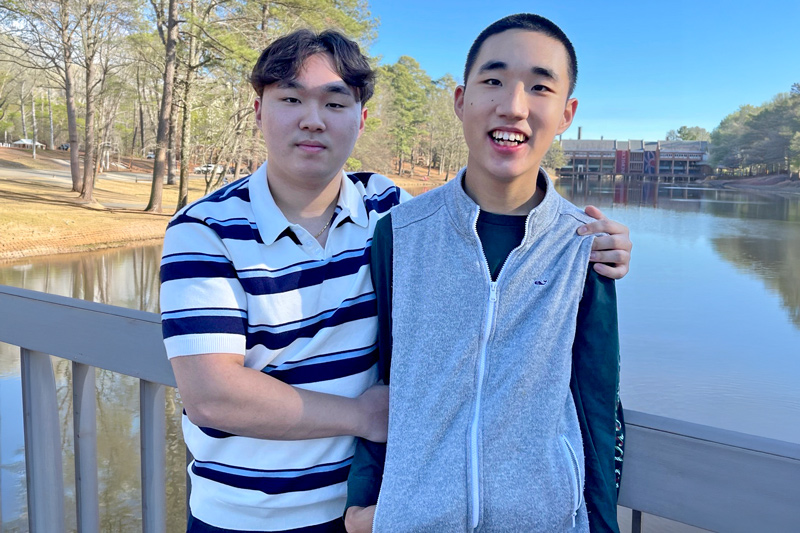
David and his younger brother, Philip
Next year, that bus will stop coming.
Philip will turn twenty-three, an age that for most families marks the start of adulthood. For ours, it marks an ending. When his school closes its doors, so too will the structure that has anchored our family’s life until now. The strict morning routine, the teachers who know his sounds and gestures, the small victories celebrated in the classroom will vanish with the end of the school year.
Philip’s world depends on predictability. His profound autism and developmental delay require full assistance, further exacerbated by his inability to speak or comprehend words. Rather, he communicates through expressions, sounds, and a handful of gestures we have learned over the years. His laughter is spontaneous and contagious. His meltdowns, while rare, fill the house with gloom. For example, every meal is an intricate dialogue of silent cues: an open mouth means “feed me”, while an arm blocking his mouth and a head turn means “I’m full”. Despite his growing age, Philip’s capabilities remain infantile: we still bathe him, change his diapers, and adhere to his 7 pm bedtime, at which the house falls silent.
Yet, most people do not see the invisible choreography that keeps his world steady. Our family lives by routines and constant vigilance. When school ends, that choreography collapses.
My parents and I have spent the past year touring adult day programs across Virginia, hoping to find a place where Philip could continue learning, socializing, or simply being safe while we work. Unfortunately, the tours blur together as we enter unsafe neighborhoods, understaffed centers, and rooms where all participants sit in front of televisions playing cartoons on loop. We have left more than one visit in silence, all of us thinking the same thing: We can’t send him here.
What’s worse, this uncertainty is not unique to us. Across the country, families face the same precipice when their loved one with autism “ages out” of school at twenty-two. Under current federal law, educational support guaranteed through the Individuals with Disabilities Education Act ends abruptly (Anderson et al., 2018; Laxman et al., 2019). Overnight, parents are left with no choice but to become case managers, advocates, and full-time caregivers again.
National estimates suggest that fewer than 20% of young adults with autism participate in day or employment programs, and access is even rarer for those with more severe forms of autism (Moser et al., 2025; Ferguson et al., 2025). Many families, particularly those from immigrant or working-class backgrounds, are forced to quit their jobs or pay privately for fragmented care (Eilenberg et al., 2019). This alarming gap between need and support is not just a statistic; it is the quiet unraveling of thousands of households like mine.
With no solution in sight, my family has begun exploring something we never imagined. We want to start a center of our own. My father, currently working in research, recently earned certification as a nursing assistant so he can help create a program for Philip. I spend weekends reading state regulations and reaching out to center founders to learn how they built their programs.
The hardest part of all of this is knowing why we are doing it. We are planning out of fear. A constant fear that Philip will spend the rest of his life in isolation, that my parents’ aging will leave him unprotected, and that one day I will be the only person left to care for him.
As anyone who’s lived with an individual with autism may know, caregiving requires a level of endurance that rarely appears in public conversations. It is a lifestyle that exists in the margins. There is constant supervision, endless paperwork, and the emotional weight of planning for decades beyond one’s lifetime. People sometimes ask if we ever get used to it. The truth is, we never do. We adapt, we adjust, we keep going. We love, and in love, we endure.
Clearly, services that support children with disabilities were not designed to last a lifetime. The transition to adulthood further exposes the fault lines in the care service system: funding shortages, long waiting times, and unresponsive agents. These policies often assume that parents will simply step in and know exactly what’s needed. As much as love is a valid reason families continue caring with everything they have, love alone is not a system of support.
At this point, I still do not know what Philip’s days will look like after June. Perhaps we will have to settle with a day care center that best fits our needs. Though other parts of the country have much better services in place for individuals with autism, all the work my family has put into helping Philip get the care he deserves in Virginia makes the move to another state nearly impossible. More likely, my mother will stay home and take care of him full-time. Until then, we focus on what we can control. We hold on to the simple daily rituals that keep our lives together.
Transition, I am learning, is less about services and more about hope. It depends on the fragile belief that love, structure, and persistence can outlast uncertainty. The school bus will stop coming soon, but our journey does not end there. It will continue on a different route, one we will walk together, one steady step at a time.

David Kang is a sibling of a brother with profound autism and hopes to become a physician who can help neurodiverse individuals. He may be contacted at kangdavid10@gmail.com.
References
Anderson, C., Lupfer, A., & Shattuck, P. T. (2018). Barriers to Receipt of Services for Young Adults with Autism. Pediatrics, 141(Suppl 4), S300–S305. https://doi.org/10.1542/peds.2016-4300G
Eilenberg, J. S., Paff, M., Harrison, A. J., & Long, K. A. (2019). Disparities Based on Race, Ethnicity, and Socioeconomic Status Over the Transition to Adulthood Among Adolescents and Young Adults on the Autism Spectrum: A Systematic Review. Current psychiatry reports, 21(5), 32. https://doi.org/10.1007/s11920-019-1016-1
Ferguson, E. F., Barnett, M. L., Goodwin, J. W., & Vernon, T. W. (2025). “There is No Help:” Caregiver Perspectives on Service Needs for Adolescents and Adults with Profound Autism. Journal of autism and developmental disorders, 55(10), 3460–3477. https://doi.org/10.1007/s10803-024-06451-x
Laxman, D. J., Taylor, J. L., DaWalt, L. S., Greenberg, J. S., & Mailick, M. R. (2019). Loss in services precedes high school exit for teens with autism spectrum disorder: A longitudinal study. Autism research: official journal of the International Society for Autism Research, 12(6), 911–921. https://doi.org/10.1002/aur.2113
Moser, C., Adams, R., Zheng, S., Bishop, S., & Taylor, J. L. (2025). Brief Report: The Vocational and Educational Activities of Transition-Aged Autistic Youth with Low IQ. Journal of intellectual disability research: JIDR, 10.1111/jir.70054. Advance online publication. https://doi.org/10.1111/jir.70054