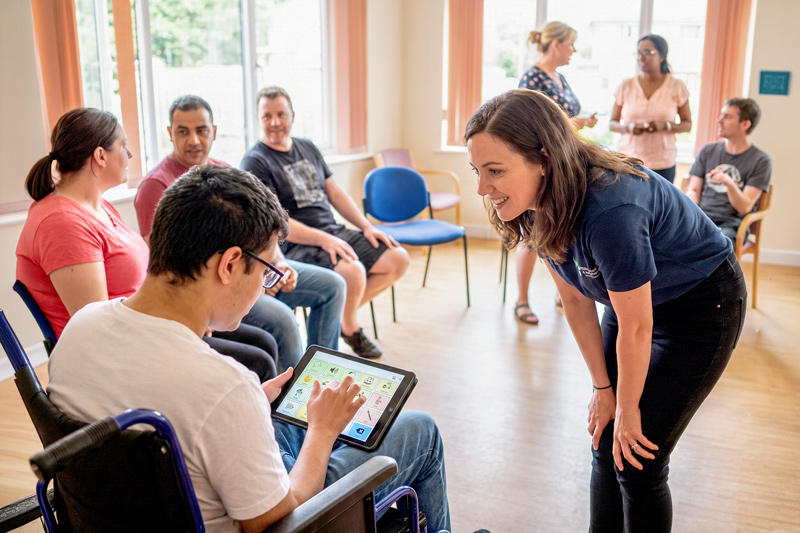
People often ask CommunicationFIRST for our recommendations for interacting with people who need and use augmentative and alternative communication (AAC) tools and supports,1 including nonspeaking autistic people, autistic people who are sometimes able to speak, and people with other disabilities—like cerebral palsy, Down syndrome, or acquired brain injuries—that affect the ways in which they can be heard and understood. Informed by the civil rights afforded to people with disabilities by law in the United States, and shaped by CommunicationFIRST’s years of leadership by and collaboration with AAC users, autistic and otherwise, the following principles will help you ensure respect, dignity, and equitable opportunity as you work with and alongside us. No matter your role, if you can rely on speech to be heard and understood, you can play a part in leveling the playing field.
Just fifty years ago in the United States, people who couldn’t rely on speech alone to be heard and understood were often sent to live in institutions as a matter of course. Many of these people were autistic, though others had other disabilities, like traumatic brain injuries, Down syndrome, or cerebral palsy. Treated as less than human, few residents of U.S. institutions had a chance at parts of life most Americans take for granted—like regular mealtimes, making basic choices, or an education—until the 1970s.2
The first changes were voluntary: no laws at the time ensured that people with disabilities were treated fairly. But disabled people living in the community, learning from the Civil Rights Movement of the 1960s, organized for their rights. In 1977, more than 150 people with disabilities, including AAC users like Hale Zukas, gathered in a federal building in San Francisco and refused to leave. The Rehabilitation Act of 1973 had promised to prohibit discrimination against disabled people in programs that received federal funding, but after four years, no regulations had been signed, leaving the law unimplemented and unenforceable. The sit-in lasted 28 days, until the Section 504 regulations were signed.
Much has changed since then. The 1975 Individuals with Disabilities Education Act (IDEA) established that disabled students have the right to a free and appropriate public education—including the supports and services they need to access it.
The Americans with Disabilities Act (ADA) was passed in 1990, affirming the civil rights of people with disabilities. The ADA’s goal is to ensure that disabled people can access the same parts of society that nondisabled people can. Just as a wheelchair user requires accessible entrances to enter buildings, people with communication disabilities may require “auxiliary aids and services” to access things like healthcare or education. In other words, we have the right to effective communication. To ensure effectiveness, public services must give “primary consideration” to the disabled person’s chosen communication method.
Effective communication in action looks like:
- Providing AAC tools and supports that enable someone to access education (also required by the IDEA)
- Providing AAC tools and supports in court to enable a witness to give testimony
- Providing extra time for someone to communicate with a teacher or physician
- Ensuring that a person has access to their AAC during a hospital stay
- Ensuring that a communication support person is allowed in a hospital room, even when “visitors” are not permitted
Our right to live in the community is also relatively new. Starting in the 1970s, inhumane institutions, including the infamous Willowbrook and Forest Haven, were permanently closed, and the independent living movement soared. In the 1999 Olmstead decision, the Supreme Court confirmed that the ADA gives people with disabilities a right to live in the community with publicly-funded supports and services. Although many of us still live in institutions (and still lack access to AAC that works for us), others receive home- and community-based services because of Olmstead.
Although robust, language-based AAC has been around since the 1920s, these tools have historically been available to just a tiny fraction of the people who needed them. Many professionals believed that people who couldn’t speak also had no ability to understand or express language. The changing attitudes of the late twentieth century—emphasizing participation, dignity, and civil rights—have expanded access to communication, but the fight for our rights, dignity, and inclusion is far from over.
The discrimination of the past lingers in biased and outdated attitudes, policies, and social norms. Many people who have no speech are still assumed to have no language. Those of us lucky enough to access AAC are still routinely excluded, isolated, abused, and otherwise discriminated against.
Civil rights cannot continue to be a matter of luck and privilege. To change our world, we need people who can rely on speech to stand with us in allyship.
1) Presume competence
You may already be familiar with the least dangerous assumption: the idea that assuming someone can understand, can learn, and can be a part of the community will always do less harm than assuming that they cannot. Presume that a person with a speech-related disability is fully aware of what is being said and done around them, and that they have thoughts, ideas, opinions, and dreams—even if they don’t have AAC that allows them to express those things yet. In practice, this might look like:
- Securing access to robust, language-based AAC as soon as possible. Timely AAC training and access supports a person’s ability to be part of their community throughout their life. (Indeed, the ability to communicate with others in the community is necessary for true integration into that community.)
This access to communication shouldn’t stop at access to symbols or making requests. “No one can possibly know all of the words someone might need or want to express—whether to make requests, comment, ask questions, or engage in other functions of communication,”
- Giving us the power to direct our own lives. Guardianships (or conservatorships) unnecessarily deprive us of fundamental rights. Supported decisionmaking (SDM) is based on the way that all humans make important decisions—by getting help from people they trust. Professionals such as educators and physicians often present guardianships as the only option. Fight back against that limiting narrative and spread the word: AAC users don’t need guardianships to be safe and live well.
2) Use your speaking privilege strategically
The speaking world moves quickly, and many of us cannot move quickly enough to join in before the conversation has already moved on. Planning ahead and speaking up to intentionally make space for us in conversations expands our world exponentially. Brainstorm ways to slow things down and give us a fighting chance at taking our turn.
Modelling respectful behavior can go a long way. When other people know how to be respectful of AAC users—and when they know that other people in their social circles value when we are respected—they’re much more likely to include us meaningfully. If you see someone speaking to our aide as though we aren’t there, address us directly. When you notice we’re being spoken over, interrupt on our behalf. If you notice we haven’t been able to participate in the conversation, speak up and make room for us. You can use phrases like:
- “Hang on, I think [name] is typing.”
- “Were you going to say something, [name]?”
- “[Name], any thoughts on this?”
Just remember that speaking up for us is very different from speaking over us. Seek out and amplify our own stories, not stories told about us. Choose your words intentionally. Be the backup for our own advocacy.
3) Though we may never be safe, you can help make us safer
It’s impossible to talk about leveling the playing field for AAC users without mentioning the dangers of an ableist, inequitable world. We are disproportionately affected by abuse, neglect, discrimination, and other kinds of trauma. We are often denied the right to make basic choices, say no, or change our environment. Even those of us with access to AAC are likely to suffer from severe social isolation. Living under these circumstances may lead to additional difficulty communicating, stress-related health conditions, and mental health problems like post-traumatic stress disorder. These problems are systemic, but we are not powerless, even as individuals.
- Be clear that our boundaries and decisions matter. The confidence to exercise our right to refuse and our right to choose is a powerful defense against abuse. When we say “no,” respect it, and back us up in enforcing our decision. Give us the opportunity to make choices, big and small. Self-advocacy skills alone can’t prevent violence, but they can build resilience and set us up to resist, ask for help, and heal.
- Make disabled peers and mentors an integral part of your social circles. Disability rights leader and lifelong AAC user Bob Williams writes that “we all benefit from . . . people who we can mutually support, learn with, dream with, and grieve with, and work together to co-create a more just world.” Peer support, whether formal or informal, engenders agency, belonging, and self-advocacy. Support AAC users to support each other—and remember that developing real relationships with people with disabilities will enrich your life, too, whether or not you’re disabled yourself.
- Be curious. Humans behave in different ways for infinite reasons. Some of those behaviors might be frustrating, harmful, or unwanted. Instead of focusing your efforts on stopping a behavior, investigate and ask questions. Why might someone behave this way? Are their needs being met in meaningful ways? Could there be a physical health problem you can address? Assume that someone who can’t rely on speech alone to be heard and understood has experienced traumatic stress, and use the principles of trauma-informed care to support them.
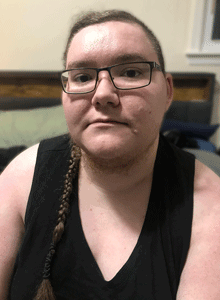
Ren Koloni, MA, is a Program Associate with CommunicationFIRST. CommunicationFIRST is the only nonprofit organization dedicated to protecting and advancing the civil rights of the more than 5 million children and adults in the United States who, due to disability or other condition, cannot rely on speech alone to be heard and understood. To read other resources we have created, or to learn more about the organization, visit communicationfirst.org. The author can be reached at [email protected]. All other communication can be addressed to [email protected].
Footnotes
- In this article, I follow the terminology guidelines adopted by CommunicationFIRST, an organization led by and for people who need and use AAC. See “The Words We Use,” (2023), at https://communicationfirst.org/the-words-we-use/.
- Content warning: some of the articles linked in this piece use terms now considered to be slurs to refer to people with presumed intellectual disabilities, in accordance with the language used at the time.