
Many nonspeakers are still locked in the prison of their own mind. Nonspeakers are underestimated because our bodies and brains are disconnected. Our minds work, but not with our body, so people conclude we are unintelligent. Apraxia is not well understood by parents, teachers, therapists, and the general population. To get a better understanding, people can listen to what we are saying when we point to letters on a letter board or are typing. There are as many as 30 million nonspeakers in the world and we have been begging for a game changer. Our minds are full of ideas, and even people that live in silence are interested in bringing them to the world. Being locked in silence leads to despair. We need to change this and it’s very possible. The nonspeaking community suffers from apraxia, but the good news is there is a way to free our minds if you put in the work and presume we are competent.
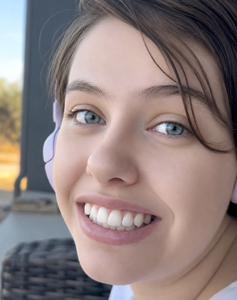
Elsa Jean Pace
How does a person with apraxia know how to free the mind? People need to understand that I had very much been dreaming of being able to write all my thoughts. I learned how to point to letters on a board. I had to work hard but over time, using the 26 letters of the alphabet, I was able to communicate my knowledge, ideas, opinions, and dreams. Being able to communicate with my family and teachers has changed all of our lives. It is so important not to underestimate nonspeakers, but to support them and help them connect to the rest of the world. Elizabeth Bonker, my hero, typed her valedictorian speech to her graduation class and told the world, “I am one of the lucky few non-speaking autistics who have been taught to type. That one critical intervention unlocked my mind from its silent cage, enabling me to communicate and to be educated like my hero Helen Keller.” I think it is hard to get an understanding through to people; writing this will help, because people really need to understand. Yet, it’s hard to feel what we feel.
People are familiar with the diagnosis of “Speech Apraxia,” or the neurological disorder where the brain can’t move the mouth; there is disconnect. So, why is it not understood that apraxia could be body-wide? I was diagnosed with Speech Apraxia when I was three, but it stopped there. No one assumed my body could not do what I asked. This is a “motor planning” problem. They thought I was incompetent or acting out. Someone who could speak to this is Dr. Diane Hennacy, a neuropsychiatrist who has been studying nonspeakers for decades. She writes, “While researching nonverbal communication with an autistic girl I realized the pervasive and painful lack of understanding about the nonverbal children.” It’s important to understand that behavior is not always a form of communication for us. The main standard for Autism therapy is Applied Behavior Analysis (ABA). Unfortunately, they are missing the main idea. The mind and body may not work in cooperation. I would receive consequences for things I could not control, like vocalizing or elopement (where I run away when I don’t mean to). This can be traumatic for someone who is aware but not able to motor plan. Dr. Hennacy writes, “There are many accepted neurological conditions in which the patient can’t speak, but they still understand language.” Nothing has changed in my head; I have always been smart.
People who live with someone who has apraxia need to buy into the idea that they are competent and, with help, are able to accomplish anything they want to do. My life has changed really dramatically after working hard day after day. Aligning my thoughts with movement gave me the ability to get an education and write this research essay. Having a good therapist that works on the body/brain connection and using a letter board to communicate was the way I became a person that people see. I see a future that is possible, like going to university and becoming a neuroscientist.
If you know or love someone with apraxia, it is important to embody the well-known motto of the apraxia community: “presume competence.” Help your loved one gain purposeful movement, which is the beginning of learning how to spell, and therefore, communicate. Lily Sherwood, who is a nonspeaker and an apraxia advocate, describes the pain of not being understood in her article, “Mind Breaks Free.” She states, “No one assumed there was any understanding or comprehension on my part…no one considered that the real issue might be a motor disability.” Like Lily, I felt the same understanding — like everyone was not learning that we are very active in our minds and we are very observant.
Lily is my friend, and she was kind enough to let me interview her. When asked about how her mental health has changed since people began presuming competence, Lily stated in our interview, “I felt seen as a whole person. Like I could be part of the world outside of myself. It was freeing.” My mental health was like Lily’s. Finding my voice made my life worth something.
It was not easy for me to write this essay. Please understand that I struggled in freeing my thoughts while working on this paper. So many great minds are still locked in silence. What great discoveries, ideas, and technologies have been missed that could be helping humanity? My community may have solutions for world problems. Our unique sense of justice and profound love for others means we care about long-term solutions. There is a whole population in the world that could make this a better place if we were not ignored but, instead, were listened to and taken seriously. We are many, so the next time you come across a nonspeaker, presume competence and speak to them with no judgement. It doesn’t take much to listen to a community who has long been silent.
Works Cited
Bonker, Elizabeth. “Be the Light.” Rollins College 2022 Commencement Address, 09 May 2022, Winter Park, FL.
Hennacy, Diane. “Breaking the Silence.” https://drdianehennacy.com/breaking-silence-introducing-issac/
Sherwood, Lily. “Mind Breaks Free.” The Parlor Magazine, https://www.theparlormagazine.com/borderlands-of-identity/mind-breaks-free


Thank you for writing so beautifully on a topic that is not well understood. I know several people who love you and the love they emit when mentioning you makes it clear you have made an impact on their lives. My hope is that as a society we are able to unlock more ways to communicate with the nonverbal autistic community – through spelling, through our hearts – as we evolve to understand who we are and what we are capable of. Sending you love on your journey.