The new student looks understandably full of questions.
“Hi!” I say, intentionally gregarious. “What’s your name?”
Which we exchange…I then give them a sly facial expression and tone—we autistics are bad at reading non-verbal communication, but we usually live long enough to learn a thing or two.
“Do you know why you’re here?”
Pause. The student shakes their head.
“This is ‘Autism Class,’ and I’m an autistic teacher. Here, we all learn about what we’ve got. You have autism, right?”
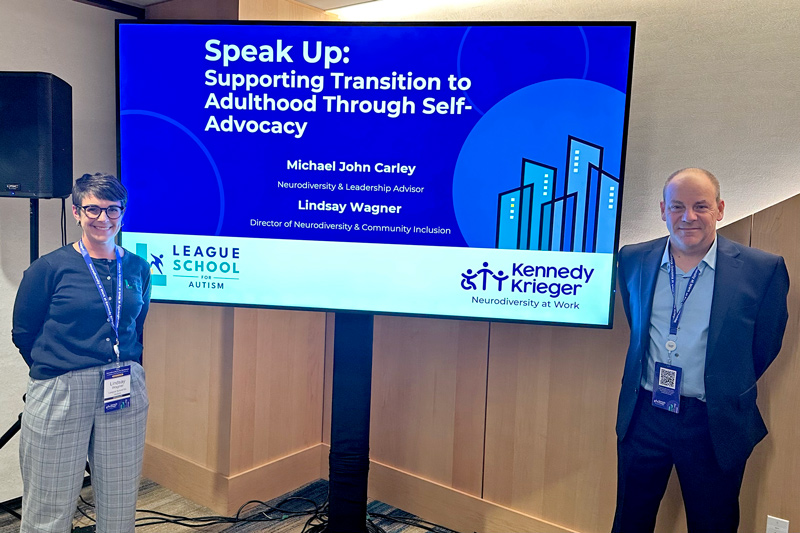
Lindsay Wagner with Michael John Carley at a recent conference
And this is where the conversation can vary.
New students arriving at the League School for Autism in Walpole, Massachusetts, come from a variety of sources and situations. They can come from other autism schools, as well as other public or private schools. They can come from State Family Services…And of equal variation are the attitudes that they’ve been brought up with…about who they are.
As we now endure mountains of disinformation from government entities (charged with our care), the reckoning that the autism world was already undergoing about cures, ABA—about what are healthy vs unhealthy attitudes about autism—that reckoning has now become even more painful.
We know that for anyone, having agency over one’s life is fundamental to achieving a high quality of life (Schalock, 2000). But for many autistic students, the transition from school to employment, post-secondary education, or independent living presents significant barriers to their capacity to make personal decisions and develop individual goals and values…especially if they don’t know what makes them tick! If you’ve been raised to think negatively of yourself, how will you ever make what we call an “informed choice”?
Research also suggests that the transition to adulthood may be eased when young people are given a stronger voice in decisions that shape their future (Chandroo et al., 2018). Facilitating guided conversations about personal interests, employment, meaningful relationships, and available support systems can help align an individual’s experiences and aspirations with their vision for a high quality of life.
Who better to give permission to autistic learners to create the life they dream of…than an autistic adult?
Back to the student: “So our class is split up into 18 sessions. We talk about autism and employment, autism and sports, stimming, autism and dating (we also have an administratively delicate session about sex) …”
The student is respectful but wants the explanation to be over so they can go sit and socialize with classmates. But before I let them go, I ask, “Have you ever had a teacher with autism before?” Some just say no. But others, even in 2025, laugh, and tell me that a teacher can’t have autism.
***
This class, and my association with the schools that let me teach it, has been around—though in an unpublished capacity—for a long time. I started developing it while consulting for District 75, the New York City Public Schools’ special education district) back in 2004. They had reached out after the adult support groups I’d been running for GRASP* started getting national attention.
* The Global and Regional Asperger Syndrome Partnership, which I founded, and ran for ten years from 2003-2013. GRASP was built on regional, spectrum run chapters and support groups (we had 28 in North America when I left) and served as the world’s largest membership organization for adults on the autism spectrum.
I wondered then…if K-12 autistic students had the autism knowledge to authoritatively talk about themselves. And they most certainly didn’t. Furthermore, they would never without exposure to positive education about the condition. ** So a half “proper” class, half support group, was created. Since then, teaching this class, and working in K-12 environments (both regular and special ed) has always been a beloved side gig to whatever my more time-consuming jobs were. I am at the League School only 3 hours per week; and that small amount of time is also used to support teachers, act as liaison between the residences and the main school building and serve as leadership consultant. But I love it, the impact is unquestionable, and the League School and I also plan to turn these 18 classes into the proper curriculum “Autism Class” should have become years ago.
The awkward conversation Autism Class opens, however, regards the phrase, “If you want to learn about autism, ask an autistic!” Long a staple of the progressive lexicon we humanists have relied on, intellectual discipline reveals this sentence to be somewhat flawed. Too often, unethical organizations and research entities have advertised their associations with (often, very lonely) autistics who haven’t been exposed to the types of supports that truly empower them, i.e. we can be, and often are, easily fooled by niceness. But these orgs get to say “See? We listened to autistics.”
***
Our course excluded, mentoring programs for autistic people are not new. In fact, there is a solid research base indicating the effectiveness of 1:1 peer mentoring programs for autistic adults and even high school students preparing for or entering post-secondary education (Duerksen et al., 2021; Hillier et al., 2019; Roberts et al., 2017). Advocacy groups and consultants charge top dollar for shared learning opportunities, mutual support, and community connection by pairing autistic young adults with trained mentors who have specialized knowledge and lived experience.
***
Much of this research has entered the field over the past five years, as the autism community struggles to strengthen its voice. However, these mentoring programs typically focus on very specific skills. For example, goal setting, coping with anxiety, navigating social life, and preparing for interviews, whether for college entrance or job acquisition, are common topics. These situations often focus on “how” to navigate life with autism, ignoring the “why.”
Decades of advocacy and a burgeoning neurodiversity movement have supported autistic children in gaining acceptance and access to learning opportunities alongside their peers. However, many autistic learners describe their school experience as difficult, complex, or demanding (Horgan et al., 2023). Reports from autistic students highlight pervasive experiences of bullying and harassment in school settings, which undermine self-perception and elevate the risk of mental health difficulties and suicidal ideation (Wang & Susumu, 2024). For younger students, inclusion models of education promote the value of neurotypical peers in modeling behavior for autistic children, which has been touted as best practice. However, it really is not “best practice.” Autistic students able to share their experiences report a lack of connection with neurotypical peers, despite attempts to include all learners in the classroom (Holmes, 2021).
Autistic students seem to suggest that autism-friendly schools should shift their culture to better understand the students and their experiences, as well as help students understand themselves (Cunningham, 2020). This is a far better experience than to be placed in a so-called “inclusion classroom” where they are unlikely to make friends. Access to education must never come at the expense of an individual’s quality of life.
***
Class is over. This group of students exit, and the next group of students comes in for the same class. However, …
The League School’s student body spans a very large portion of the autism spectrum. Very few will attend college, and very few have the dramatic support needs that require staff members to always be on alert. But in between those opposite ends of the spectrum is an enormous middle ground of varying ability and potential. So, each class is enacted four times each day, to cover four different groups of students—groups that are constructed by a combination of factors such as cognitive skills, their capacity for emotional regulation, and their current social statuses with each other. The lesson plans too, are therein tailored to each group. And if because of variety of challenges, the worst-case scenario is that a student retains only 5% of what was taught? Well, that 5% is more information that they would have learned otherwise, and that no other class will teach. That 5% is no embarrassment.
***
The school generously lets me teach the class in the administrative Board room, so students all get to sit at a long table as if they’re in a TV show about big business. Roughly 25-35% of each class is still spent socializing, regulating the students, consoling students…and this is more than fine. Our class is an opportunity to feel belonging because of their autism, not despite it. Teachers and paras who accompany many of the students must sit in chairs against the wall, i.e. they are not allowed to sit at the table. Many a first-time para in our class has been jolted up from their chair at the table by the students, who laughingly exclaim, “No neurotypicals at the table. Sit at the back!” While reverse discrimination is certainly not an overall goal, trying to teach their teachers what it feels like to be marginalized is a worthy shock, and it even more enhances the honesty of the discussions at the table. Furthermore, teachers often proclaim after their first time seeing the dynamic, “How cool! I’ve never seen anything like that. They felt so good, and empowered.”
The “by as well as for” concept is a long-proven asset in other marginalized communities. Teachers of African-descent more easily convince students of African-descent that they have a shot at a good life. A straight person running an LGBTQ support group will struggle to obtain credibility. I also wrote a very well circulated article in 2022, arguing for more autistics to run college autism programs (my fulltime job is running New York University’s autism program), and out of at least 80 such programs in the US, today there are still no more than 3 of us at a given time running similar support systems. It’s not because there are so few of us autistics that are capable. Trust me, I’m not that smart. Many fellow spectrum folk can do what I do. The problem at all levels is at the top. Supposed educators that exist as Superintendents, heads of School, Presidents, and Provosts, that are still deeply biased and won’t hire us…they are the problem.
***
By being autistic we’re not better people. But when a student is told that their teacher has autism, they are infinitely more able to trust them. Why?
When you grow up with autism, everybody makes mistakes about your intent. All through your development, you are constantly feeling as though your job is to teach others about who you are, even when they’re people that are supposedly qualified to oversee your care, like a therapist, a family member, or a teacher. It’s frustrating.
Very often we associate trust and love as being synonymous. They’re not. They are completely different animals. It would hurt them tremendously if my elder family members had known how little I trusted almost all of them when I was growing up. They always said they understood me, but they never showed that they understood me. I’d be having some social struggles, for example, and they’d say, “Oh, just be yourself.” That was the worst advice you could have given a kid like me. I knew not to trust their advice.
But luckily, I saw how much they loved me, and that I loved them in return, because love is so much more important than trust.
Being an autistic teacher will garner a student’s trust more quickly and more fully. “Ok, this teacher might not be my favorite, but at least I won’t have to explain myself to them all the time!” The relief that’s experienced therein by certain students feels almost biblical.
Teaching autistic students about their differences early in life can set them up for deeper self-awareness and confidence as they begin the transition to adulthood. For example, in a sensory integration lesson, students learn about their senses and the differences in processing that impact 90% of autistic people (Ochuka & Wairungu, 2024). By sharing their experiences with sound, touch, and body awareness, students begin to understand their peers better and often spontaneously share coping strategies that work for them, normalizing the so-called autistic traits that may have been discouraged or suppressed at a young age. Rocking, stimming, humming, and wearing noise-cancelling headphones in public become shared experiences, not embarrassing behaviors.
***
This class has had a wide-ranging impact on the rest of the school. We now boast a decent number of recently diagnosed teachers. And these teachers…are allowed to sit at the table. So when a teacher does so for the first time, the students might say to me, “Mr. Carley, why is this teacher allowed to sit here?” and I wish I could tell you how beautiful it is to see the teacher turn to the student, and start a conversation by telling them, “I just got diagnosed.”
Oh. And neurodivergent staff now have their own, school-backed, regular support meeting.
That’s culture-building!
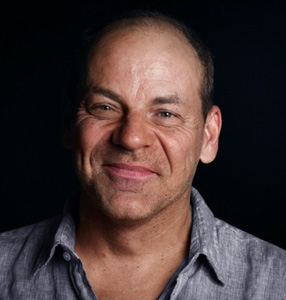

Michael John Carley is the Facilitator of the “Connections” program at New York University for their worldwide autistic students, and he also has a private, Peer Mentoring practice. In the past, he was the Founder of GRASP, a school consultant, and the author of “Asperger’s From the Inside-Out” (Penguin/Perigee 2008), “Unemployed on the Autism Spectrum,” (Jessica Kingsley Publishers 2016), “The Book of Happy, Positive, and Confident Sex for Adults on the Autism Spectrum…and Beyond!,” (Neurodiversity Press 2021, where he recently became the Editor-in-Chief), and dozens of published articles. His many other current posts include being the Neurodiversity and Leadership Advisor for the League School for Autism, and he is Core Faculty for Stony Brook University’s LEND program. For more information on Michael John or to subscribe to his free newsletter, you can go to www.michaeljohncarley.com.
Lindsay Wagner is Director of Neurodiversity and Community Inclusion at the League School for Autism.
References
Bradley, R. (2016). ‘Why single me out?’ Peer mentoring, autism, and inclusion in mainstream secondary schools. British Journal of Special Education, 43(3), 272-288. https://doi.org/10.1111/1467-8578.12136
Chandroo, R., Strnadova, I., & Cumming, T. M. (2018). A systematic review of the involvement of students with autism spectrum disorder in the transition planning process: Need for voice and empowerment. Research in developmental disabilities, 83, 8-17. https://doi.org/10.1016/j.ridd.2018.07.011
Cunningham, M. (2020). ‘This school is 100% not autistic friendly!’ Listening to the voices of primary-aged autistic children to understand what an autistic friendly primary school should be like. International Journal of Inclusive Education, 26(12), 1211–1225. https://doi.org/10.1080/13603116.2020.1789767
Duerksen, K., Besney, R., Ames, M., & McMorris, C. A. (2021). Supporting autistic adults in postsecondary settings: A systematic review of peer mentorship programs. Autism in Adulthood, 3(1), 85-99. https://doi.org/10.1089/aut.2020.0054
Hillier, A., Ryan, J., Donnelly, S.M. et al. (2019). Peer Mentoring to Prepare High School Students with Autism Spectrum Disorder for College. Adv Neurodev Disord, 3, 411–422. https://doi.org/10.1007/s41252-019-00132-y
Holmes, S. C. (2024). Inclusion, autism spectrum, students’ experiences. International Journal of Developmental Disabilities, 70(1), 59-73. https://doi.org/10.1080/20473869.2022.2056403
Horgan, F., Kenny, N., & Flynn, P. (2023). A systematic review of the experiences of autistic young people enrolled in mainstream second-level (post-primary) schools. Autism, 27(2), 526-538. https://doi.org/10.1177/13623613221105089
Ochuka, E., & Wairungu, G. M. (2024). Sensory Processing Disorder in Autism Spectrum Disorder: What Speech Therapist Should Know. European Journal of Science, Innovation and Technology, 3(6), 447-456. Retrieved from https://ejsit-journal.com/index.php/ejsit/article/view/349
Roberts, N., & Birmingham, E. (2017). Mentoring University Students with ASD: A Mentee-centered Approach. J Autism Dev Disord, 47, 1038–1050. https://doi.org/10.1007/s10803-016-2997-9
Schalock, R. L. (2000). Three decades of quality of life. Focus on autism and other developmental disabilities, 15(2), 116-127. https://doi.org/10.1177/108835760001500207
Wang, R., & Susumu, Y. (2024). Factors of bullying victimization among students on the autism spectrum: A systematic review. Review Journal of Autism and Developmental Disorders. 1-20. https://doi.org/10.1007/s40489-024-00478-7