For decades autistic people have had to listen to other people debate what supposedly made us autistic. Vaccines have probably been one of the most persistent claims, despite this question being researched repeatedly over many years. I really hope we are finally reaching a point where this conversation can be put to bed, because while people continue looking for something to blame for autism, autistic people are still living with the consequences of how those beliefs shape the way we are seen and treated.
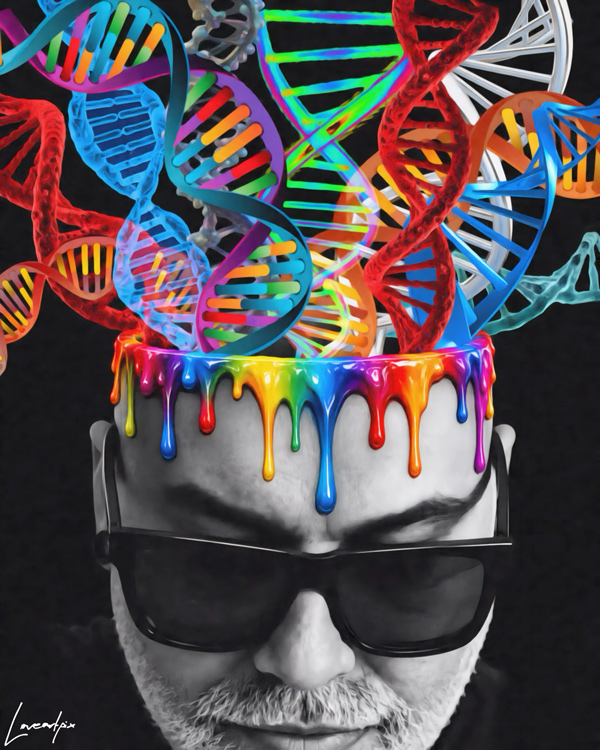
Born Autistic – Original artwork by Loveartpix
On 15 September 2026, the National Autistic Society stated definitively, following a review of 83 research papers, that autism is genetic. Their position could not really be much clearer: you are born autistic and you are autistic for life. That does not mean there is one autism gene that can simply be identified and that is the end of the story. Autism is genetically complex. Thousands of genes may contribute, different combinations will be involved for different people and, less commonly, other factors before birth can play a part alongside genetics.
This has not suddenly appeared from nowhere. The genetic evidence has been building for years. One of the largest population studies looked at more than 2 million people across five countries and estimated the heritability of autism at around 80%. Large genetic studies involving tens of thousands of autistic people have also identified contributions from inherited genetic variants alongside new genetic changes that occur during development. What has changed is how clearly this is now being said.
Autism is something we are born with. It is not something we catch, something somebody gives us, or an illness that suddenly develops because something happened after we were born. The NHS states that autistic people are born autistic and that autism is not an illness. So, when somebody starts talking about curing autism, I genuinely struggle to understand what they think they are curing. There is no scientifically established cure for autism, and no treatment has been demonstrated through robust evidence to turn an autistic person into a non-autistic person.
I have personally been told countless times that I can cure my autism. These people do not know my life or what I experience every day, yet feel comfortable telling me how to change something that is fundamentally part of who I am.
I was diagnosed autistic at 41 after spending more than two decades within the mental health system. Since then, I have researched autism, compared my experience with the research and with what other autistic people describe, spoken with specialists and families, and collaborated with universities. This is not simply an interest. This is my life.
That is why I do not see misinformation as harmless. If somebody starts from the assumption that autistic people are damaged, poisoned, or somehow need removing from their own autism, that changes the way they see us and the way they speak about us. It also affects autistic children who are listening. If a child grows up constantly hearing that autism is something terrible that happened to them, something that damaged them, or something that should be cured, what are we teaching that child to believe about themselves? Stigma, misconceptions, and poor recognition can also create barriers around adult diagnosis.
The same applies to another phrase I hear constantly: “We’re all a bit autistic.”
No, we are not.
People might recognize individual autistic traits in themselves. Somebody may dislike a particular noise, prefer routine, or become overwhelmed occasionally. That does not make them “a bit autistic.” Everyone gets breathless at some point, but we do not say everybody is a bit asthmatic. Recognizing one part of somebody else’s experience in yourself does not mean you share the neurological reality of living with autism every day.
The vaccine question itself has not been ignored by science. In September 2026, the World Health Organization published an updated systematic evidence review looking at peer-reviewed research from 2010 through August 2025. The strongest studies did not support a causal relationship between vaccines and autism, and none of the meta-analyses included in the WHO review supported one.
A major meta-analysis published in Vaccine included cohort studies involving more than 1.2 million children and additional case-control studies. It found no relationship between vaccination and autism and no association with MMR or thimerosal. A later nationwide Danish study followed more than 650,000 children and again found that MMR vaccination did not increase autism risk. More recently, data from more than 1.2 million children in Denmark found no evidence that greater exposure to aluminum through childhood vaccination increased rates of autism or the other neurodevelopmental outcomes investigated.
Of course science should be questioned. Science develops because people challenge ideas and investigate them properly. But asking questions also means being prepared to engage with the answers. If increasingly large studies across different populations keep reaching the same conclusion, and reviews across the wider evidence reach the same conclusion, continuing to repeat the original claim regardless is not the same thing as following the science.
Imagine somebody telling the parents of a child with cystic fibrosis that their child’s genetic illness had been caused by a vaccine and then claiming they knew how to cure it. Would we put that opinion alongside decades of genetic research and pretend both carried the same weight simply because everybody is entitled to an opinion? I do not think we would.
I am not comparing the genetics of cystic fibrosis directly with autism. Autism is much more genetically complex. I am questioning the completely different standard we seem willing to apply when autism is the subject.
Lived experience does not replace scientific research, but scientific research about autistic people should not make autistic people irrelevant either. For me the strongest understanding comes when research and lived experience meet.
This becomes particularly important when we start talking about environment. Changing the environment can change somebody’s experience immensely without changing who that person is. If somebody uses a wheelchair and a building is only accessible by steps, putting in a ramp can completely change that person’s ability to enter the building. Nobody then claims the ramp has cured the wheelchair user. We understand that the person has not suddenly changed. Something around them that was preventing access has changed.
Why is the same principle so difficult to understand when we talk about autism?
NICE guidance already recognizes the effect environment can have on autistic people, including adjusting lighting and noise where sensory differences create difficulty. If fluorescent lighting causes me significant sensory distress and somebody changes that lighting, my autism has not disappeared. The environment has simply stopped causing me the same level of distress.
This raises an uncomfortable question. Is it easier to put responsibility onto the person who is struggling than to look at what everybody else might need to change? Telling the autistic person to cope better leaves everything around them exactly as it was. Accepting that the environment has a part to play can mean a school has to examine what it is doing, an employer has to reconsider an expectation, or another person has to accept that something which does not affect them may affect somebody else very differently.
The same applies to diet and physical health. An autistic person can have gastrointestinal problems, restricted eating, or nutritional difficulties, and helping with those things can improve health and quality of life. That does not mean their autism has been cured. NICE advises against exclusion diets being used to treat the core features of autism. There is an enormous difference between helping somebody feel physically better and claiming that their neurodevelopment has somehow been removed.
What I hope is different now is that the evidence is becoming increasingly difficult to ignore. I hope people who have relied on outdated information take the time to educate themselves and that this clearer understanding supports positive change, because while people have spent years searching for something to blame for autism, autistic people have been here the whole time explaining what would actually make our lives easier.
I am autistic when an environment supports me and I am autistic when that same environment overwhelms me. Changing what is happening around me can completely change my experience without changing who I am.
Most of all, I hope people start listening properly to autistic people about what makes life unnecessarily difficult for us and what could actually make it better.
I do not need strangers telling me how to cure myself.
I need people to stop assuming they understand autism better than the people living it.

Loveartpix is an autistic, self-taught, multi-award-winning mixed-media artist, educator and advocate, and the founder of The Loveartpix Neurodivergent Perspective Gallery in Manchester. His practice is rooted in lived experience, education, and creating better understanding of neurodivergence. To learn more, visit www.loveartpix.co.uk, email [email protected], or find him on LinkedIn and Instagram at @Loveartpix.
Research and Evidence
Andersson NW, Bech Svalgaard I, Hoffmann SS, Hviid A. Aluminum-Adsorbed Vaccines and Chronic Diseases in Childhood: A Nationwide Cohort Study. Annals of Internal Medicine. 2025;178(10):1369-1377.
Bai D, Yip BHK, Windham GC, et al. Association of Genetic and Environmental Factors With Autism in a 5-Country Cohort. JAMA Psychiatry. 2019;76(10):1035-1043. Study population of more than two million people; estimated autism heritability approximately 80%.
Hviid A, Hansen JV, Frisch M, Melbye M. Measles, Mumps, Rubella Vaccination and Autism: A Nationwide Cohort Study. Annals of Internal Medicine. 2019;170(8):513-520.
Khudiakova V, Sin J, Suzuki M, et al. Lived Experience, Family, and Clinician Perspectives on Barriers to Adult Autism Diagnosis and Post-Diagnostic Supports: A Mixed-Methods Systematic Review. Journal of Developmental and Physical Disabilities. 2026.
National Autistic Society. Autism is genetic. Evidence review based on 83 research papers. Published 15 September 2026.
NHS. What is autism? Current guidance reviewed May 2026.
NICE. Autism spectrum disorder in adults: diagnosis and management (CG142).
Taylor LE, Swerdfeger AL, Eslick GD. Vaccines are not associated with autism: an evidence-based meta-analysis of case-control and cohort studies. Vaccine. 2014;32(29):3623-3629.
World Health Organization. Vaccines, thiomersal and autism spectrum disorder: evidence review 2010-2025. Published 3 September 2026.
Zhou X, Feliciano P, Shu C, et al. Integrating de novo and inherited variants in 42,607 autism cases identifies mutations in new moderate-risk genes. Nature Genetics. 2022;54:1305-1319.