Recreation is often seen as a luxury rather than a necessity. For autistic adults, it is essential for quality of life, mental health, and social inclusion. The Americans with Disabilities Act (ADA) ensures physical access but does not address the unique needs of autistic adults. To truly provide access, we need a new approach.
The Limits of ADA in Dealing with Autism
The ADA of 1990 was a landmark piece of legislation that fundamentally changed the field of physical accessibility in the US. From the construction of ramps and installation of lifts to the retrofitting of public buildings, the ADA has ensured greater physical access to parks, recreation centers, community facilities, and public spaces for millions of people with disabilities (U.S. Department of Justice, n.d.). While the physical access provided by the ADA is an important step forward, the needs of autistic adults go well beyond physical access. Autism is a neurological difference that affects how individuals experience and move through the physical and social world. Differences in sensory processing, communication, need for predictability, and social interaction all require a new accessibility framework.
Where ADA Falls Short in Practice
Here is how the ADA fails to meet autistic adults’ needs:
- A public park can meet the ADA’s physical accessibility standards yet be overwhelming and unusable due to loud noise, crowds, and unpredictable activities.
- A recreation program can be physically accessible but remain unusable due to social or communication barriers.
- Community facilities that meet physical access standards may still exclude autistic adults via unsuitable policies, programs, or practices.
Meeting ADA’s minimum standards does not ensure true inclusion.
Why Recreation Matters for Autistic Adults
Recreation is crucial for autistic adults’ health and quality of life but is often deprioritized.
A strong body of research confirms the benefits of recreation participation to the well-being, social skills, and quality of life of autistic adults (García-Villamisar et al., 2017, pp. 325-340).
- Participation in structured recreational programs improves executive functioning, adaptive behavior, and social outcomes for autistic adults (Garcia-Villamisar & Dattilo, 2011).
- Autistic adults who are provided with choice and autonomy in recreation programs manifest greater social and emotional recognition skills (Préfontaine et al., 2026, pp. 123-133).
- Participation in valuable recreation is a strong predictor of quality of life for autistic adults across the lifespan (Préfontaine et al., 2026, pp. 123-133).
Autistic adults participate in recreation less than non-autistic peers due to program barriers, not lack of interest (Préfontaine et al., 2026, pp. 123-133).
Barriers Beyond the Physical
To improve recreational access to autistic adults, it is important to understand not only well-known physical barriers but also the less recognized challenges they face. Here are five of the most common barriers to recreation participation faced by autistic adults:
- Sensory Barriers: The sensory demands of many recreation programs and facilities, such as bright lights, loud noises, strong smells, and crowds, can be overwhelming for autistic adults.
- Unstructured programs, unclear rules, and last-minute changes create stress and anxiety for autistic adults.
- Social Barriers: Many recreation programs, such as team sports and group fitness classes, require a level of social interaction and communication that can be uncomfortable or stressful for autistic adults.
- Attitudinal Barriers: Negative attitudes and biases among recreation staff, such as a lack of knowledge about autism and a failure to accept and accommodate autistic adults, can be a major barrier to participation.
- Economic and System-wide Barriers: Institutional obstacles, such as cost, transportation, and lack of programs specifically designed for autistic adults, can make it difficult or impossible for autistic adults to participate in recreation programs.
Advancing Recreation Accessibility
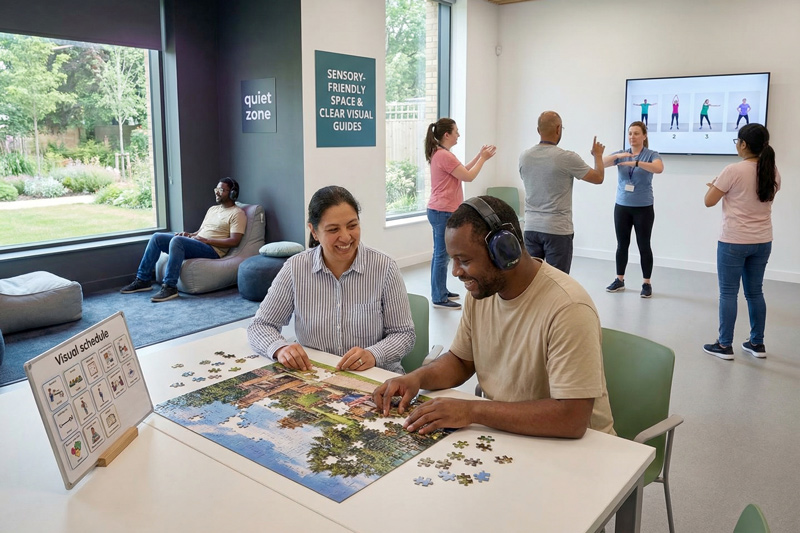
To advance access, recreation providers must go beyond ADA requirements and focus on the needs of autistic adults. Here are five core principles that provide clear recommendations for advancing recreation access to autistic adults. Each one delivers practical actions for designing and delivering accessible programs and facilities: Formed Design. Recreation facilities and programs should be designed with the sensory needs of autistic adults in mind, including the provision of quiet spaces, ear protection, sunglasses, and other sensory accommodations.
- Ensure predictable structure using visual schedules and clear, advanced communication of changes.
- Offer multiple options and respect individual preferences to foster choice and autonomy.
- Staff Training and Cultural Competency. Recreation staff should be trained in autism-related issues, including strategies for communication, inclusion, and support, to ensure programs and facilities are welcoming to autistic adults.
- Adapt recreation programs to include autistic adults, using peer support and involving them in planning and evaluation.
- Co-Design with Autistic Adults. Autistic adults should be involved as equal partners in the design and delivery of recreation programs and facilities to ensure that programs meet their specific needs and priorities.
From Compliance up to Innovation
Improving recreation access for autistic adults requires coordinated innovation and action at the program, policy, organizational, and community levels.
Policy-Level Strategies:
- Expand minimum accessibility standards to specifically include the sensory and neurocognitive needs of autistic adults, requiring these as part of policy and practice. Identify and share resources for inclusive recreation programs and facilities for autistic adults.
- Make recreation access part of standard healthcare and disability service plans.
Organizational-Level Strategies:
- Focus on including autistic adults as a core value in organizational mission statements, formal policies, and standard operating procedures. Training and development for recreation staff on autism-related issues.
- Use outcome-based evaluation to measure real access and inclusion, not just attendance numbers.
Community-Level Strategies:
- Build partnerships to increase local recreation opportunities and ensure autistic adults are included.
- Develop inclusive recreation ecosystems that address the specific needs and priorities of autistic adults.
The Future of Inclusive Recreation
The future of recreation for autistic adults is exciting and filled with rich possibilities. Here are some of the key trends and breakthroughs that will determine the future of recreation for autistic adults:
- Leveraging new technologies, such as virtual and augmented reality, to improve recreation access and inclusion for autistic adults.
- Expanding nature-based and community-integrated recreation programs, which have been shown to have numerous physical and mental health benefits for autistic adults (Picton et al., 2020).
- Prioritize meaningful interaction and inclusion in recreation over mere attendance.
Conclusion
The Americans with Disabilities Act (ADA) of 1990 was a landmark piece of legislation that fundamentally changed the field of physical accessibility in the US. While the ADA has been incredibly effective at ensuring physical accessibility, it falls short in meeting the different and complex needs of autistic adults. To improve recreation accessibility, providers must go beyond ADA standards and focus on the specific needs of autistic adults. By improving recreational accessibility, we ensure that everyone can participate in meaningful activities. Recreation is essential for connection, identity, health, and belonging for autistic adults.
Our challenge: Make recreation spaces usable, welcoming, and empowering for autistic adults.

Dr. Isaac Mawuko Adusu, DHA, MSNPM is a Policy Advocate, Assistant Vice President of Adult Services at Seven Hills Foundation, Rhode Island and an internationally recognized nonprofit leader in intellectual and developmental disabilities (IDD) and behavioral health, specializing in workforce transformation, community-based care, and organizational innovation. He can be contacted at [email protected] or [email protected].
References
Garcia-Villamisar, D., & Dattilo, J. (2011). Social and clinical effects of a leisure program on adults with autism spectrum disorder. Research in Autism Spectrum Disorders, 5(1), 246–253. https://doi.org/10.1016/j.rasd.2010.04.006
García-Villamisar, D., Dattilo, J. & Muela, C. (2017). Effects of therapeutic recreation on adults with ASD and ID: a preliminary randomized control trial. Journal of Intellectual Disability Research 61(4), pp. 325-340. https://doi.org/10.1111/jir.12320
Picton, C., Fernandez, R., Moxham, L. & Patterson, C. F. (2020). Experiences of outdoor nature-based therapeutic recreation programs for persons with a mental illness: a qualitative systematic review. JBI Evid Synth. 2020 Sep;18(9):1820-1869. https://doi.org/10.11124/JBISRIR-D-19-00263
Préfontaine, I., Normand, C., Berbari, J., Fecteau, S., Ruel, J. & Couture, M. (2026). Involvement of Autistic Adults in Recreational Activities. Journal of Autism and Developmental Disorders 56(1), pp. 123-133. https://doi.org/10.1007/s10803-024-06521-0
U.S. Department of Justice. (n.d.). Americans with disabilities act of 1990, as amended. ADA.gov. https://www.ada.gov/resources/2010-ada-standards/