What we think we know about autistic people may actually be a portrait of what happens to them.
The email came in on a Saturday morning, about forty-five minutes before I walked into a room full of clinicians to present at the biggest psychotherapy conference I’ll attend this year.
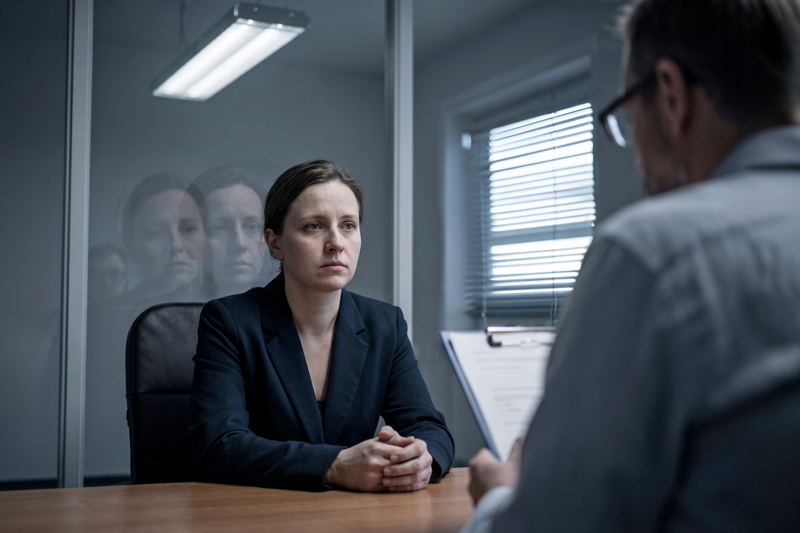
A former client, “Sarah” emails just as I open my laptop, one hour into a five-hour psychological evaluation, in a desperate attempt to get graduate school accommodations. Within thirty minutes, the evaluating psychologist had already started expressing doubt that Sarah met diagnostic criteria. The reason? She made eye contact and used “appropriate gestures while she talked.”
My former client broke down crying. She explained that both were learned behaviors, developed under years of familial and social pressure. That she is almost constantly monitoring herself for the correct type of eye contact. She explained that she is exhausted, burnt out, and constantly unable to complete simple tasks because of the energy expended socially each day. Sarah shared documentation from our work together. The evaluator apologized and said, I believe you, unfortunately, without the non-verbal piece, you just don’t meet the criteria for Autism.
She ended her message with five words: “Fighting for my autistic life here.”
I read it twice. Then I walked into the room of 400 therapists who were there to learn about the Foundations of modern autism.
“We have much to do.”
This email is not unusual. It is a description of a system doing exactly what it was built to do: look for a particular kind of autism, in a particular kind of presentation, and find reasons to doubt everything else. A high-masking autistic adult, in a formal evaluation, having to defend the authenticity of her own nervous system to someone with the clinical authority to decide whether she gets help.
This is the world my clients are living in. And it is the context for everything I’m about to say.
The Control Group We Don’t Have
Here is a fact we don’t talk about enough: there has never been a generation of autistic people who grew up fully seen, accurately diagnosed, genuinely accommodated, and believed when they described their own experience.
Not one.
The autistic adults filling our offices today grew up in a world that, at best, didn’t know what to do with them and, at worst, actively punished them for being who they were. Too much. Too sensitive. Too rigid. Too weird. They were medicated for symptoms that were adaptations. They were taught, explicitly and implicitly, that the way their nervous system worked was a problem requiring correction. They learned to mask so completely that they lost track of where the performance ended and they began. Many of them spent decades in therapy working on the wrong diagnosis with the wrong tools, accumulating what I’ve come to call provider trauma: the particular wound of having trusted helpers make things worse.
What we have no data on is what autistic people look like without all of that.
We don’t know what an untraumatized autistic nervous system presents like in adulthood, because we have never produced one at scale. Our diagnostic frameworks, our clinical observations, our entire research base: all of it is built on subjects who arrived already carrying the weight of a world that misunderstood them. We are studying the damage alongside the neurology, and we have not yet learned to tell them apart.
This isn’t a provocative framing. It’s a logical consequence of what we know about adversity, nervous system development, and the compounding effects of chronic stress. It has specific implications for how we assess, diagnose, and treat autistic clients. And it is a conversation our field needs to have.
How the Damage Accumulates
The trauma I’m describing rarely announces itself in the way that a big T, catastrophic event might in therapy. Although those happen too. It accumulates the way water shapes stone: slowly, persistently, leaving marks that eventually look like the landscape itself.
It starts early. An autistic child who doesn’t yet have language for what their nervous system is doing learns very quickly that certain responses get punished. The meltdown in the grocery store. The refusal to hug the relative they’ve just met. The shutdown in the classroom when the fluorescent lights are doing something unbearable to the inside of their skull. The adults around them, operating from a neurotypical framework and almost certainly undiagnosed themselves, do what people do: they try to correct the behavior. They push for eye contact. They demand compliance. They interpret the autistic child’s need for predictability as defiance, their sensory overwhelm as drama, their honest communication as rudeness.
The child learns. Not that anything was wrong with the adults or the environment. They learn that something is wrong with them.
By adolescence, most of my clients were already expert-level maskers. Not because they chose to hide, but because the costs of being visible had taught them to. They memorized social scripts. They suppressed the stims that brought their nervous systems regulation. They learned to perform eye contact that felt like sandpaper and call conversations engaging when they were actually running threat assessments the entire time. They developed the particular hypervigilance of someone who has been repeatedly surprised by their own failure to fit in: a constant low-level scan of every room for signs that they are about to get it wrong again.
By adulthood, they arrived in my office. Some had been in therapy before, often many times. The average autistic adult I work with has seen between one and eight providers before reaching me. My outliers have seen twelve. And in most of those prior relationships, the masking held. The provider saw anxiety, or depression, or emotional dysregulation: all real, all present, all pointing at something. But they missed the story beneath all of the symptoms and behaviors. The autistic nervous system that had been doing this exhausting work for decades, now presenting the very symptoms of that exhaustion as if they were the primary diagnosis.
The treatments prescribed rarely worked, because they were treating the adaptation rather than the origin. And when the treatment didn’t work, the implicit message (sometimes explicit) was that the patient wasn’t trying hard enough. Resistant. Difficult. Not a good candidate for this modality.
This is how provider trauma compounds the original wound. The people who were supposed to help became another source of evidence that the problem was the patient, not the framework. And unlike a single traumatic event, this one repeats. Every new provider is another opportunity to be misread, mistreated, or simply failed again. Some of my clients have stopped trying entirely. I don’t blame them.
The Lineage
One thing that shifts when you start looking at autism through a trauma-informed lens is that the story gets longer. It stops being about the individual in front of you and becomes a multigenerational narrative.
Autism is genetic. This is not contested, regardless of whatever theory has recently been offered loudly to suggest otherwise. It is one of the most robustly replicated findings in the field. Which means the autistic adult sitting across from me almost certainly grew up in a home with at least one, and often several, undiagnosed autistic people. Parents who had their own unmet sensory needs, their own communication differences, their own rigid patterns and nervous system struggles, and no language for any of it. Grandparents described as eccentric, cold, obsessive, or just “not big talkers.” A family system shaped entirely by neurodivergent brains that never got to understand themselves.
I come from exactly this family. My grandfather wasn’t cold when he spent Christmas in the basement building clocks. He was overstimulated. My grandmother wasn’t odd for breeding rare Australian dogs and spinning her own wool yarn from sheep on a backyard farm. She was doing what an autistic nervous system requires: deep, consuming engagement with a specific interest that made the world feel right. My family’s history includes people who became quietly famous for what their brains could do. It also includes people who died by suicide, because the same world that failed to see them also failed to support them.
Fame and suicide. Both present in my lineage. That range is not unusual among the families of my clients. And it tells you something important: this is not a story about pathology. It is a story about what happens when a particular kind of brain meets a world without adequate support. This brain-body combo is hardly a tragedy, but it’s clear that the absence of understanding is.
When an autistic adult gets a late diagnosis and starts looking back at their family through that lens, something often shifts. The confusing people start to make sense. The inexplicable childhood dynamics start to paint a clearer picture. And sometimes, for the first time, there is something that feels like compassion for the parents who caused harm, not because the harm wasn’t real, but because they were also unseen, also unaccommodated, also doing their best with a nervous system they didn’t have language for.
That is not the same as excusing harm. It is the beginning of understanding its origin.
The Clinical Implications
If we accept that we cannot cleanly separate autism from the trauma done to autistic people, several things follow.
Intake needs to change. Asking “when did these symptoms begin?” is less useful than asking “what was the environment in which this nervous system developed?” I need to be asking about family history, not just the diagnostic kind, but the descriptive kind. Tell me about your grandfather. Tell me about the people in your family who were always described as a little different. Tell me what it was like to be a child in your house. The autism map is drawn in families, and the trauma map often follows the same lines.
When a treatment isn’t working, “the patient is resistant” should not be the default conclusion. DBT doesn’t work for autistic burnout the way it works for other presentations, not because the patient isn’t trying, but because the underlying mechanism is different. When a client cannot identify what they were feeling before a binge, or name an emotion on demand in session, that is not avoidance. That is alexithymia: a real, physiological difficulty accessing emotional experience in real time. The feeling will arrive, often days later. Asking someone to produce it on a clinical schedule and then noting non-compliance in the chart is not treatment. It is another entry in the provider trauma file.
SSRIs have significantly lower efficacy for autistic nervous systems than for neurotypical ones. Standard mindfulness interventions can increase distress in people with alexithymia. When we prescribe treatments built on neurotypical assumptions and those treatments fail, we are not learning that the client is difficult. We are learning that the framework is wrong.
The question to hold in every session is not “what is wrong with this person?” but “what happened to this nervous system?” Those are not the same questions. The first locates the problem in the patient. The second opens up the possibility that the problem is contextual, systemic, historical, and therefore addressable in ways the first question forecloses entirely. It is also, in my experience, the question that finally makes people feel like someone in a clinical setting is actually listening. And once our clients are seen, and understood, it opens the door to the real question we should be asking in therapy, “What do your brain and body need right now to feel safe?”
That alone changes things.
The Mandate for Humility
We do not yet have a generation of autistic people who grew up fully supported and understood. The children being raised right now by parents who have their own late diagnoses, who know what they’re looking at, who are fighting for accommodations and using neurodiversity-affirming language and building homes where different nervous systems are welcomed: those kids are just now moving through childhood. We won’t know for twenty years what they look like as adults. We won’t know which parts of what we currently observe in autistic adults are intrinsic to the neurology, and which parts are scar tissue from a world that didn’t know how to hold them.
Until then, we are practicing with incomplete information.
Today, our “practice-based evidence” is largely our only “evidence based practice. We need to treat self-reported data as our primary informant for care. We must return to curiosity when the list of diagnoses doesn’t fit the whole person. We should be trusting that when a client tells us that a treatment didn’t work, they are giving us information about the treatment, not evidence of their own intractability. It means building clinical relationships in which an autistic client can actually unmask, because you will never know what you are working with if what you see is the performance they have spent a lifetime perfecting.
And it means understanding that what my former client was doing in that evaluation room, explaining her own eye contact to a clinician who was supposed to be assessing her, is not an uncommon case. This is what autistic people do to survive a system that keeps asking them to prove they are struggling in exactly the right way.
We can do better than that. Starting now.
A Different Kind of Starting Point
What I’ve been describing clinically, I have also lived. This is relevant because the argument lands deeply when someone has been on both sides of it.
I was diagnosed with anxiety, then trauma, then depression. Then a cascade of other things, each one describing something real and missing the thing underneath. I spent time in cognitive behavioral therapy, EMDR, and bounced from therapist to therapist looking for useful tools and the right person. I felt like I was not the right person. The shame of that, the sense that I was failing the treatment rather than the treatment failing me, added its own layer to what was already there.
When the framework finally shifted, when I was able to see my own neurology clearly for the first time, something happened that I don’t think has a clean clinical name. It wasn’t just relief, though there was enormous relief. It was more like recontextualization. The same history, the same memories, the same struggles, now viewed through a lens that didn’t locate the problem in me. A lens that said: your nervous system was doing exactly what it needed to do to survive the environment it was in. The survival strategies were adaptive. The exhaustion is real. The trauma is real…and it isn’t over.
That reframe is therapeutic before a single clinical intervention is applied. I have watched it happen in my office hundreds of times. Not because a diagnosis is magic, but because being seen accurately, being understood as a coherent person whose responses make sense given their history and neurology, is itself healing.
We don’t have to wait for more research to offer that. It is available right now, in any relationship where someone is finally being seen accurately.
We just have to be willing to ask different questions. To hold both things at once: the neurology and the wound, the autism and the world it met. To resist the urge to flatten a complex human story into a checklist that tells us what is wrong.
The people in our offices, and the people reading this who have spent years wondering why everything felt so hard, are not the sum of their deficits. They are autistic people who have been living in a world built for someone else, often without anyone telling them that was what they were doing.
The least we can offer is the truth about that.
It changes everything.

Kory Andreas, LCSW-C, is an autism specialist and licensed clinical social worker in private practice serving clients in Maryland, Virginia, and Massachusetts. She works exclusively with autistic adults and specializes in late diagnosis, high-masking presentations, and neurodiverse couples. She is the host of That’s Me: Autistic Lives. Unfiltered. and the creator of the Unmasked & Unplugged retreat. She is also a late-diagnosed AuDHD adult. For more information, visit koryandreas.com.