When we talk about employment outcomes for neurodivergent adults, the conversation usually centers around job training, workplace inclusion, or employer education. Those are all important. But there is a more basic issue that often gets overlooked.
Getting there.
Transportation remains one of the most practical—and persistent—barriers to independence. For many individuals, especially those who experience anxiety, executive functioning challenges, or sensory sensitivities, traditional pathways to driving simply don’t work.
Each year, a large number of neurodivergent individuals transition into adulthood in the United States, yet only a fraction find stable employment. In practice, it is often not a lack of ability that limits participation, but a lack of access—starting with mobility.
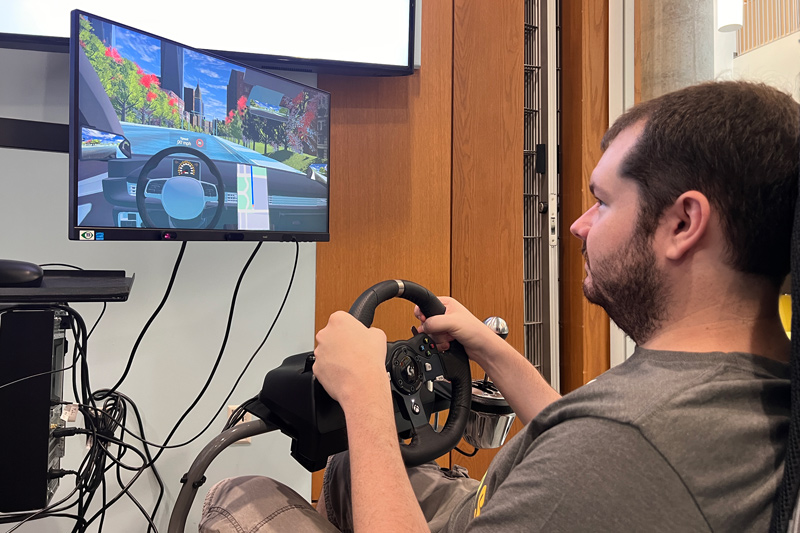
SANDI helps neurodivergent learners build confidence and decision-making skills in a safe, risk-free environment – because readiness is about more than driving; it’s about access to life.
Why Traditional Driver Education Doesn’t Fit Everyone
Learning to drive is inherently stressful. Even under typical circumstances, it requires managing multiple streams of information at once—traffic flow, signage, spatial awareness, and decision-making in real time.
For individuals who process information differently, or who experience heightened anxiety in unpredictable environments, starting directly in live traffic can be overwhelming. In many cases, it becomes a stopping point rather than a starting point.
Families and providers often find themselves in a difficult position: knowing that driving could open doors, but lacking a pathway that feels both safe and realistic.
What Changes When You Remove the Immediate Risk
One approach that has gained traction in recent years is simulation-based driver readiness.
Instead of placing someone behind the wheel in real traffic from day one, simulation allows for a different entry point. Learners can work through scenarios repeatedly, pause when needed, and build familiarity before the stakes are high.
In these environments, individuals can:
- Work on recognizing hazards without the pressure of real-world consequences
- Take more time to process decisions
- Practice situations that would be difficult—or unsafe—to recreate on the road
- Gradually build confidence in a setting that feels manageable
SANDI, a simulation platform developed through research at Vanderbilt University and supported by the Frist Center for Autism and Innovation, is one example of how this is being applied in practice.
What stands out is not just the technology itself, but how it changes the learning experience. It gives people room to learn.
The Role of Executive Functioning and Emotional Regulation
Driving is not only a mechanical skill. It is deeply tied to attention, flexibility, and emotional regulation.
That is where structured frameworks like STEER—developed through San Diego State University—become relevant. The focus is not just on “how to drive,” but on how to manage the cognitive and emotional demands that come with it.
In real-world settings, these are often the factors that determine whether someone continues or disengages. Addressing them directly, rather than indirectly, can make a meaningful difference.
Programs that combine simulation with this type of structured support tend to see learners progress in ways that are difficult to achieve through traditional instruction alone.
From Learning to Contributing
An interesting shift is starting to happen in some programs.
Rather than viewing neurodivergent individuals only as participants, there is growing interest in how they can also take on roles within these environments. In simulation-based settings, this might include supporting other learners, guiding exercises, or working as part of the instructional team.
A pilot initiative in Tennessee is currently exploring this model, bringing together service providers, researchers, and technology partners.
At its core, the idea is simple: if someone has developed familiarity and confidence within a system, that experience has value. It can be shared.
This does not replace traditional roles, but it expands the range of possibilities.
What This Means for Employment
Mobility and employment are closely linked. Without reliable transportation, job opportunities narrow quickly—regardless of skill or motivation.
By creating pathways that support driving readiness, programs are not just teaching a life skill. They are removing a structural barrier.
At the same time, introducing new roles within these programs—such as simulation-based instruction—creates additional entry points into the workforce. These roles can be adapted, structured, and supported in ways that align with individual strengths.
It is still early, and more evaluation is needed. But the direction is worth paying attention to.
Looking Ahead
There is no single solution that will address employment disparities for neurodivergent individuals. The challenge is too complex for that.
What is becoming clearer, however, is that progress often comes from rethinking the systems around the individual—not just the individual within the system.
Transportation is one of those systems.
If we want to improve participation in education, employment, and community life, mobility has to be part of the conversation. Not as an afterthought, but as a starting point.
Simulation-based driver readiness is one way of approaching that challenge. It may not be the only way, but it offers a practical example of how small shifts in approach can open up entirely different outcomes.

Jan Schlueter is Co-Founder & CEO of Neurodiverse Technologies. For more information, visit neurodiversetechnologies.com.