Why Math Instruction Matters for Students with Autism
Mathematics is often perceived as a discipline marked by abstraction and complexity, frequently associated with low academic performance among students in general. For students with Autism Spectrum Disorder (ASD), these challenges may be intensified by cognitive, linguistic, and executive-function barriers. However, difficulties in mathematics should not be interpreted as an inability to learn, but rather as an indication that instructional approaches may need to be reconsidered.
Research over the last decade has advanced our understanding of how students with ASD learn mathematics, yet important gaps remain. Fleury et al. (2014) emphasized that evidence-based mathematical interventions for students with ASD are still limited, particularly when compared to literacy-focused practices. Even so, there is strong consensus that access to meaningful mathematics instruction is essential for students with ASD, as mathematical competence is directly related to autonomy, problem-solving, and independent living skills (Bouck et al., 2021).
Executive Function and Mathematical Learning in ASD
One of the most frequently reported barriers to mathematical learning among students with ASD involves executive-function difficulties. Executive functions include working memory, inhibitory control, and cognitive flexibility, skills that are fundamental for planning, monitoring, and adapting strategies during problem-solving situations (Demetriou et al., 2018).
According to the Núcleo Ciência Pela Infância (NCPI, 2016), executive functions support conscious control over thoughts, actions, and emotions, allowing individuals to regulate behavior and make autonomous decisions. When these skills are compromised, students may struggle to retain numerical information, shift between strategies, or inhibit impulsive responses during mathematical tasks.
A recent integrative review conducted by Costa and Elias (2025), examining studies published between 2015 and 2024, identified six primary barriers to mathematical learning in children with ASD:
- Executive-function deficits, particularly in working memory;
- Intelligence quotient (IQ) as a predictor of mathematical performance;
- Language difficulties affecting comprehension of mathematical vocabulary and problem statements;
- Visuospatial processing limitations;
- Weak early number sense;
- Insufficient or poorly mediated use of concrete and virtual instructional materials.
These findings highlight the need for instructional strategies that reduce cognitive load and provide structured, meaningful support during mathematics instruction.
Making Math More Engaging: The Role of Concrete Materials
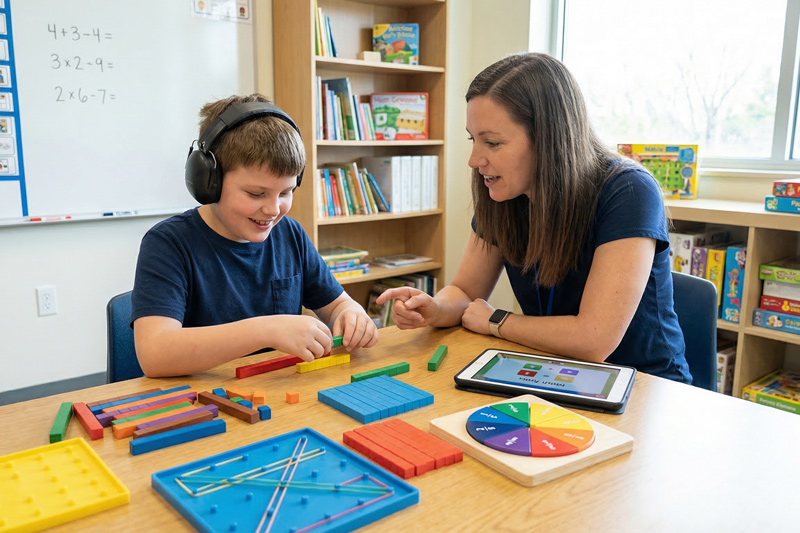
Does mathematics instruction for students with ASD need to be rigid and abstract? Evidence suggests otherwise. Concrete and hands-on materials can transform mathematical learning into a more engaging and accessible experience.
Concrete manipulatives, such as physical objects that represent numerical or geometric concepts, support conceptual understanding by making abstract ideas visible and tangible. Bouck and Long (2021) argued that these tools are especially beneficial for students with ASD, as they promote active engagement and support multiple learning modalities. Virtual manipulatives, delivered through digital platforms and applications, further expand instructional possibilities.
However, manipulatives alone are not sufficient. Hord et al. (2020) emphasized that the effectiveness of visual and concrete resources depends on intentional teacher mediation. Guided questioning, explicit instruction, and verbal scaffolding are essential to help students connect manipulatives to symbolic mathematical representations.
Evidence from Practice: The PRAHM Experience
In Brazil, a successful example of structured mathematical assessment using concrete materials is the Protocolo de Registro e Avaliação das Habilidades Matemáticas (PRAHM). Originally developed by Costa et al. (2017) for children with Down syndrome, the protocol has since been applied to 51 children and adolescents with ASD.
Across all applications, the use of concrete materials facilitated task comprehension and reduced assessment-related anxiety. Materials included cardboard tokens, two-dimensional geometric shapes, and the Monta Fácil® construction toy. These resources allowed students to demonstrate mathematical understanding in ways that were not solely dependent on verbal or symbolic processing.
Additional materials, such as adapted fraction circles, Cuisenaire rods, base-ten blocks, geoboards, and the Multiplan, have also been used successfully in teacher training programs and undergraduate coursework in Special Education at the Federal University of São Carlos. These tools illustrate how playful, hands-on approaches can coexist with rigorous mathematical instruction.
Below are two images of two concrete materials used:
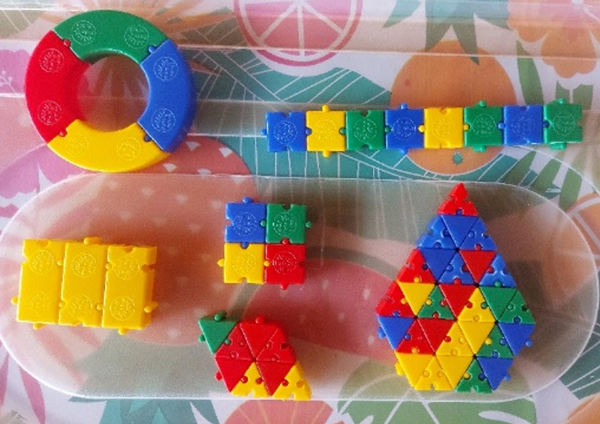
Figure 1: “Easy Assemble®” Toy
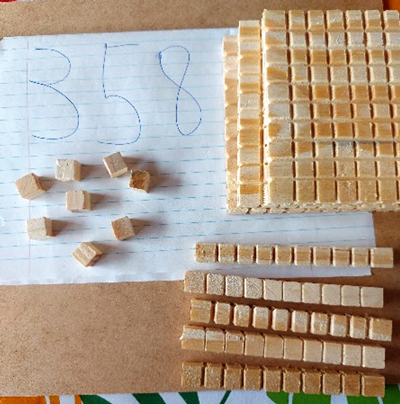
Figure 2: Base Ten Blocks
Final Considerations
Teaching mathematics to students with ASD presents complex challenges, particularly when executive-function, language, and visuospatial barriers are not adequately addressed. Nevertheless, research and practice indicate that thoughtfully selected concrete materials, combined with intentional instructional mediation, can significantly enhance engagement and learning outcomes.
Rather than simplifying mathematics, these approaches reframe it—honoring students’ cognitive profiles while preserving conceptual depth. In doing so, mathematics becomes not only more accessible, but also more meaningful for learners on the autism spectrum.


Ailton Barcelos da Costa, PhD, is Postdoctoral in the Department of Psychology at The Federal University of São Carlos, Brazil. He has autism, ADHD, and giftedness, conducts research on teaching and assessing mathematics for people with visual impairments and people with autism. He can be reached at [email protected], +55 16 3351-8357.
Nassim C. Elias, PhD, is Professor in the Department of Psychology at The Federal University of São Carlos, Brazil, who conducts research on autism and behavior analysis-related topics. He can be reached by email at [email protected], +55 16 3351-8357.
References
Bouck, Emily C.; Root, Jenny R.; Jimenez, Bree A. (Ed.). Mathematics education and students with autism, intellectual disability, and other developmental disabilities. Council of Exceptional Children/Division on Autism and Developmental Disabilities (DADD), 2021.
Costa, A. B. & Elias, N. C. (2025). Barreiras para a aprendizagem de habilidades matemáticas para crianças com autismo [Barriers to learning math skills for children with autism]. In Anais of 11º Congresso Brasileiro de Educação Especial (pp. 1-13). Even 3 Publishing.
Costa, A. B. D., Picharillo, A. D. M., & Elias, N. C. (2017). Avaliação de habilidades matemáticas em crianças com síndrome de Down e com desenvolvimento típico [Assessment of mathematical skills in children with Down syndrome and typically developing children]. Ciência & Educação (Bauru), 23, 255-272.
Demetriou, E. A., Lampit, A., Quintana, D. S., Naismith, S. L., Song, Y. J., Pye, J. E., … et Guastella, A. J. (2018). Autism spectrum disorders: a meta-analysis of executive function. Molecular psychiatry, 23(5), 1198-1204.
Fleury, V. P., Hedges, S., Hume, K., Browder, D. M., Thompson, J. L., Fallin, K., … & Vaughn, S. (2014). Addressing the academic needs of adolescents with autism spectrum disorder in secondary education. Remedial and Special Education, 35(2), 68-79.
Hord, C., DeJarnette, A. F., McMillan, L. A., & Baldrick, P. (2020). A student with mild intellectual disability and two‐step equations. Support for Learning, 35(4), 506-521.
Núcleo Ciência Pela Infância – NCPI (2016). Funções executivas e desenvolvimento na primeira infância: habilidades necessárias para a autonomia [Executive functions and development in early childhood: skills necessary for autonomy.]. Estudo 3. Fundação Maria Cecília Souto Vidigal.