A key component of a high quality of life is the ability to clearly communicate one’s needs and desires with others. Effective communication allows individuals to advocate for themselves, make choices within their environment, and express their thoughts and feelings. For autistic individuals, however, communication can present significant challenges. Approximately 25–30% of autistic children are non-speaking or minimally verbal (Guerrera et al., 2025). For individuals with more complex communication needs, augmentative and alternative communication (AAC) systems provide a powerful pathway for interacting with others. AAC includes both low-tech and high-tech options, with speech-generating devices (SGDs) becoming increasingly popular. These devices produce spoken output when a user selects pictures, combines icons, or types words and sentences. Because SGDs generate clear verbal speech, they can be easily understood by others, supporting communication across a variety of environments and situations.
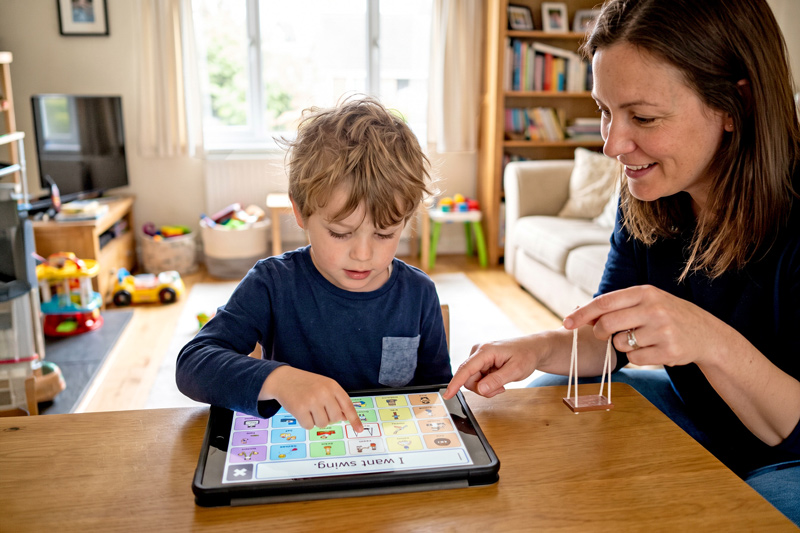
While these systems can provide great promise for enhancing communication, SGDs do not always meet the needs of their users. Too often, families are left to problem-solve often complicated systems that may not be functional for their environments, leading to frustration and missed opportunities. For SGDs to be effective, comprehensive supports must be in place to guide both the individual and their family in learning how to use the system. These supports should be thoughtfully implemented and regularly evaluated to ensure they are meeting the user’s needs. The following section outlines core components of effective communication plans that promote the development of meaningful, functional communication.
Identify Critical Skills to Teach
Before starting teaching, time should be devoted to developing a strong understanding of the individual’s preferences to build an enriching environment. Teaching communication needs to be structured around the individual’s motivation. This may include conducting preference assessments, through formal evaluations or informal observation. Preference assessments can be done by observing how the individual likes to spend their time, what activities hold their attention, and their level of happiness when engaging with different people and activities. These highly preferred items, people, and activities can serve as initial communication targets. Teaching within these contexts helps the individual learn that using their communication system results in access to meaningful and desired interactions.
Equally important to teaching individuals how to ask for things they want is teaching them to say they don’t want something. This includes communicating “no” and related phrases, such as “I want to do something else.” The ability to say no is essential for making one’s needs known and is a critical safety skill.
Arrange the Environment to Support Communication
The individual’s environment should be intentionally designed to encourage communication. This includes incorporating highly preferred items, activities, and social interactions throughout the day. For example, desired items might be visible but slightly out of reach, creating natural opportunities for the individual to initiate communication. Providing a variety of different activities also supports communication across different people and settings. Many autistic individuals have strong preferences for sensory experiences—such as swinging, spinning, deep pressure, visually stimulating materials, or favorite sounds. These experiences can create dynamic and motivating opportunities for communication.
Communication systems must be consistently accessible throughout the entire day and across all environments. We would never limit when or where a speaking individual can communicate; the same expectation should apply to individuals who use speech-generating devices (SGDs). SGDs should travel with the individual wherever they go, including school, home, and community settings.
Teach Others to Support Communication
Communication skills should be taught using systematic, individualized teaching plans. These plans should include clear instructions on how to follow the individual’s motivation and use evidence-based strategies such as modeling and prompting. Adult prompts should be quickly and carefully faded to prevent over-reliance on adult support. When communication instruction primarily occurs in school settings, it is essential that caregivers are also trained to use the same strategies at home. This training should include how to encourage communication and use effective prompts. Consistency across environments ensures that communication remains meaningful and functional.
Adults in the individual’s environment need to be taught to honor communication attempts, especially when skills are newly emerging. Honoring responses teaches the individual that their communication matters. As an individual becomes more proficient with their SGD, teachers and families can gradually build in delays and teach tolerance for situations when preferred activities aren’t immediately available.
Set Goals and Measure Progress
The ultimate goal of any AAC system is that the individual uses it spontaneously when they have the desire to communicate. Individualized Education Plans (IEP) and treatment plan goals should reflect this aim with measurable goals that include independent and spontaneous communication responses. Data collected to measure teaching progress should include tracking how the individual engages in spontaneous requests and initiations with the SGD.
Data should be reviewed regularly to determine whether teaching strategies are effective or if adjustments are needed. The following may indicate limited progress and the need to modify instruction:
- The individual always waits for adults to prompt or cue the use of the SGD
- The individual indicates that they do not want to use the SGD, such as pushing it away or leaving activities when it is present.
- The individual only uses their SGD in some environments and not others
- The individual struggles to navigate multiple screens or icons on their system
- The individual only uses their SGD for a limited number of responses
Ongoing collaboration among the individual’s team, including teachers, related service providers, and caregivers, is essential for addressing these challenges. Involving team members across settings supports shared problem-solving, allows for the identification of successful strategies, and encourages creative solutions. This collaborative approach helps build on progress and supports continued growth and expansion of the individual’s communication skills.
A checklist: Teaching meaningful communication with a speech-generating device
- Teach meaningful requests – people, items, activities that are highly preferred
- Teach saying “no” or other refusal response
- Arrange the environment to encourage communication
- Develop systematic teaching plans with clear cues and plans to fade prompts
- Teach all adults how to prompt and respond to communication across environments
- Write goals for spontaneous communication
- Ensure that SGD is available in all settings
- Collect data on communication responses in multiple environments
- Meet as a team at least monthly to review data, discuss progress, and make changes to the plan as needed

Megan Robinson Joy, PhD, BCBA, is a licensed psychologist and National Director of Autism Services at Devereux. With over 25 years of experience supporting autistic individuals across home, school, and community settings, she specializes in teaching critical, meaningful skills across the lifespan using evidence-based, person-centered approaches. Dr. Joy leads national initiatives in clinical program development, staff training, and systems implementation, with a focus on delivering high-quality, compassionate care. She regularly presents on topics including functional communication, positive behavior supports, and effective intervention practices.