A career on Broadway isn’t the only way to incorporate a love for theatre into a job. Direct Support Professionals (DSPs) often find meaningful ways to include the arts and performance into their work every day. Shayna Stroh, a DSP at Family Residences and Essential Enterprises (FREE), who has been in the role for eight years, uses her college degree in theatre to help bring a creative outlet to people with developmental disabilities—teaching dance classes and theatre.
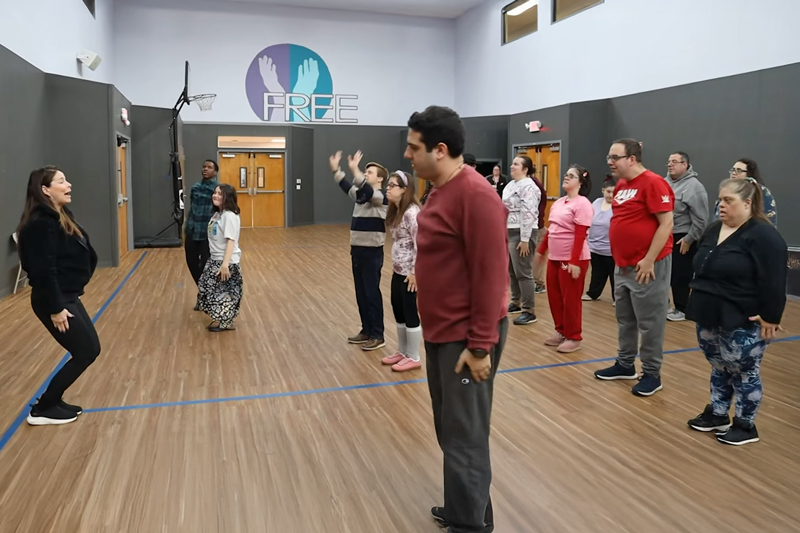
Theatre program at Family Residences and Essential Enterprises (FREE) in Old Bethpage, NY.
“I think working in the performing arts, we get to see that tangible progress every single show that we do,” Shayna shares in her interview for the #MoreThanWork campaign.
“The participants’ confidence grows with each rehearsal, and each time that they walk onto that stage and hear that applause, there’s nothing like that feeling.”
Shayna’s approach to teaching the arts is by meeting participants where they are. Many of the people she works with may be afraid to get on stage, but that doesn’t stop her from getting them involved. Instead, she finds ways to help them participate by maybe joining the stage crew or acting in videos. In this way, the people she works with can have positive experiences with the performing arts in a low-stress environment, while giving them exposure to new skills and activities.

The Arts as a Tool for Empowerment
Social interaction is a key factor influencing quality of life. Participation in theatre and other performing arts programs creates powerful opportunities for connection and personal growth. Studies exploring inclusive arts programming have found that exposure to the performing arts can help people with disabilities develop important life skills, strengthen their sense of identity, and build meaningful relationships with others (Le Roux et al., 2021).
Family members of those involved in inclusive theatre programs have also observed noticeable changes, including increased confidence, stronger self-advocacy skills, and a greater sense of belonging within a community (Saar et al., 2025).
Theatre is uniquely suited to this kind of engagement because it relies on teamwork. It’s a collaborative process that allows people to practice communication, problem-solving, and social interaction in a supportive setting. Over time, these experiences can translate into improved communication skills and greater confidence in navigating social situations.

DSP Shayna Stroh with a participant for the #MoreThanWork campaign
Turning Passion into Purpose
For Shayna, the connection between theatre and direct support work feels natural. “Being able to use theatre in this role has been incredible,” she says. “It’s not just about the performance—it’s about watching people discover what they’re capable of.”
The most meaningful part of the job for many DSPs is finding creative ways to help people live fuller, more connected lives. That’s where passions outside of traditional caregiving can become powerful tools. Having a background in healthcare, education, or even the arts and music can add something unique to the lives of the people DSPs support.
That spirit of creativity and connection is at the heart of #MoreThanWork, a campaign highlighting the meaningful and often unexpected ways direct support professionals make a difference every day.
That passion is what makes others shine.
References
Le Roux, M., Kathard, H., & Lorenzo, T. (2021). Creating inclusive performing arts practices for development of youth with disabilities: A critical ethnographic study. African Journal of Disability, 10, a753. https://pmc.ncbi.nlm.nih.gov/articles/PMC8252130/
Saar, K. W., et al. (2025). Sharing the stage: Inclusion theater programming, social participation, and quality of life. Research in Developmental Disabilities. https://www.sciencedirect.com/science/article/abs/pii/S0891422225000666