
A Few Truths
The world is often set up in ways that are highly unreliable and unpredictable for autistic people. This sets the stage for frequent dysregulation, disengagement, and disability, all of which can be even more extreme for non-speaking autistic individuals. The frequent bias towards being overwhelmed can be, in part, mitigated with support coming from trusted partners. Trusted partners provide supports to increase predictability in day-to-day activities and interactions as well as provide authentic and useful supports for their neurologically based differences. This type of support facilitates engagement, and it increases confidence and competence for all people, regardless of neurotype. Activities and environments in many domains are often inherently set up to support participation for most individuals. When quality support is present for a non-speaking autistic individual, stress is minimized, and they, too, are more available for learning and interacting in these same environments and activities.
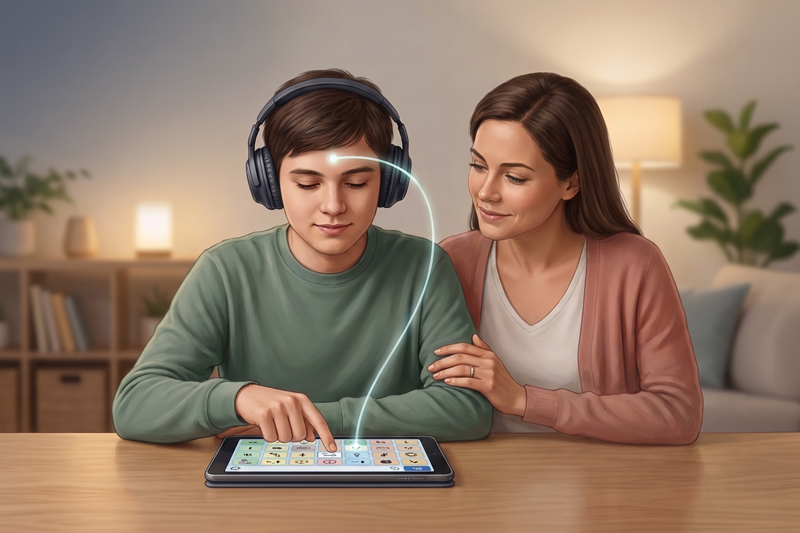
The Relationship between Communication and Regulation
Communication is a complex developmental capacity that includes an individual’s abilities to initiate, respond to, and maintain interactions. It is the foundation of participation in shared experiences, which supports the development of meaningful relationships with others. It is important to note that a person’s communication abilities are influenced by their regulatory profile. When any person experiences dysregulation, their access to language processing and formulation is adversely affected. Indeed, individuals of all neurotypes can likely recall difficulty expressing themselves when faced with a stressful situation. Lack of access to authentic means of communication that others respect and respond to also causes dysregulation. Jordyn Zimmerman, a non-speaking education advocate’s statement captures this experience. “I was in a perpetual state of being frustrated as not only did I have a huge human need to be with other people, but worse — because I could not effectively communicate with speech, there were many assumptions made regarding what I needed” (Jordyn Zimmerman, May 19, 2023).
Emotional regulation is the capacity to adjust one’s emotional and physiological arousal states (or energy level) to meet the demands of one’s social and physical environment, and it develops across the lifespan. When emotional regulation is effective and successful, individuals shift arousal states to match the environment in a way that supports maintaining engagement (e.g., biobehavioral states consistent with higher energy to play versus lower energy to sleep). This match between internal state and environmental characteristics is often referred to as a well-regulated state. When a person is not able to shift energy or emotion to meet environmental demands, they may experience arousal that is too high or low to engage successfully. This is often referred to as dysregulation. Danny Whitty, a non-speaking disability advocate, described his frequent experiences of dysregulation. “I am full of energy that I can’t manage. There is a lot of anger and anxiety and fear. The energy overwhelms me. This is something I might spend the rest of my life trying to deal with. That is daunting” (Danny with Words, November 15, 2025).
Considerations for Easing Dysregulation and Supporting Communication for Autistic, Non-speaking Individuals
A multitude of factors are linked to an individual’s ability to attain and maintain a regulated state. These include a person’s physiology, interoception, sensory, motor, cognitive, social, and communication profiles. Each of these may present as risk or protective factors for regulation. This is true for all people, and individuals who are autistic often present with extreme profiles that differ from the anticipated norm within these domains, which could relate to a heightened risk for dysregulation. For each of the profile factors listed previously, the literature provides evidence of significant neurobiological and/or biopsychosocial differences for autistic people. For example, interoceptive differences are well documented among autistic people, which influence their ability to register and interpret internal sensory experiences (e.g., hunger, thirst, pain, etc.) (Williams et al., 2023). Kim Clairy, an Autistic Occupational Therapist, discusses the impact of interoceptive differences on regulation, communication, and interactions. She states, “Am I hot, hungry, overwhelmed? What is my body telling me?… You can’t advocate for yourself if you don’t know what you need nor when you need it” (Kim Clairy, February 14, 2025).
It is also well established that many autistic individuals experience sensory processing differences (heightened or lowered sensitivity thresholds). Research on sensory processing also tells us that sensory overwhelm predicts social communication difficulties. When the sensory environment is overwhelming to a person, they may become dysregulated and their nervous system will attempt to prioritize regulation over social engagement. Niko Boskovic (March 13, 2024) discusses the impact of sensory processing differences on his regulation and ability to interact with others. “As an autistic person, I have a deep relationship with my environment. What I mean is since I was a baby, I have been attuned to all the sensory stimulation coming at me. Sounds, smells, bright lights, heavy blankets… all sorts of experiences that my infant, then later toddler, brain couldn’t process. It was very chaotic, and I turned inward by focusing my senses on only a few safe activities.” Perhaps most pertinent to the issue at hand, in the domains of social, communication, and cognition, autistic adults report a preference for utilizing written communication to interact with others, noting that they find it to be less stressful than engaging in spoken conversation, as well as supportive of their ability to process information and formulate ideas (Turna et al., 2025; Howard & Sedgewick, 2021).
All regulation factors and support needs described thus far are relevant to non-speakers, but they often report two additional profile factors as key levers influencing their ability to regulate, engage, and communicate: motor and social. Motor differences for non-speakers are often categorized as apraxia, or diminished abilities to ideate, initiate, and execute purposeful movements in a coordinated manner at will. Research findings suggest that a high percentage of autistic individuals experience apraxia and that apraxia impacts motor skill beyond speech production (Damiao et al., 2026). Danny Whitty highlights the very real impact of motor coordination difficulties on his ability to communicate. “…I can’t control my body! I am stuck in apraxia. I need support to communicate in a reliable way” (Danny with Words, November 17, 2025).
In terms of the social, many non-speakers discuss the importance of having a trusted, responsive person who knows and respects them and who knows their full profile. For example, if a young adult who is a non-speaker uses an augmentative and alternative communication (AAC) system to express themselves and interact with others, is in a supportive environment with known partners and with access to their AAC, their difference is minimized, as is their disability. However, if that same young person is in an environment where they do not have access to their effective communication system and/or others are not consistently responsive to the person’s communicative bids using their AAC, the individual is likely to experience severely disabling conditions that impact their ability to interact and engage.
Understanding autistic communication preferences and individual profiles is crucial to providing supports and to the development of trusting and supportive relationships, a key factor influencing regulation. Trusting relationships are the foundation for engagement for everyone, including autistic individuals. In essence, a trusted, supportive partner who truly knows, respects, and responds to a non-speaker’s profile, inclusive of but not limited to communication, can help to mitigate many other regulatory risk factors that often interfere with engagement. They can help to mitigate interoception, physiological, sensory, social, communicative, cognitive, and motor differences by offering accommodation and providing support. Elizabeth Bonker, a non-speaking communication rights advocate, offers “NON-SPEAKERS HAVE WHOLE BODY APRAXIA, A MOTOR DISORDER.” Communication partners help non-speakers overcome their apraxia “WITH THEIR CALM PRESENCE” (Communication 4 ALL, June 12, 2026). These sentiments are echoed by a growing number of non-speaking individuals who have found that communication methods such as spelling with a responsive partner can help to overcome regulation challenges and support communication development and vice versa.
Just as it is for all of us, we cannot forget that we only communicate when it is meaningful and worthwhile to us. Hari Srinivasan, a non-speaking neuroscience PhD candidate, summarizes some of the challenges of communication for non-speakers as “every message already takes attention, motor planning, and time,” so arbitrary demands for interaction, often a key aspect of unnecessarily attempting to validate some forms of AAC, are sure to be highly dysregulating (Communication First, May 25, 2026).


Amy C. Laurent, PhD, OTR/L, and Jacquelyn H. Fede, PhD, are Co-Directors of Autism Level UP! For more information, visit www.autismlevelup.com.


This article reflects the approach of believing everything one reads. Cases such as Elizabeth Bonker actually spelling out complex prose have not been objectively verified. Anyone who has that kind of sophisticated narrative inside their head would not behave the way she did when she was on a stage with her mother. She was handed a spelling card by the host, and she reached for it, but then her mother intercepted and grabbed it away, because she didn’t want (obviously!) the ruse to be busted. These nonspeakers who supposedly spell out such eloquent, advanced narrative never seem to have even the simplest of part-time jobs that don’t require talking. Hmmm. Wonder why that is. Because that narrative IS NOT THEIRS. It’s the “communication partner’s.” These nonspeakers have an intellectual disability that prevents employment.
There are tons of stories online about autistic people and their competitive employment. Not a single one of them is nonspeaking. NOT ONE. Why? Because nonspeaking autism (for reasons neuroscientists can’t yet explain) co-occurs with significant intellectual impairment. I’m sick of this spelling-card pseudoscience making yet another round online. It’s facilitated communication all over again, except rebranded, repackaged and with slight procedural differences.
I’ve viewed video of spellers in action, in slow motion, over and over, and have yet to see anything coherent actually spelled out. It’s gibberish. It would be so simple to verify they’re actually spelling, but their CRP’s always refuse a test. Wonder why. The cadence of the tapping to the card never matches what the CRP “translates.” How does this get past highly educated people? Have the authors of this article, and editors, not viewed the video clips?
They poke at the same spots on the board, yet it gets translated to master’s thesis level composition, yet these individuals have never had so much as a part-time job sacking groceries? Apraxia my foot. They seem to have no difficulty manipulating a tablet to view Thomas the Tank Engine.