April traditionally brings showers, but in my world, it brings Autism Awareness Month – or is it Autism Acceptance Month, or is it Autism Action Month? It seems the verbiage changes from year to year. Awareness is good, acceptance is great, but action is the key to inclusion. For me, April means a flood of attention, love, and sometimes overwhelming feelings. I don’t know whether to run and hide or let myself stand out.
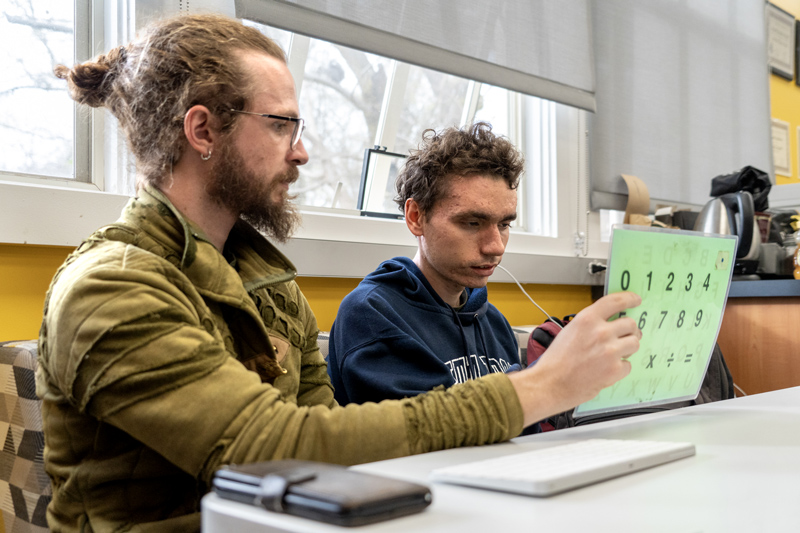
Noah McSweeney selects letters to ask a question of a guest speaker with the help of his communication partner Buckminster Barrett during an Oak Leaf class March 4, 2025. Photo credit: Ziggy Leon Carrillo
This April, I want to take some action to include those who communicate differently.
There are many ways humans communicate. A lot can be said without words; power exists in a glance or gesture. Although words are not always necessary, most people possess the ability to speak when and how they want. However, millions of individuals with disabilities that affect speech must endure a life without spoken words. Believing that someone is unintelligent because they can’t speak is hurtful and often just plain wrong.
Autistic people who lack speech or reliable speech may use alternative ways to communicate. This is also true of others with conditions like Down syndrome, cerebral palsy, or other unnamed developmental disabilities. Even stroke survivors may need speaking accommodations.
There is, however, a way to be heard even if you don’t speak.
Augmentative alternative communication (AAC) gives those of us otherwise trapped in silence a voice for all to hear. I use a low-tech version of AAC called a letterboard, a laminated piece of cardboard with the alphabet printed in rows. Sometimes I use a high-tech version of AAC, with a keyboard connected to an iPad and voice output. It all depends on my level of fatigue and sensory overload.
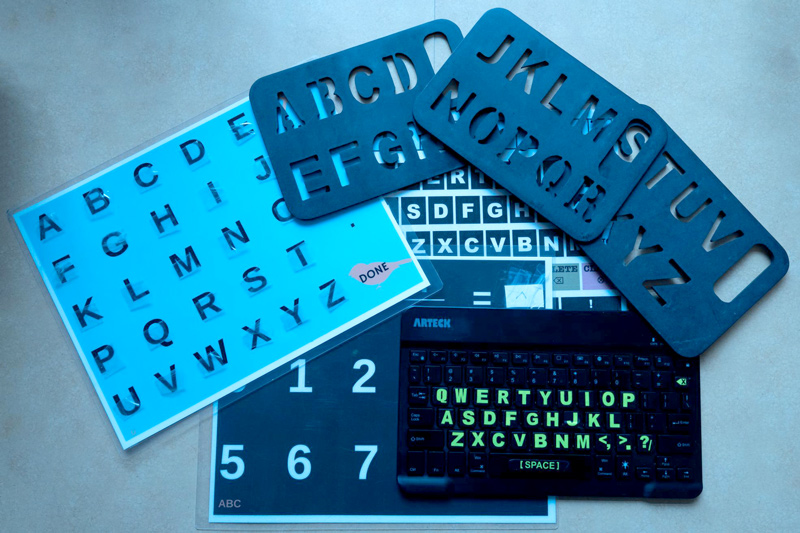
Santa Rosa Junior College student, Noah McSweeney, uses a letterboard to communicate by pointing and spelling out his thoughts and dialogue. April 2025. Photo Credit: Adair Alvarez Rodriguez
People often hesitate to engage nonspeakers in conversation. This may be because they’re unsure how. Even though AAC users vary widely in diagnosis, the opportunity to share insight presents itself this Autism Action Month. Please educate yourself on how to interact with nonspeaking AAC users with the below tips.
Tips for Connecting with AAC Users
- Talk to us and know we understand you. This presumes competence. We may not show that we are listening in traditional ways, but we hear you. We might look away to hear you better. Personally, my eyes and ears don’t work at the same time; it’s just the way my sensory system operates.
- Be prepared to wait for our responses; they will take time. Most AAC users struggle to coordinate their eyes and hands. The pace of spoken conversation is quick. Although we take things in, responding in real-time requires that we use our AAC. This may mean spelling thoughts out one letter at a time, pointing, or typing. Without adequate wait time, our thoughts miss a timely window to enter the conversation. A change to new topics renders our contributions irrelevant. This is hurtful and discourages AAC users from engaging in social situations.
- Speak directly to us. Say our name. Look at us, not our communication partner. We may not look at you. In addition to the communication tools we rely on, many of us need a trained partner (communication/regulation partner or CRP) to support our access. I feel invisible and unworthy when someone speaks to my CRP instead of me.
- Wait for us to finish spelling our thought before speaking; it helps the AAC user focus. Concentration to select the correct letter is even more challenging when someone is watching. Don’t ask another question before we’ve had time to answer the first one.
- Please don’t finish a word or sentence for us; it might not be at all what we intended to say. For example, if I spell M-A-N, the word might continue to become M-A-N-A-G-E, M-A-N-I-F-E-S-T, M-A-N-Y, M-A-N-N-E-R-S, or M-A-N-I-A-C.
- Even though I might have a communication partner, the words I type are mine. Believe that.
- Be attentive while the AAC user is communicating. Don’t play on your phone or talk to others. Instead, show respect and interest.
- Try to keep the conversation going, even if the AAC user doesn’t answer in the moment. It may be because they can’t. There’s no problem in comprehension. They are following the conversation; it’s just that the output takes extra time.
I hope the next time you meet an AAC user, you include them in your conversations with a new understanding. The interaction may surprise you. There is endless benefit to humanity in bringing AAC users out of the shadow of doubt. Talking can no longer be our only means of connection.
Take a risk to engage a nonspeaker in lively conversation and you might make a new friend.

Noah McSweeney is a Nonspeaking Autistic Self-Advocate, College Student, Poet, and Award-Winning Student Journalist. For more information, visit linktr.ee/noahpoet , email [email protected], and check out Noah’s Instagram page and public Facebook page.
This article has been republished with permission. View the original source here.