“Sit still, focus, pay attention.” We hear these familiar reminders at home, in the classroom, during homework, and even at social gatherings. But does a child really need to sit still to learn? Could making room for movement help?
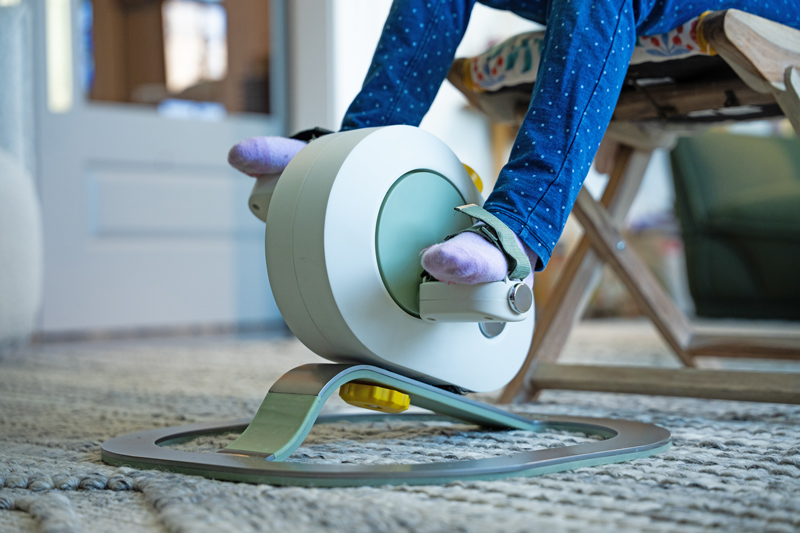
Tovie is a compact floor cycle designed to provide proprioceptive input through movement, helping children support self-regulation during learning and play.
For parents and educators supporting autistic and other neurodivergent children, these questions become increasingly important. We want children to feel comfortable, participate in lessons, and show us what they know. Research on autistic children suggests that physical activity may support some learning skills. Understanding these findings can help us consider how movement might fit into a child’s day and support learning and participation.
Finding the right movement for a child means considering a child’s needs, interests, and everyday routines. Tools like Tovie, a floor cycle that can fit under a desk or table, can help families and educators make room for pedaling during everyday activities.
What Does the Research Tell Us?
Researchers have explored how physical activity may affect self-regulation, executive functioning (thinking skills), and classroom participation. Examining these skills can help us understand how movement supports a child’s readiness to participate in learning. Some studies examine movement before learning, while others explore movement during cognitive tasks. Together, research on aerobic exercise, cycling, sensory-motor activities, and movement-based video games offers promising insights into how different movement experiences may support different skills.
In one study, first published online in 2023 in Autism, researchers examined cycling and self-regulation in 64 autistic children. Researchers randomly assigned children to one of three activities: learning to ride a bicycle, stationary cycling, or walking. Children who learned to ride a bicycle improved their thinking skills, including cognitive flexibility and inhibition. “The learning to ride a bicycle group and the stationary cycling group also significantly enhanced their self-regulation.”1
These terms connect to everyday experiences. Self-regulation involves managing thoughts, feelings, and actions. Cognitive flexibility helps us adjust when rules or plans change, such as switching from drawing to a math activity. Inhibition helps us pause or manage a response, such as waiting for instructions before starting a game. Overall, these findings suggest that cycling may support self-regulation and thinking skills that help children learn and participate in everyday activities. With tools like Tovie, pedaling can be offered as a movement choice before a learning activity or alongside a task, depending on the child’s preferences and comfort.
Where Does Body Awareness Fit In?
Movement also gives kids information about their bodies. Proprioception helps us sense body position and movement, while the vestibular system helps us sense head movement and balance. A small, randomized study involving 22 autistic children examined vestibular and proprioceptive exercises alongside therapy. The researchers reported that “vestibular and proprioceptive training significantly reduced hyperactivity and impulsivity while improving sensory processing and modulation.”2 Researchers also reported that “there were improvements in behavior and emotional responses.”2
Observing how a child responds to movement can guide activity choices and support comfort and participation at home and at school.
How Does Movement Connect to Learning?
Other research has examined how autistic children performed during classroom activities. In a 2011 study, researchers compared children’s responses to classroom tasks with and without 15 minutes of aerobic exercise beforehand, such as running or jogging. The authors concluded “that aerobic exercise prior to classroom activities may improve academic responding in young children with autism spectrum disorder.”3 These findings remind us to consider what children understand and accomplish alongside how attentive they appear.
Researchers have also explored movement during thinking tasks. A study involving 18 adolescents with ADHD explored pedaling during working-memory (WM) tasks. Working memory refers to the ability to hold information in mind while using it, such as remembering a teacher’s instructions while completing a classroom activity. Although performance did not differ significantly between cycling and sitting still, the researchers reported that “exploratory analyses suggested that cycling during more difficult trials (i.e., high WM demands) is beneficial for WM performance.”4 These early findings suggest that pedaling may help during more challenging thinking tasks, although further research is needed to understand whether similar benefits occur in autistic children specifically.
What About Interactive Movement?
Interactive activities offer another way to combine physical movement with cognitive demands. One study also explored movement through virtual reality (VR) exercise and its effect on executive functions (EFs) and emotional regulation (ER). Researchers randomly assigned 40 autistic boys ages 7–10 to a VR exercise intervention group or a sedentary, inactive video game group. Children in the exercise group performed better on thinking-skill assessments and showed improvements in emotional regulation as reported by their parents. The researchers noted that “VR exercises can serve as a preliminary trial to enhance EFs and ER in children with autism.”5
Interactive movement offers a way to practice thinking skills through play. Depending on the activity, children may move while remembering rules, making choices, or adjusting their responses.
What Can Parents & Educators Take Away?
Research suggests that movement can support self-regulation, thinking skills, and classroom responses in autistic and neurodivergent children. The activity, the demands, and the child’s individual needs all deserve careful consideration. From a pediatric occupational therapist’s perspective, I encourage families and educators to start with activities the child enjoys and feels comfortable doing. Offer movement opportunities and choices, ask questions, and notice what happens before, during, and after the task. Does the child begin more comfortably, share their ideas, or need less support? Observe across several occasions, since sleep, task difficulty, and the environment can also influence participation.
Regulation does not always mean being quiet or sitting still. The goal is to help children feel ready and supported to participate. Instead of focusing only on stillness, we can ask: What helps this child engage and show what they know?
Making room for movement starts with finding options that fit a child’s interests and everyday routines. Tovie, a floor cycle, offers several seated pedaling modes: Pedal-to-Play for interactive gameplay, Quiet mode for other activities, and Pedal-to-Watch mode. These choices give families ways to explore movement while keeping their child’s comfort, preferences, and participation at the center.
Learn more about Tovie and its Kickstarter campaign: Tovie Kickstarter

Kirti Gandhi, OTD, OTR/L, is a registered and licensed pediatric occupational therapist at Tovie. She can be reached at [email protected].
References
- Tse, A. C., Liu, V. H., Lee, P. H., Anderson, D. I., & Lakes, K. D. (2024). The relationships among executive functions, self-regulation, and physical exercise in children with autism spectrum disorder. Autism, 28(2), 327–341. https://doi.org/10.1177/13623613231168944
- Eri̇k, E., Safran, E. E., & Sevgin, O. (2025). Effectiveness of vestibular and proprioceptive exercises in reducing hyperactivity in children with autism spectrum disorder: A randomized controlled trial. Research in Autism, 123, 202543. https://doi.org/10.1016/j.reia.2025.202543
- Oriel, K. N., George, C. L., Peckus, R., & Semon, A. (2011). The effects of aerobic exercise on academic engagement in young children with autism spectrum disorder. Pediatric physical therapy: the official publication of the Section on Pediatrics of the American Physical Therapy Association, 23(2), 187–193. https://doi.org/10.1097/PEP.0b013e318218f149
- Ruiter, M., Gorlich, E., Loyens, S., Wong, J., & Paas, F. (2022). Effects of desk-bike cycling on phonological working memory performance in adolescents with attention deficit hyperactivity disorder. Frontiers in Education, 7. https://doi.org/10.3389/feduc.2022.841576
- Sepehri Bonab, H., Ebrahimi Sani, S., & Behzadnia, B. (2025). The impact of virtual reality intervention on emotion regulation and executive functions in autistic children. Games for Health Journal, 14(2), 146–158. https://doi.org/10.1089/g4h.2023.0240