After 32 years as the Director of Family Support Services at Citizen Options Unlimited, Savita Sharma still begins a countdown to the organization’s Camp Loyaltown in Hunter, NY each January.
“Parents tell me: ‘Bags are packed, it’s only January. [Our child] knows camp is coming,’” she said.
Across the country, sleepaway camps dedicated to autistic campers of all ages provide personalized support to those whose needs cannot be met by a traditional camp setting. A study from the Children and Youth Services Review found that a majority of campers progressively improved their social skills each summer across ages and support needs.
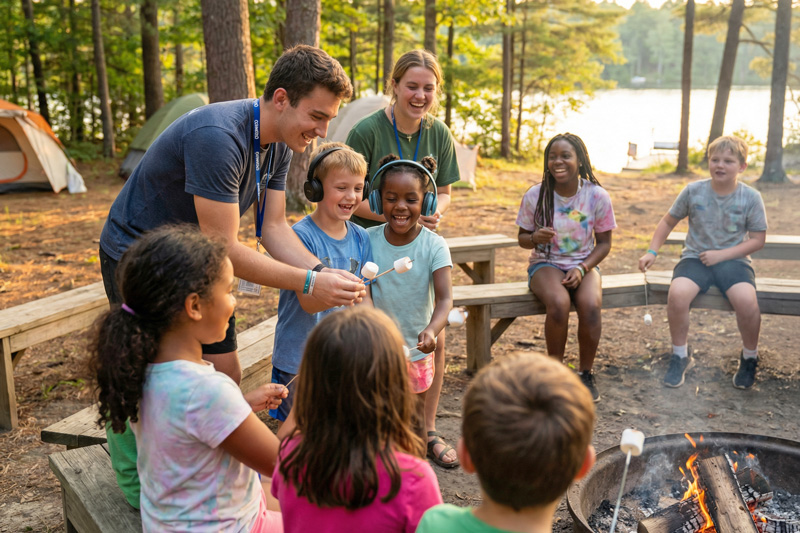
Camp Loyaltown, which has served both youth and adults with high support needs for over 50 years, offers two-week sessions of recreational activities and skill-building with a staff ratio averaging one counselor for every one to three campers. Beyond your typical swimming pool and arts and crafts center, the camp also provides access to resources such as designated quiet spaces and iPads connected to the camp’s wifi to cater to individual needs.
“There’s no other place like it in the world,” Sharma said. “It really is Disneyland. If someone’s transitioning into camp, they come up and see Camp Loyaltown. And then they get this feeling, and then they say, yes, my child would want to come here.”
Sharma, who started a program to sponsor cultural visas for staff from over 45 countries, said the benefits of camp are also worthwhile for their hundreds of counselors and administrators.
“[Camp is] the first time that a person, including myself when I did this, really learns to understand a person that you would do anything [for them],” she said. “I know it’s successful because we had somebody who was a staff member when he was 18 years old and he started a company in his home country for people with developmental disabilities. He takes them abroad, he takes them to recreation, and he wants to bring them to America.”
In the Green Mountains of Vermont is Camp Akeela, a three-week-long experience specifically tailored to autistic individuals who are able to attend a typical camp but struggle to foster deeper social connections with their peers.
Founded in 2008 amidst the emergence of Asperger’s syndrome as a diagnosis in the U.S., Camp Director Debbie Sasson and her husband Eric sought to create a space like traditional camp with added “social scaffolding” and support.
Camp Akeela also offers what they call “social coaching” rather than utilizing a particular social skills curriculum. Sasson said their approach allows campers to learn organically in an environment that doesn’t feel like a classroom.
“We’re using the camp day,” she said. “We are using the opportunities that come up when you have to live together in a community 24/7.”
Sasson noted one family, who was initially anxious to send their daughter to the camp.
“[Their daughter] was anxious her first summer. She didn’t really believe she would meet other kids who loved Dungeons and Dragons as much as her and was hesitant to expose herself socially. Her mom now tells me her daughter can’t wait to go back and describes camp to other people as the place where she feels really seen.”
For Sasson’s campers, Camp Akeela is an opportunity to safely and comfortably break out of their comfort zones, even in seemingly small ways.
“I have talked to so many parents who start off by telling me that they’re really unsure that their child will be able to eat chicken nuggets that aren’t in a particular shape,” she said. “Camp can be an amazing tool to help push them to do things that they may be uncomfortable with.”
Though these camps cater to vastly different individuals across the autism spectrum, they both share the same goal: to foster community, connection, and joy for campers in a space that families can trust.
“I think the best gift a parent can give their child is an opportunity to grow independently,” Sasson said. “That’s hard for parents to recognize, but I think kids are really capable of more than we give them credit for.”
In the welcoming spirit of camp, Sharma enthusiastically added:
“Come visit whenever you want.”
Emily Blumberg is a writer, producer, and educator based in Washington D.C. For more information, visit www.emilyrblumberg.com. She can be reached at [email protected].