Despite the fact that I managed to successfully earn my PhD while also managing to earn multiple awards as both a researcher and an author, I still find it mind-boggling when I’m given a puzzled look when I state that I am a Neurodiverse learner. Yet, whenever I say I grew up receiving special education services or spent most of my life navigating learning challenges, I always get the same questionable stare that holds a combination of both pity and surprise. The thing is, I don’t understand how we are in the year 2025 and not making stronger efforts to eliminate the negative stigma that comes with “special ed” or “learning disabled” and replace these terms with more accurate, uplifting labels…that title being: Neurodiverse.
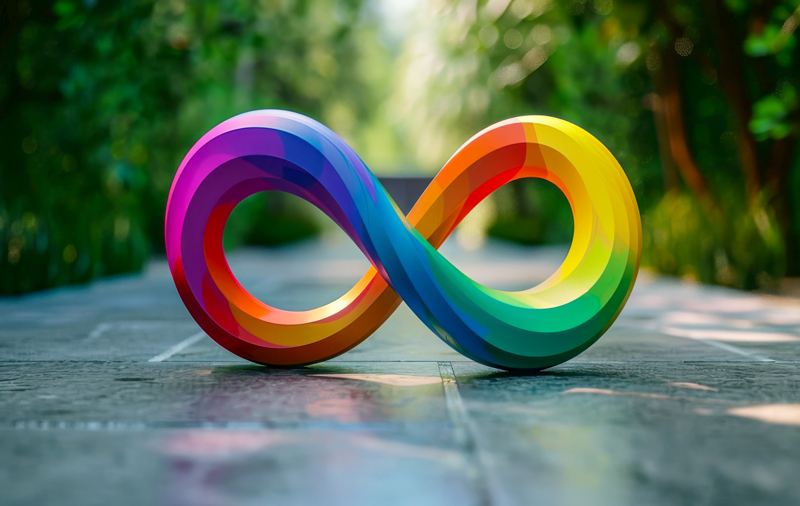
So, I know what you’re thinking: what does Neurodiverse really mean, and even more so, why should we start using that fancy terminology? What most people don’t realize is the advantages that come with having a Neurodiverse learning style and how it can serve as a positive in so many aspects of everyday life rather than taking on a glass-half-empty approach in categorizing someone as “learning disabled” or “special ed.” or even worse, “sped.” Before I share all of the lovely superpowers that come with being a neurodiverse learner, let’s talk about what it actually means to be neurodiverse.
The term neurodiversity originated in 1998 from Australian sociologist Judy Singer, who first developed this title as a way to recognize that everyone’s brain develops in a unique way (Cleveland Clinic, 2022), recognizing that neurodiversity encompasses the natural variations in how individuals think, interact with, and perceive the world around them (Camden et al., 2024). There are various diagnoses that fall under the neurodiversity umbrella that include but are limited to the following: autism spectrum disorder (ASD), Attention-Deficit Hyperactivity Disorder (ADHD), dyslexia, dyscalculia, and Tourette syndrome (Le Cunff et al., 2024). In other words, the term neurodiversity implies that your brain develops differently rather than defectively, recognizing its wonderful abilities that differentiate it from those who are neurotypical. According to author Jurgens (2020), the term “neurotypical” pertains to those of standard neurodevelopment, whereas those who are “neurodiverse” or “neurodivergent” pertain to those whose brain functions differ from what society considers to be standard. Now I know what your next question is: what is so special about being neurodiverse?
There is literally research that has shown that those who are neurodiverse have advantageous skills that are extremely helpful in the workforce that are not possessed as often among those who are neurotypical. For example, those who are diagnosed with ASD possess strengths in working with systems (e.g., computer languages, mathematical systems, machines), and when participating in a research study, those with ASD demonstrated stronger capabilities in identifying tiny details in complex patterns compared to neurotypical individuals (Armstrong, 2015). This is why those who have ASD thrive being employed in technology companies that require systemizing tasks such as writing computer manuals, managing databases, and searching for bugs in computer code (Armstrong, 2015). Another study that compared entrepreneurs with ADHD to entrepreneurs without ADHD found that those with ADHD had more intuitive cognitive styles, higher levels of entrepreneurial alertness, resource-induced coping heuristics, and demonstrated supernormal levels of focus/energy, all of which are very constructive for the workforce (Moore et al., 2016). Additionally, those with dyslexia are stronger in processing/mentally picturing 3D objects compared to those who are neurotypical, making them much faster at identifying optical illusions, demonstrating their neutral talent for jobs such as graphic design, arts, and engineering (Cleveland Clinic, 2022). What is the common factor among all of these findings? The talents and gifts are found among those who have a Neurodiverse learning style. This is why it is so important that we as a society start adapting the glass-half-full perspective that comes with implementing the term Neurodiversity and start to let go of the antiquated, limiting concept of categorizing these diagnoses as being “learning disabled” or “sped.”
In taking this matter a step further, research has shown words and language related to neurodiversity make a difference in how people live because those who are neurodivergent learn that it means their brains are different, not defective, and as a result, they are more likely to be happier, aim higher in their careers, as well as achieve more success in their line of work (Cleveland Clinic, 2022). At the risk of being vulnerable, I have had a neurodiverse diagnosis since I was two and a half years old. Despite having a very supportive family, many friends, experiencing multiple romantic relationships, and having an extremely active social life, I spent the majority of my life struggling with my self-esteem, often believing that I was not smart enough according to societal “norms” due to our one-size-fits-all education system. It was not until approximately five years ago, shortly after earning my master’s degree, that I discovered the term neurodiversity. The term neurodiversity completely shifted my perspective on recognizing my capabilities within my inattentive ADHD diagnosis rather than my inabilities, all of which resulted in my self-identification as a neurodiverse learner. I did my own personal research and realized the wonderful qualities that come with being neurodiverse, whether it be creativity, hyperfocus, collaborative learning practices, exceptional intuitive skills, or lateral processing capabilities that allowed me to think “outside-of-the-box.” Once I shifted my perspective to realize that my brain works differently rather than defectively, I learned how to lean into my talents, and suddenly, the glass was half full! I can tell you first-hand as someone who just earned their doctorate at the tender age of 28 while wearing many hats as an author, researcher, educator, and professional speaker, I am very proud to say I am a neurodiverse learner. I can only hope that through sharing my personal story, conducting/disclosing progressive research, and spreading awareness, our society can become more fluent in utilizing the term neurodiverse while simultaneously dropping the limiting ideology behind the term “learning disabled” or “sped.” Lastly, as someone who loves fashion, let me also be the first to tell you that neurodiversity is the new trend…I’m living proof that having a neurodiverse brain that works differently, NOT defectively, is chic!

Dr. Claudia Rose Addeo, PhD, was the recipient of the 2024 “John Beach Award for Outstanding Achievement” in the PhD Literacy Program at St. John’s University! Dr. Addeo currently works as an award-winning writer, K-8 learning specialist, neurodiverse advocate, educational speaker, and children’s book author. Having earned a master’s degree in literacy education, Claudia writes and speaks about her personal journey, sharing additional information through her social media platforms. You can follow her on Instagram @claudia.addeo, Facebook: Claudia Rose Addeo, LinkedIn: Dr. Claudia Rose Addeo, or go to her website for additional contact information at www.claudiaaddeo.com.
References
Armstrong, T. (2015). MEDICINE AND SOCIETY. The Myth of the Normal Brain: Embracing Neurodiversity. AMA Journal of Ethics, 17(4): 348-352. AMA J Ethics. 2015;17(4):348-352. doi: 10.1001/journalofethics.2015.17.4.msoc1-1504.
Camden, W. L., Allen, K. S., Specht, M. L., Bennett, M. W., Badr, K. H., Mottram, C. L., & Gutierrez, S. L. (2024). Cognitive ability: A promising option for assessing neurodiverse talent. Consulting Psychology Journal, 76(1), 20–41. https://doi.org/10.1037/cpb0000271
Cleveland Clinic (2022, June 2). Neurodivergent. My.Clevelandclinic.org. Retrieved May 28, 2025, from https://my.clevelandclinic.org/health/symptoms/23154-neurodivergent
Jurgens, A. (2020). Neurodiversity in a neurotypical world: an enactive framework for investigating autism and social institutions. In Neurodiversity Studies (pp. 73-88). Routledge
Le Cunff, A.-L., Giampietro, V., & Dommett, E. (2024). Neurodiversity positively predicts perceived extraneous load in online learning: A quantitative research study. Education Sciences, 14(5), 516. https://doi.org/10.3390/educsci14050516
Moore, C. B., McIntyre, N. H., & Lanivich, S. E. (2021). ADHD-related neurodiversity and the entrepreneurial mindset. Entrepreneurship Theory and Practice, 45(1), 64–91. https://doi.org/10.1177/1042258719890986