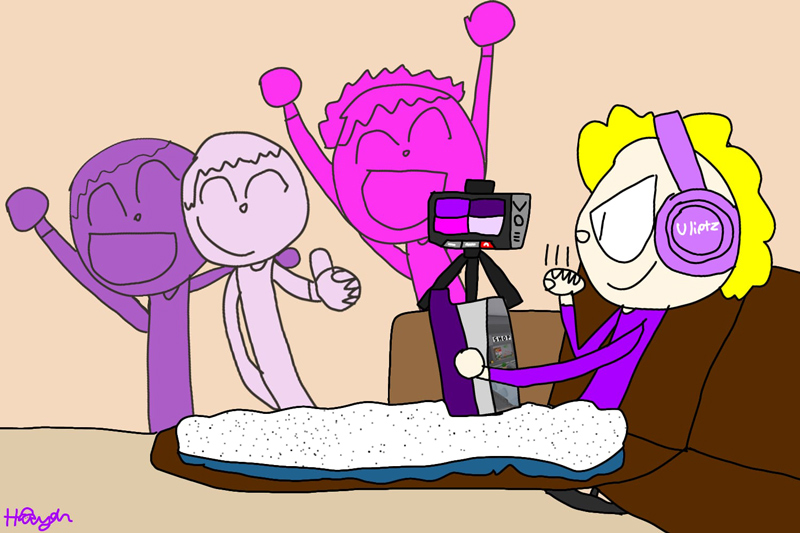
It’s a Thursday evening. I am just about to dish out dinner when my son Haydn runs into the kitchen with a massive grin on his teenage face whilst doing a happy autistic dance. He yells (I wince as my own autistic hearing struggles when he is so excited), “Oh my God, T, A, C and L (names changed to protect identity) are all on my Minecraft server at the same time!” Cut to him shoveling down his usual beige-food dinner whilst he watches the team chat, eager to engage. Sitting next to him, I hear him bark out orders to his “team-mates”, patiently reprimand one friend who defaced another friend’s base (with my regular request for him to reduce his voice volume as he is unaware of its increase when he talks online), and regularly he will ask them “are you ok, am I being ok, am I being a good friend?”. This made me realize that he and his fellow male autistic (some AUHD) peers were learning life skills here that they fail to in mainstream classrooms due specifically to allistic students and a lack of trained classroom support. For me, this is the major positive of online recreation. My teenage autistic son has a social life that I as a female autistic child of the 80’s failed to experience. He is safe in my home after a draining day socializing with both autistic and allistic people at school, and he can exit the interaction at any time when he crashes. But I know my opinions are not widely shared.
Online gaming is not a form of socialization many parents, and society, approve of. When parents were asked for their thoughts concerning gaming and their 13-15 year olds in 2024, 41% said they were worried about “(T)he content of the games they are playing, in terms of violence, bad language, disturbing content, etc.”, 44% mentioned “(T)he pressure to make in-game purchases, for things like access to upgrades, skins, loot-boxes, in-game currency or other rewards.” 48% were aware of “(T)he possibility of them being bullied by other players, and “(T)he possibility of them talking to strangers while gaming, whether within the game or via the chat function” was the worry of 62% of surveyed parents (Statista.com, 2024). The surveys do not specify if the 13–15-year-old child is autistic or not, but it is well known that autistic teenagers can be far more susceptible to scams, to trusting new online “friends” without meeting them IRL (in real life), and to misinterpret other player’s responses.
Returning to my son and his friends, I can categorically say that there is a fair share of bad language and discussions centered around toilet jokes and meme references (stereotypical boys humor). My son attends school with four of the team-mates, and the youngest one he met at a local LGBTQ club. They play on a private server that my son set up which can only be accessed by the players he invites (so no stranger danger here), and he talks to them all on Discord or WhatsApp video chat whilst playing. Rather than being a dictator, my son has given admin rights to everyone to promote equality. This can backfire when one player falls out with another, and naturally the bad language can escalate. This is when I must step in and advise my son to shut the game down for an hour to allow all members to cool down. Most times I have witnessed the group working out their differences verbally and calling out any bullying quickly, but I have also seen members rage-quit and go AFK (away from keyboard) all evening. This again requires me to step in, supporting Haydn as he works through the paranoia, anger and tears that come with any teenage fallout. 1 hour later and they were all singing a bad version of Baby Shark!
This article is not a sales pitch for Minecraft. They also play various games on Roblox where the temptation to make impulse purchases is ever-present, and my son is subjected to global strangers in the chat part of every game. My son can only spend his pocket money on his debit card; all other payment methods have been blocked or have password alerts linked to my account. When he is alone in a game, only members of Haydn’s age group can talk to him due to Roblox’s new age verification system (photo verification required otherwise the chat option is disabled): “(S)tarting in January 2026, Roblox requires age checks for users to access Communication features. To use Communication features like Experience chat, Voice chat, and Party chat, all users must successfully complete an age check. Once users complete an age check, they will be able to chat with global users in similar age groups” (How to Chat on Roblox, 2026). When inevitably a player speaks inappropriately, one quick click can have the player reported and swiftly banned for 3 days by the AI admin built into every Roblox server. But the main solution my son uses is to set up a private server in his chosen Roblox game for he and his friends to access and play privately; something he learnt how to do via YouTube.
The main tips I would give to all parents/carers of autistic gamers are:
- You need to be present and paying attention when they are gaming online. Sit within earshot / sightline of your child when they are gaming some of the time. This can help you understand the games they play, meet their friends, hear the language they use, and observe the social and cognitive skills they are developing in this virtual environment.
- Be ready to step in when talk becomes too adult or argumentative and take time to sit with your child whilst they process their emotions following a falling out.
- Agree ground rules BEFORE gaming starts, such as language expectations and time limits (and warn your child before their time limit is up).
- Take a real interest in your child’s online gaming. Ask questions and follow up ones if they do open up in any form of communication.
- Take time to learn technical speak. I have included a few well-used gaming terms in this article but do take some time to update your vocabulary so you can understand what you hear / read when your child is gaming.
- Set up password protections on payment methods to prevent unauthorized in-game payments.
- Read up on the security settings the online gaming platforms offer to protect your child from strangers.
- Ensure your child knows how to report someone to admin for inappropriate behavior (first explaining what such behavior can look like).
- Explore how to set up private servers for your child to play safely on their own, with permitted friends, or even with you!
Online gaming is no longer something parents should fear. When set up correctly, it can give your autistic teens a safe space to socialize with their peers in the safety of their own home. It is an ever-changing form of recreation that requires the parent/carer to do their own research, that they develop and maintain an open dialogue with their child, and ensure they are ever-present to support and guide their autistic gamer. Who knows, your child might make a gamer out of you!

Emma Sharrocks, BA, MA, PGCE, is a formally diagnosed autistic woman, Parent to a 13-year-old Autistic Boy, full-time Applied Psychology degree student, and former Further Education teacher. She can be reached at [email protected].
References
How to Chat on Roblox. (2026). Roblox Support. https://en.help.roblox.com/hc/en-us/articles/43611824582292-How-to-Chat-on-Roblox
UK parents children gaming concerns by age 2024| Statista. (2024). Statista. https://www.statista.com/statistics/274469/parents-concerned-about-gaming-content-in-the-uk-by-childs-age/?srsltid=AfmBOop0pok00lZsNPO4chhLe3enNsqZB0sl7fAbDXsnmq2CKU4pnf00