Family travel is stressful. Full stop. Especially when your family has distinct needs planning and preparation can be overwhelming…like trying to update your phone while your storage is full, the Wi-Fi is unstable, and three apps are frozen at once. Chunking the aspects of travel and identifying specific challenge areas can be a valuable first step in the preparation process; for example, travel to the airport, through the airport, on the plane, and through the destination airport. As a parent in a neurodiverse family, I’ve learned that breaking things into chunks helps me spot potential error codes before our family operating system goes full blue screen. Pop up before continuing nothing here is foolproof, and there’s always a side quest, the device that won’t connect to Wi-Fi, the charging cord that won’t work, the missing headphones that “feel just right,” something is going to happen. Regardless, having a strategy helps me enjoy travel more and maintain a positive mindset.
Video Self-Modeling
Video modeling is an evidence-based practice featuring a video of a targeted behavior or skill (Cox & AFIRM Team, 2025) watched in anticipation of the task or skill completion. Specifically, video self-modeling includes the individual themselves completing the task or skill successfully (Wert & Neisworth, 2003). Video self-modeling has been demonstrated as more effective than even peer video modeling (Marcus & Wilder, 2009). Think of it like future-you coaching current-you with video evidence supporting your own potential.
Viral Video Self-Modeling
In the viral shorts era, asking an individual to watch a bland self-video model is like trying to sell a 4-minute instructional video to a brain accustomed to 17-second fireworks. Enter: viral video self-modeling. A viral video self-modeling segment can be developed with epic transitions, engaging sound effects, and catchy images, maintaining that 15-30 second timeframe. For example, imagine an individual has a sensory challenge with a specific aspect of the travel journey… let’s say, the seatbelt. This self-starring hype video can be filmed in an engaging way and watched leading up to the sensory challenge. This reinforcement can build confidence and reduce anxiety associated with the experience. Watching this video filmed in the somewhat chaotic, but familiar, backseat of the family minivan can be built into a travel routine and can help generalize the behavior across novel situations.
Close Distance Communication
New travel environments are very stimulating: lots of visuals, smells, and sounds. Leading with curiosity can sometimes create safety concerns in these settings. For young travelers without personal technology, providing simple two-way communication might be helpful. Our family found that using a Bluetooth-based item tracking tool was a first-class upgrade for stress reduction. One of the essential features for our success was a “locate my phone” feature from the device. We used this button to “Call mom” throughout our travels. I was also able to tap “find device” on the app and the device would ring. We reinforced, “Find your family” when it rings. Playing this game in everyday settings provided a motivating back-up plan in case of separation. This solution is not all encompassing; the tracking can be unreliable and is limited by range. Still that additional interactive reassurance acted like a software update for our collective nervous system.
Game-Based Grounding Strategies
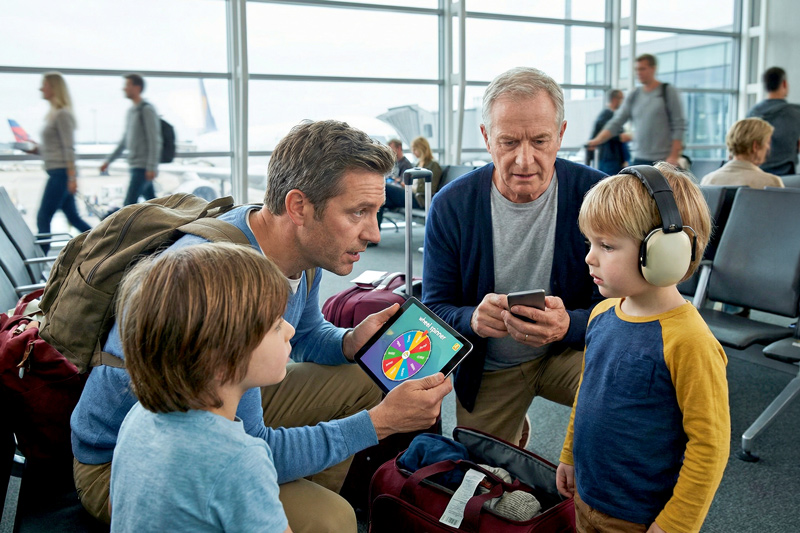
We’ve made it through the airport; we have our seat belt on and now the take-off anxiety is in full gear. Rather than listing grounding strategies that are dismissed as quickly as an ad is skilled, try a different presentation. Swipe from the viral video self-model to the wheel spinner. This classic tool is available through a variety of apps or websites, providing options for grounding strategies within the wheel picker. This format can reduce caregiver prompting pressure. I like that the wheel can be easily accessed, pre-programmed, and modeled by a caregiver exactly when it’s needed most.
Final Destination Approaching
Just like having options within your travel itinerary, having quick access to technology resources to support the travel process is like packing snacks, you may not need them every minute, but when you do, you really do. Exploring these supports in everyday environments allows for adjustments and early introduction, so when the environment shifts, the support already feels safe and predictable. Curiosity and anxiety regarding travel is expected, but normalizing planning for supports as intentionally as we plan for logistics can create space for smoother transitions and softer landings.

Lauren Tucker, EdD, is Associate Professor at Southern Connecticut State University. For more information, email [email protected].
References
Cox, A., & AFIRM Team. (2025). Video Modeling, Updated. The University of North Carolina at Chapel Hill, Frank Porter Graham Child Development Institute, Autism Focused Intervention Resources and Modules. https://afirm.fpg.unc.edu
Marcus, A. and Wilder, D. (2009). A comparison of peer video modeling and self-video modeling to teach textual responses in children with autism. Journal of Applied Behavior Analysis, 42(2), 335-341. https://doi.org/10.1901/jaba.2009.42-335
Tsui, G. and Rutherford, M. (2014). Video self-modeling is an effective intervention for an adult with autism. Case Reports in Neurological Medicine, 2014, 1-6. https://doi.org/10.1155/2014/425897
Wert, B. Y., & Neisworth, J. T. (2003). Effects of video self-modeling on spontaneous requesting in children with autism. Journal of positive behavior interventions, 5(1), 30-34.