For around 30% of people with autism spectrum disorder (ASD), verbal speech is limited, unreliable, or unavailable (Jaswal et al., 2026). Autistic people who are nonspeaking use a variety of augmentative and alternative communication (AAC) to communicate; this includes picture-based systems, high-tech image-based systems on tablets, typing on keyboards, or using letterboards with communication partners (ASAN, 2026).
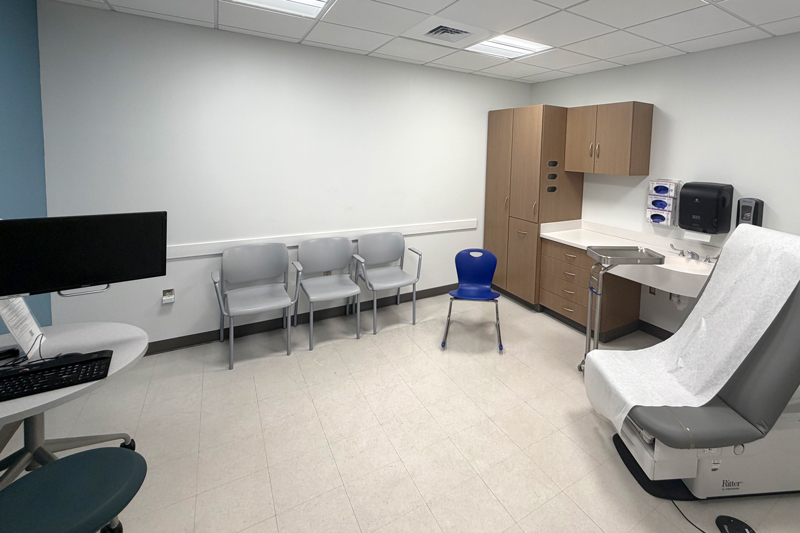
An exam room at the Jefferson FAB Center for Complex Care. The room is large, with additional seating options for patients or supporters, a height-adjustable exam chair, and dimmable lights.
Many primary care providers have received little to no specialized training in supporting the care of patients with autism, with common barriers to providing quality care cited as lack of confidence in managing behavior, lack of time, lack of resources about autism, and lack of prior training in autism (Mazurek et al., 2020). Without training and opportunities to learn from autistic advocates, providers are less prepared to support the needs and communication styles of nonspeaking autistic adults. As a result, people with IDD/A are less likely to receive all recommended preventative screenings in adulthood, which can result in higher rates of certain cancers and other health conditions being diagnosed in later stages of disease (Javaid, Nakata, & Michael, 2019).
There can be many challenges for an autistic person to participate in their medical visit and receive quality care. Fear and anxiety, need for additional processing time, sensory sensitivities, and difficulty communicating effectively with providers were identified as primary barriers by autistic individuals (Raymaker et al., 2017).
Autistic advocates are the best teachers to ensure medical providers can provide quality care following the principle “nothing about us without us.” Creating a supportive healthcare environment can support positive outcomes for autistic people.
Recommendations from a Nonspeaking Self-Advocate
Consider these recommendations from a nonspeaking self-advocate and responses from a physician on how to best support and implement these recommendations in the medical office.
- We hear and understand everything that is shared with us.
When healthcare professionals enter a room for a patient visit, the default should be to presume competence and to presume strong receptive language even when patients are nonspeakers. All conversations should be directed to the patient first, not to their caregivers or support persons.
- Speak with us like we are adults.
Providers should always use age-appropriate and respectful language when communicating with patients. Using infantilizing language is both disrespectful to the patient and creates distrust in the relationship.
- Some of us are unreliable speakers. A spoken response of “yes” may not mean consent.
Consent should always be verified by other communication methods (e.g. AAC devices), and often questions may need to be phrased in other ways to confirm understanding. In these situations, it may be helpful to have input from caregivers or other support persons to determine the best ways that a patient receives and communicates information.
- Allow us time to spell and type.
Time constraints are one of the biggest challenges in healthcare settings, but it is critical to allow time for processing and responding. This ensures that patients are heard and helps to avoid missed portions of the medical history that could lead to misdiagnosis or erroneous treatments.
- Schedule more time for our appointments.
In practice, this may mean blocking extra time for visits, scheduling short-interval follow-up visits, or prioritizing the few most important issues during a visit. While this can be challenging from a scheduling perspective, it can greatly improve the quality of care for nonspeakers.
- Use patient portals. They give us time to gather our thoughts in advance and to communicate in between appointments.
Patient portals are a great accessible communication tool that allow providers to send advance notice of topics that may be covered in an upcoming visit. Patients can even send thoughts ahead of time for providers to review, which will help make the visit more efficient.
- Our bodies do not always do what our brains want.
This highlights a common bias in healthcare where clinicians may incorrectly assume that physical disabilities imply co-occurring intellectual disabilities. Patients with apraxia have difficulty carrying out purposeful movement despite having the ability and desire.
- Visuals are helpful.
Incorporating visual aids, such as models, social stories, or symptom scales can be beneficial for enhancing comprehension and accurate communication. They can be important tools for improving patient education and increasing comfort with portions of visits that may be anxiety-provoking.
- Provide all the facts.
Patients deserve to know all of the information about their health so that they can make informed decisions. Providers should not withhold any information based solely on assumptions about a patient’s level of understanding. It is also crucial that information is presented in an accessible format for patients to understand and process at their own pace.
- Be aware that we may feel anxious about being there. Be kind and understanding.
Many patients experience anxiety in medical settings, and this can be especially true for nonspeakers who may have had negative past experiences due to communication barriers or biases from healthcare providers. It is important to acknowledge these feelings and approach visits with warmth, curiosity, and flexibility to work in partnership with patients.
Creating a healthcare environment that is respectful of communication styles, mindful of anxiety, and centering the patient as the expert in their own care will help improve the experience and outcomes for nonspeaking autistic adults and others with IDD.
Rosemary Corcoran, MS, OTR/L, is Education Coordinator III at the Jefferson FAB (For Adolescents and Beyond) Center for Complex Care at Thomas Jefferson University. Hannah Facey, MD, is a Physician at the Jefferson FAB Center for Complex Care and Assistant Professor in the Department of Family and Community Medicine at Thomas Jefferson University. Sarah Ackerman is a Self-Advocate and member of the FAB Center’s Community Advisory Board.
For more information, email [email protected], visit the Jefferson FAB Center for Complex Care, and visit the educational project website.
References
Autistic Self Advocacy Network. About Autism. Accessed May 1, 2026. https://autisticadvocacy.org/about-asan/about-autism/
Jaswal VK, Prizant BM, Barense MD, Patten K, Stobbe G. Why we need to study assisted methods to teach typing to nonspeaking autistic people. Autism Res. January 12, 2026:e70176. doi:10.1002/aur.70176
Javaid A, Nakata V, Michael D. Diagnostic overshadowing in learning disability: think beyond the disability. Prog Neurol Psychiatry. 2019;23(2):8-10. doi:10.1002/pnp.531
Mazurek MO, Harkins C, Menezes M, et al. Primary Care Providers’ Perceived Barriers and Needs for Support in Caring for Children with Autism. J Pediatr. 2020;221:240-245.e1. doi:10.1016/j.jpeds.2020.01.014
Raymaker DM, McDonald KE, Ashkenazy E, et al. Barriers to healthcare: Instrument development and comparison between autistic adults and adults with and without other disabilities. Autism. 2017;21(8):972-984. doi:10.1177/1362361316661261