Andrew recently spent a night in New York City. It was a staycation — a Broadway show, dinner in Manhattan, an overnight stay at a Times Square hotel, and shopping for souvenirs.
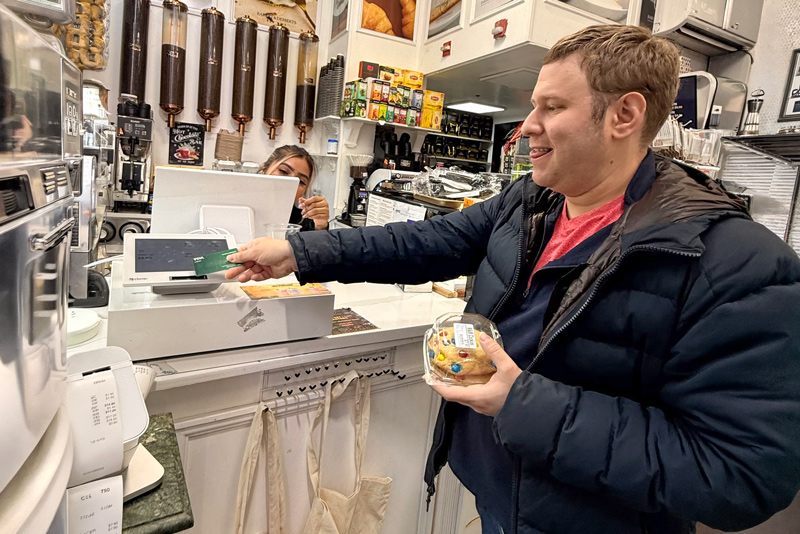
Andrew makes a purchase with his debit card during a recent AABR community outing — an everyday transaction that represents choice, independence and participation.
Andrew is a young autistic man supported by AABR, and during this particular trip, something new was in his wallet: his own debit card. When it came time to buy souvenirs, Andrew made his selections, took out his wallet, and used his card to make the purchases.
He turned to his staff mid-transaction and beamed with pride.
I was struck by how utterly ordinary the experience was. Choose something you want. Take out your wallet. Pay for it. Walk away with your purchase.
Most of us do some version of this multiple times a day without giving it a second thought.
For Andrew, that ordinary transaction represented something much bigger. We have spent decades developing ways to protect people’s money. We have spent far less time thinking about whether they get to experience the freedom that money provides.
What Is the Money For?
Financial planning for a loved one with a disability understandably centers on protection: government benefits, special needs trusts, ABLE accounts, estate planning, protection from exploitation, and ensuring sufficient resources throughout a person’s lifetime.
Yet planning for the future is only part of the equation. Financial resources also have a role in the life a person is living now.
At AABR, we have begun to see the impact of this technology firsthand. More individuals are gaining supported access to their personal spending money through debit cards, giving them greater opportunity to make everyday purchasing decisions for themselves. We currently use True Link to facilitate this access, though similar tools are available through several providers. The value lies less in the specific platform than in the independence it can help make possible.

Individuals can have greater access to their own money while appropriate safeguards remain in place. Spending parameters can be established, balances and transactions reviewed, and staff can support budgeting and decision-making. The important difference is that the individual participates in those decisions.
That participation matters as the economic world around us continues to change. For generations, financial independence meant carrying cash. Then came checks, credit cards, and debit cards. Today, many of us tap a card or phone, use mobile payment apps and digital wallets, and check our balances instantly. Tomorrow’s transactions will undoubtedly evolve again.
If we advocate for inclusion in restaurants, stores, theaters, sporting events, transportation, and travel, we also must ensure that the people we support can use the financial tools increasingly required to participate in those experiences. Financial inclusion is becoming inseparable from community inclusion.
Technology can make that easier. We already rely on GPS to navigate, autopay to remember our bills, banking apps to track balances, and fraud alerts to protect our accounts. These tools do not diminish our independence; they help us navigate the world more successfully. Used thoughtfully, they can do the same for the individuals we support.
The Freedom to Get It Wrong
Greater financial agency also brings the opportunity to make mistakes. Some individuals have spent their discretionary money before the end of the month, experienced buyer’s remorse, or wished they had saved for something they wanted later. Those experiences can become meaningful opportunities to learn.
A conversation about budgeting takes on new meaning when it is grounded in experience. “If you spend this much today, this is what you will have left for the rest of the month” is no longer an abstract lesson when someone has experienced wanting something later and realizing the money has already been spent.
This is, after all, how most of us developed financial judgment. We made choices, lived with the consequences, and adjusted over time. Sometimes we made the same mistake more than once. Experience taught us lessons that no budgeting worksheet could fully replicate.
For people with disabilities, however, the desire to protect can sometimes limit opportunities to develop that same judgment. The dignity of risk asks us to distinguish between protecting someone from genuine harm and preventing every uncomfortable consequence of a decision.
Safeguards are essential. Financial choices should never jeopardize food, housing, health, safety, or other basic needs. But running out of discretionary money is different. Buyer’s remorse is uncomfortable, and waiting until next month to purchase something can be frustrating, but those experiences reinforce an important understanding: money is finite, choices have consequences, and what we decide today affects the choices available to us tomorrow.
Support still has an important role. Staff can help individuals review transactions, check balances, understand what happened and think through what they might do differently next time. The goal is not to remove support, but to shift its purpose — from managing money for someone toward managing money with someone. That is the essence of supported autonomy.
During the holidays, I gave wallets as gifts to several individuals we support. There was no grand philosophical intention behind it at the time. People had cards and needed somewhere to keep them.
Later, though, I thought about what a wallet represents. It is such a familiar adult possession that we rarely give it much thought. We carry our identification, our money, and our means of navigating the economic world inside it. There is an expectation that we will carry it, keep track of it, and make decisions about what is in it.
For the individuals we support, that simple expectation can carry its own meaning: This belongs to you. You carry it. You take care of it.
There is dignity in that, too.
Securing a Life, Not Just Money
This experience has broadened the way I think about financial security. Families understandably spend enormous time and energy planning for solvency, benefits, trusts, safeguards, and the future. But ultimately, what they are trying to secure is not an account balance. It is a life.
Our recent shopping events, community outings, staycations, and vacations have offered a glimpse of what greater financial participation can look like. It can be as simple as buying your own lunch, choosing a souvenir, deciding something costs too much, or saving because there is something else you want more.
These are everyday experiences, but they carry something that is too often missing from conversations about financial planning: the joy of choosing, the pride of paying, and the satisfaction of owning something you selected for yourself.
Financial security, then, should mean more than ensuring that sufficient resources exist to support someone throughout their lifetime. It should also create meaningful opportunities for that person to participate in decisions about how some of those resources are used to live the life they want.
Protection and autonomy do not have to compete. With thoughtful safeguards, appropriate support, and room for reasonable risk, people with disabilities can have both. And as commerce continues to evolve — from cash to cards, apps and digital wallets, and eventually to whatever comes next — accessibility must evolve with it.
We should protect people’s money because their lives matter, not protect it so thoroughly that we lose sight of what that money was meant to make possible.
Which brings me back to Andrew.
He had seen a Broadway show, gone to dinner, spent the night in Times Square, and found some souvenirs he wanted to bring home. He chose what he wanted, took out his wallet, and paid.
And he beamed.
Hundreds of people around him were probably doing exactly the same thing. Maybe no one else noticed.
That’s okay, because the goal was never for Andrew’s moment to be extraordinary.
The goal was for it to be ordinary.

Libby Traynor, LCSW, is Chief Executive Officer of AABR, Inc.