
On July 26, 2026, the 36th anniversary of the Americans with Disabilities Act (ADA), the National Council on Disability (NCD) announced the “Plan for Disability Middle Class Framework.” The NCD is the independent federal agency that first recommended the creation of an ADA and wrote the initial draft of the legislation. And since the law’s inception, the NCD has continued to be an advisor to the federal government on disability issues. The goal of the ADA was to “ensure equality of opportunity, full participation, independent living, and economic self-sufficiency” for people with disabilities. Yet, in contrast to the progress made in other areas, economic insecurity remains a major issue facing the disability community. According to the U.S. Census Bureau, roughly one in four Americans with disabilities live below the poverty line, which is more than double the rate of Americans without disabilities.
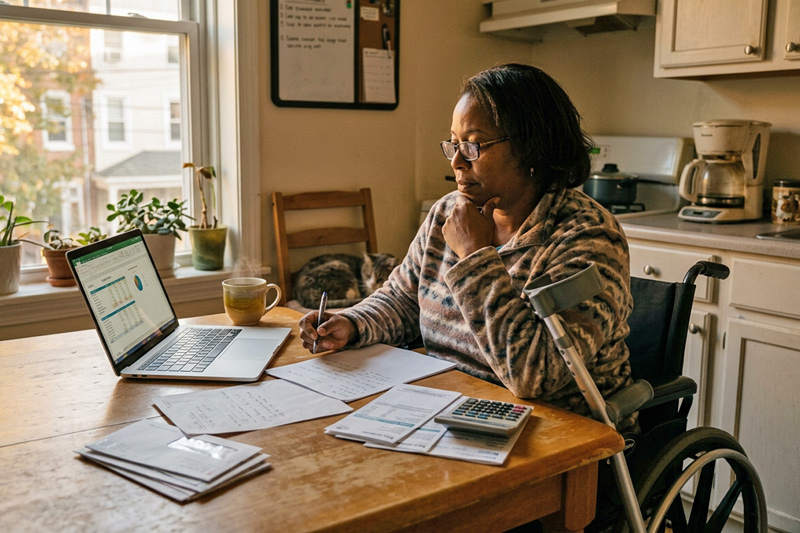
In commemorating the ADA anniversary, Acting NCD Chair Neil Romano reaffirmed the Council’s continued commitment to promoting and defending the law. He also said, “NCD wants to live up to its legacy by articulating to federal policy makers the blueprint to move more Americans with disabilities into the middle class and break down the policy barriers that have kept too many relegated to poverty.” One of these “policy barriers” is the $2,000 asset limit for Social Security Income (SSI) recipients. As NCD noted in a 2023 Progress Report, the SSI asset limit (which hasn’t been updated since 1989) not only mitigates against saving money but also disincentivizes working. It penalizes marriage too, since the asset limit is $3,000 for couples.
As I’ve written about elsewhere, the SSI asset limit always trapped me in a dilemma. While I couldn’t make enough to be self-supporting, I was always at risk of earning just the right amount to jeopardize my benefits. When I think back on the amount of difficulty this caused, I’m struck by the realization that the problem wasn’t my autism, but the constraints placed on me because of it. A perfect example of the social model of disability. I am no longer on social security. My income comes from my part-time position on the Boston LEND Faculty, consulting work, long-term disability from a former employer, and my mother’s life insurance policy. Given that my rent alone is over $1,000 a month (and I’m in affordable housing), living within the confines of the $2,000 SSI asset limit would be unsustainable.
My mother’s life insurance policy is my safety net. When my mom passed away, one of my aunts, a financial planner, arranged for the life insurance policy to be placed with her stockbroker. The money is invested conservatively, and I get a monthly stipend. I can also ask for more if I’m ever in a pinch. But most importantly, there’s just about as much money in the brokerage account today as when it was set up almost ten years ago. I’ve watched the stock market go up and down, but like waves in the ocean, regardless of how the tides rise and fall, the water is always there. So, assuming I don’t go on a spending spree and siphon too much, I should be ok.
Because of private insurance, I don’t rely on Medicaid for healthcare. But I’m no less alarmed by cuts to the program forced on states by the budget reconciliation act (aka, the One Big Beautiful Bill or H.R. 1) signed into law last summer. I have friends and colleagues who do depend on Medicaid, not only for healthcare but also for the Home and Community Based Services (HCBS) that enable them to live in their own homes instead of nursing homes or other institutions. As in the past, when states are faced with federal cuts to Medicaid, HCBS (which are considered optional) are always on the chopping block. Yet, as noted during a recent congressional briefing, HCBS are more cost effective than institutional care.
In the months leading up to the passage of H.R. 1, the Commonwealth Fund analyzed the potential impact cuts to Medicaid and SNAP (Supplemental Nutrition Assistance Program) could have on state economies. A March 2025 report estimated a $1.1 trillion decrease in federal funding over the next decade, 1.03 million job losses nationwide in healthcare and food-related industries, $113 billion in lowered state GDPs, and $8.8 billion in lost tax revenue. The driving force behind this downturn would be the multiplier effect: hospitals and grocery stores, the direct recipients of Medicaid and SNAP dollars, would lose revenue, causing a ripple effect across supply chains. Services, salaries, and jobs would then be cut, reducing consumer spending and the amount states can collect in property, income, and sales taxes.
People with disabilities are too often perceived as a financial burden. In the private sector, employers make assumptions about the prohibitive costs of accommodating employees with disabilities. Yet, research shows that most accommodations cost little to no money, and companies that hire people with disabilities are more profitable. Likewise with public services. With the right supports in place, people with disabilities can live in the community and contribute to society. The thinking needs to shift from “expense” to “investment.” People with disabilities are not a drain on limited resources. We’re an untapped well of unlimited potential.
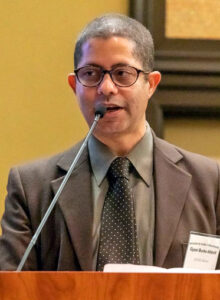
Gyasi Burks-Abbott, MS, is on the faculty of the LEND (Leadership Education in Neurodevelopmental and related Disabilities) Program at Boston Children’s Hospital and UMass Boston’s Institute for Community Inclusion. He serves on the boards, committees, and commissions of many autism and disability organizations, and he’s written for several autism and disability-related publications. Gyasi tells the story of how he became an Autism Self-Advocate in his book My Mother’s Apprentice: An Autistic’s Rites of Passage. He can be reached at [email protected].


A thoughtful and well constructed article on an issue all should be concerned about. Thanks for sharing your story, Gyasi.