Spring and summer travel planning is in full swing, but for many parents, especially those with children with autism or sensory needs, the thought of planning and taking a vacation can be daunting. Fortunately, there are ways to make travel more manageable and enjoyable, even as a single parent of a child with unique challenges, creating family experiences and memories that will last a lifetime.
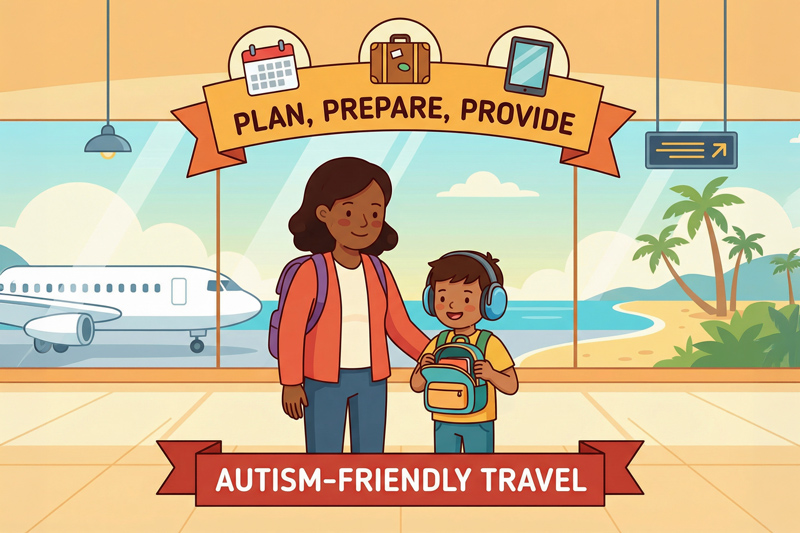
To navigate the challenges of traveling with kids on the spectrum, the secret to a successful vacation is following the “3 P’s: Plan, Prepare, and Provide.” As a mom of now young adult children on the autism spectrum, I’m sharing tips I’ve learned over the years, along with strategies I’ve added to my toolkit since becoming a single mom, to make travel smoother and more enjoyable.
Plan
Planning ahead is the first step to success when traveling with children, especially those with exceptional needs. Choose a destination that is manageable, offering a variety of activities but not so much that it becomes overwhelming. What feels manageable may change over time, depending on past travel experiences and a parent’s confidence and comfort level in traveling with their children.
If traveling by air, try not to schedule flights too early, when rushing to the airport may be stressful, or too late, when children may be tired or cranky. For long or international flights, keep in mind that your child may not sleep. One of my kids stayed awake for an entire overseas flight, so be prepared with activities to keep them occupied.
This is not the time to hide your child’s disability. Notify the airline of any special needs when making the reservation, in their online system, and again at airport check-in, security, and at the gate. Contacting TSA Cares ahead of time can make screening and security lines easier to navigate. Be sure to tell the gate agent you’d like pre-boarding for your family. Most agents are happy to accommodate, though some airlines may allow only one adult to pre-board with the individual with the disability.
My son is fine on the plane, if he has a window seat. He will literally look out the window the entire flight. (He even kept the window shade open during an overnight international flight, much to the chagrin of the flight attendant who kept asking us to lower it. But better an open window than an outburst on the plane!) So be sure to book early to reserve a window seat, especially when there are enough seats available for the entire party to sit together.
Here’s a pro tip: If you book a restrictive fare that doesn’t allow seat selection at the time of reservation, you can call the airline afterward to have seats assigned together, especially if you’re traveling with a child with a disability or a young child.
Some airport information desks offer the Hidden Disabilities Sunflower lanyard, which signals knowledgeable airport personnel to provide extra support to individuals with non-visible disabilities, such as autism and anxiety. More details on this global program are available at hdsunflower.com.
Booking a hotel with helpful amenities and a convenient location is also important – being close to attractions and easily accessible if a child needs a break during the day. Hotels that offer a buffet breakfast can be especially helpful, as finding restaurants that accommodate picky eaters or children with food allergies can be challenging.
Prepare
Preparing your child for what to expect is incredibly important when planning a vacation, especially if this is a new experience for the family. One effective strategy for autistic children is to create and share a social story, outlining what they can expect during travel and clarifying expectations for their behavior. Incorporating the itinerary along with pictures of the airport, destination, hotel, and attractions can make the experience more concrete and less intimidating.
Some airlines now provide social stories on their websites. For example, United Airlines offers a guide to help families prepare: https://www.united.com/en/us/fly/travel/trip-planning/social-story.html. Even reading books or watching videos about different aspects of travel can help children feel more comfortable, reduce anxiety about unfamiliar places or routines, and build excitement for the trip.
As you plan your vacation, include activities that both you and your children will enjoy. Be flexible – it’s okay if you don’t get to everything on your itinerary. Make sure to schedule downtime, especially opportunities to cool off and rest during hot weather.
Provide
Providing items to make travel easier for children with special or sensory needs is highly recommended. Bring activities to keep them occupied on planes and during downtime, such as iPads, activity books, fidget toys, and snacks. Many airlines also provide screens on the back of seats, offering distractions like movies or tracking the plane’s progress on the journey.
We never travel without headphones for my son, to help with his auditory and sensory sensitivities and block out the sometimes-overwhelming sounds of airports, airplanes, and busy destinations. When the demands of travel become too much for children not used to a constant inflow of new sights, sounds, and experiences, offering comforting reassurance or a quiet moment can be very helpful.
Traveling as a Single Parent
With the high incidence of divorce in families with children with disabilities, single parents are often the ones responsible for coordinating travel logistics and caregiving during family trips.
Previously, parents may have shared duties during travel, so newly divorced parents may struggle with whether and how to handle everything on their own. Bringing a helper, such as a relative or caregiver, can be very helpful for an extra pair of hands. If that isn’t feasible, there are still ways to simplify travel logistics and make them more manageable:
Book direct flights whenever possible to avoid the stress of connections.
- Arrange for someone, or a service, to drop you off and pick you up at the airport, rather than worrying about parking and navigating the airport with children and luggage.
- Check in luggage to keep your hands free for your child, but bring a backpack with snacks, activities, and sensory or comfort items.
- Consider traveling to a destination where you can stay with, or visit, familiar family or friends.
- Some companies offer trained staff to assist families traveling with children on the spectrum on cruises and at resorts.
- Don’t hesitate to ask for help.
- Start with shorter trips and gradually build up to longer ones.
- Be confident: you can do this!
The more you travel with your child on the spectrum, the easier it becomes. With proper planning, preparation, and sensory-friendly supports, you can create fun and enjoyable travel experiences for your family.

Mary Ann Hughes, MBA, is a Certified Special Needs Divorce Coach and Coparenting Specialist, and Founder of Special Family Transitions LLC. She spoke at TEDx Third Ward in January 2026 about her journey in divorce as the mother of autistic children, sharing how advocating for loved ones helps caregivers find their strength and purpose. For more information and resources on special needs divorce or transitions, please visit SpecialFamilyTransitions.com and follow on Facebook, Instagram, YouTube, and LinkedIn.You can also reach Mary Ann at [email protected].