Ninth grade was a turning point for my nonverbal daughter with autism. After years in a life skills classroom, she moved into an academic setting. For the first time, she was studying algebra instead of counting money and writing paragraphs instead of discussing the weather each morning. This transition was only possible because she had learned to communicate using a letterboard.
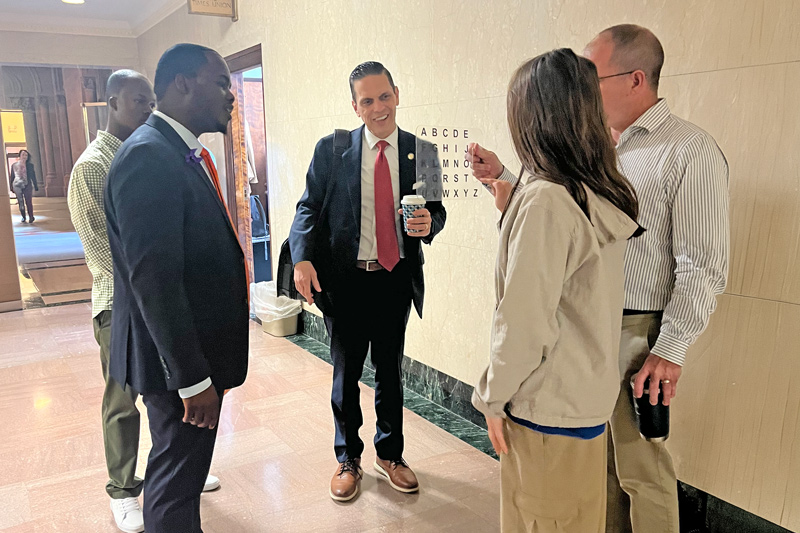
My daughter speaking with New York State Assembly members at the Capitol
I first heard about spelling from two other mothers of autistic children, but I hesitated to explore it in part because of the American Speech-Language-Hearing Association’s (ASHA) position statement, ASHA Warns Against Rapid Prompting Method or Spelling to Communicate. In hindsight, I wish I had known that the statement contained factual inaccuracies and reflected bias—it might have led me to try this approach much sooner. I offer this for parents who are considering a spelling journey.
ASHA’s position statement lists five concerns about spelling methodology. The first claim against spelling methodologies is that there is uncertainty regarding who does the spelling. It states that “a simple way to reduce facilitator bias is for the aide to place the alphabet board on a table or mount instead of holding it in the air.” Yet ASHA also permits speech‑language pathologists (SLPs) to hold, stabilize, or position an AAC device. This suggests a double standard: SLPs are presumed capable of handling a device without influencing communication, while spelling practitioners are not. The International Association for Spelling as Communication (I-ASC), however, outlines best practices that include presuming competence, understanding the cognitive-motor balance, and ensuring proper board positioning. As with many developmental disabilities, prompting is often most intensive during early skill-building and usually decreases over time. Prompting is also used extensively by SLPs and was documented frequently in my daughter’s individualized education program (IEP). Furthermore, requiring fully autonomous communication is inconsistent with the Americans with Disabilities Act.
ASHA’s second claim, that RPM creates dependence on another person and therefore prevents independent communication, relies on an outdated concept of “independence” that disability rights advocates have long rejected. It also overlooks the motor-planning challenges many autistic individuals experience. During our spelling journey, my daughter was diagnosed with global dyspraxia, which helped her school better understand her needs. Using a letterboard or keyboard allows her to complete her studies, connect with peers and family, and pursue her passions, including advocating for her community and finding a boyfriend! We are working with my daughter to help her use a letterboard, keyboard, or iPad on a stand, but I will not deny her the basic human right to communicate simply because she is not yet fully independent.
ASHA’s third claim is that RPM lacks evidence of effectiveness. Evidence-based practice generally rests on three equal pillars: research, clinical expertise, and patient and family values. ASHA, however, appears to treat research as the only pillar that matters. While research on spelling methodologies is still emerging, the existing findings are encouraging. One recent study (Jaswal, Wayne, & Golino, 2020) examined influence by tracking spellers’ eye movements and found that participants looked at each letter before pointing, made very few spelling errors, and showed timing patterns similar to fluent typists. These results support the conclusion that spellers were selecting their own words even when the board was held. If you are considering spelling as a communication method, it may help to remember that new forms of communication have been doubted before. Sign language faced similar skepticism for more than a century, when schools and professionals denied that it was a real language and even prohibited its use in classrooms.
Clinical expertise and patient and family values are also essential pillars of evidence-based practice. Professionals who can currently spell with my daughter include spelling practitioners, her high school teacher, several teacher aides, and a direct support professional, yet none of these perspectives are represented in ASHA’s statement. ASHA also overlooks the lived experience of families like mine, even though spelling has been life-changing for us. Like many autistic individuals, my daughter’s behavior at home and school had become increasingly difficult to manage with the onset of puberty. After she gained the ability to communicate with a letterboard, however, her behavior improved significantly. Spelling has literally opened up her world: she was able to take her first cross-country flight and will soon take her first international trip. Our family is not alone in this experience — many books, blogs, and social media posts describe similarly life-changing outcomes.
ASHA’s fourth claim is that RPM holds the potential for harm. Although the statement makes this serious allegation, it offers little support beyond saying that families may spend months or years on an unproven method instead of using interventions it considers effective and appropriate. What ASHA does not acknowledge is that many families, including ours, have already spent years pursuing the traditional therapies recommended by experts. In our case, after more than a decade of treatment and tens of thousands of taxpayer-funded dollars spent on school-based speech therapy, our child still had no functional language.
Before starting this journey, we discussed the financial risk to our family, and as a middle-class household, we were able to take it. Many families do not have that option, which creates socioeconomic inequities and leaves them stuck with the same ineffective therapies. As the saying goes, “insanity is doing the same thing over and over again and expecting different results.”
ASHA’s fifth claim is that RPM is similar to a discredited and dangerous technique called Facilitated Communication (FC). ASHA writes that “FC has resulted in serious harm to people with disabilities and their families, including false allegations obtained through FC of sexual abuse and maltreatment.” As the mother of a nonverbal daughter who faces a higher risk of abuse, I initially found it difficult not to take that statement personally. However, I recognize that ASHA’s priorities differ from mine. Its main concern is protecting SLPs and limiting legal exposure. As a parent, however, my priority is my daughter’s safety, and that safety increases when she can communicate and report abuse. Additionally, there is no evidence that non speakers make false allegations of abuse more frequently than speakers.
If you are considering a spelling or typing journey for your child, I encourage you to weigh all three pillars of evidence-based practice. Talk with spelling practitioners, connect with parents of spellers, and read writing by spellers themselves. As a nurse, I was able to help my daughter develop functional communication, something a decade of speech therapy had not achieved. It has changed our family’s life, and my only regret is not starting sooner.
Andrea Palerino, PhD, PPCNP-BC, is an Assistant Professor at Utica University. For more information, email [email protected].
References
American Speech-Language-Hearing Association. (2018). ASHA warns against Rapid Prompting Method or Spelling to Communicate. https://www.asha.org/slp/asha-warns-against-rapid-prompting-method-or-spelling-to-communicate/
International Association for Spelling as Communication. (n.d.). I-ASC. https://i-asc.org/
Jaswal, V. K., Wayne, A., & Golino, H. (2020). Eye-tracking reveals agency in assisted autistic communication. Scientific Reports, 10(1), 7882. https://doi.org/10.1038/s41598-020-64553-9