Note: The generic term “Spelling” is used here for all methodologies of assisted communication access with spelled or typed output. The term “Spellers” is a generic label accepted by non-speakers who communicate via these methods. “Non-speaker” (preferred over “non-verbal”) includes non-speaking and minimally-speaking individuals unable to engage in spoken conversation.
Spelling as a method of communication access for non-speakers is rapidly expanding within the Profound Autism community. Thousands of Spellers have gained communication through Spelling to Communicate (S2C), Rapid Prompting Method (RPM), Spellers Method, and other assisted communication methods. This is absolutely life-changing (as the Spellers movie effectively illustrates). Non-speakers who spell have become college graduates, valedictorians, researchers, and song, movie script, and play writers, and have authored many books.
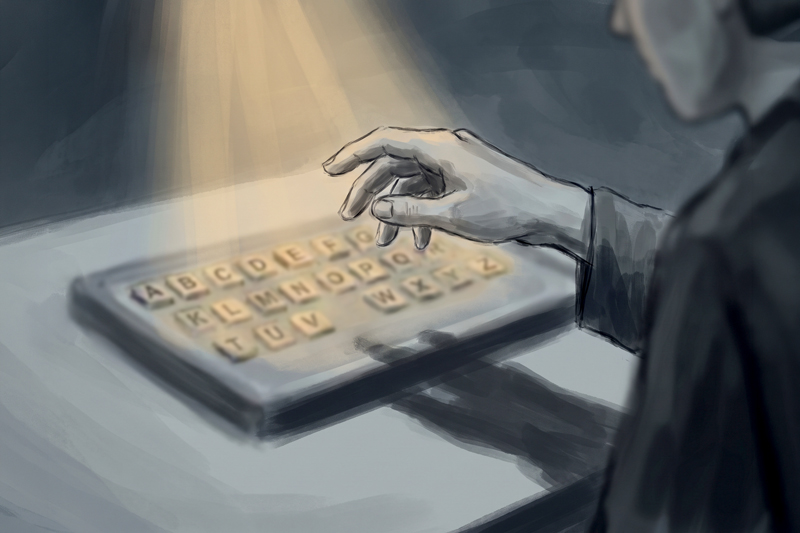
Yet these communication methods continue to be challenged by a small group of vocal critics. The central question for critics is authorship: is spelled communication from the non-speaker? How much is it influenced by the communication partner? Anytime another person is involved in the communication process (translator, transcriber, reviewer, editor), there is opportunity to influence the resulting communication. This is especially true of spelled communication where the communication partner is essential to the initial output.
This criticism is nothing new for non-speakers. Helen Keller frequently had to defend against critics who couldn’t believe a deafblind person was an author. Stephen Hawking faced accusations that he wasn’t the only author of his works, as he relied heavily on others to assemble his text for publication (editing is a very labor-intensive task for a non-speaker relying on AAC). Speech is so intertwined with our perception of intelligence that lack of speech is often conflated with lack of thought.
Prove It
Critics of Spelling and Assisted Typing demand proof of authorship most commonly through a “message-passing test,” where a non-speaker is shown something unknown to their communication partner (overtly or via deception), and asked to “pass on” that information. Psychology experiments have often obscured the true purpose of a test by misdirecting participants with false information. This ruse “blinds” the participants so they do not alter their behavior for the test. This is ethical when the expected scientific knowledge justifies the deception and test subjects are not put at risk.
A “blinded” experiment on a non-speaker is an unethical request. Message-passing for Spellers is not a neutral test. The consequences for the non-speaker are incredibly high. Especially for an inexperienced Speller early in the process, or when a test is done without their knowledge and input, this demand is dehumanizing, ableist, and unethical.
Ethical Research
The Belmont Report provides the USA’s ethical and legal framework that governs behavioral research on human subjects. It established three fundamental ethical principles:
- Respect for Persons: recognizing autonomy and protecting people with diminished autonomy
- Beneficence: maximizing benefits while minimizing harm
- Justice: ensuring risks and benefits are distributed fairly, without exploiting vulnerable groups
A message-passing test, especially when conducted without a non-speaker’s consent or input, violates all three ethical principles. These principles are particularly important when research affects the communication access and services eligibility of non-speakers with profound autism.
The Expert’s Inside Perspective
Imagine you are a non-speaker who can only communicate by spelling with great difficulty, focus, and effort, and with the support of a communication partner:
You are intelligent, but unable to speak or sign beyond a few basic words (Yes/No, Please, More…). For years, no one knew what you thought. You were excluded from conversations, activities, and decisions about your future because you couldn’t talk. Your body is impulsive, is difficult to control, has automatic loops and stimming behaviors, and doesn’t consistently do what you want — many Spellers describe their body as “having a mind of its own.” Your mouth may produce understandable words, but only repetitive scripting and echolalia, not what you want it to say. Your body is easily triggered into fight or flight mode.
You have been learning to communicate by Spelling. It is incredibly hard, but you have been able to spell words that show you have more thoughts than you have been able to express. People who care deeply about you are seeing the unexpected, and are experiencing the shock and cascade of guilt that they may have underestimated your intelligence your entire life. They are incredulous, asking themselves, “Can I believe what I just saw?”
An “expert” warns your parents, “This isn’t real. This is wishful thinking. Let me test this without the communication partner.” You scream silently inside your head, “That’s not fair!” You rely on your communication partner to keep you regulated, on task, and focused, and to prompt your body when necessary. You realize if you fail this test, the window of opportunity may close and never open again. No one will ever know you or hear what you have to say. Non-performance will be considered a failed test (“They couldn’t pass the test; they didn’t spell when I tried it.”). You don’t want to be viewed as intellectually disabled for the rest of your life because you couldn’t show otherwise. This paralyzes you with fear.
Asking a non-speaker to complete a message-passing test carries the highest possible stakes. That is why it is unethical. A request for authorship testing may also be disingenuous if the motive is not genuine scientific curiosity and seeking to understand, but only to disprove. Message-passing is not a standard psychology testing protocol, and is not used to validate other AAC communication methods. Treating a Speller as a test subject in a blinded experiment to validate a critic’s doubt does not benefit the individual and has little or no scientific merit. Test subjects can fail a message-passing test for multiple reasons (stress, anxiety, lack of needed supports, unfamiliar environment, poor test design, subjective data interpretation, refusal to participate, etc.). Anything less than a precisely correct answer could affect a participant’s future access to communication. And when non-performance is considered a failure, unethical becomes cruel.
Proving Authentic Communication
Wouldn’t fluent Spellers want to prove they are truly communicating? Yes, and they have. There are thousands of individuals who are spelling and typing complex sentences, poems, stories, and personal experiences with the aid of a communication partner. They are communicating with their doctors, choosing from the restaurant menu, and participating in college classes by spelling on a letterboard or keyboard. To many observers, this accommodation is no more remarkable than a foreign speaker with a translator, or a deaf person with a sign-language interpreter. Most communication partners are parents who are communicating with their child. Many parents were skeptical at the start (or afraid to hope) but soon could not deny the reality of what they were seeing and hearing.
There are other ways to approach the question of authenticity. Non-speakers routinely spell out grammatically correct and insightful paragraphs, and may communicate readily with multiple aides trained in the same communication method. Anne Sullivan was Helen Keller’s first but not her only communication partner. Naoki Higashida, the author of The Reason I Jump, when faced with critics’ challenges about authorship, responded by writing more books. Jerry Rothwell, the documentary filmmaker who directed The Reason I Jump, met with Naoki in person before he invested his time and effort in filming and wrote “I didn’t want to make the film if I had any doubt about his authorship.”
Sharing of unknown information happens naturally during conversations — it does not require the artificial setup of a double-blind message-passing test. Every time a Speller shares a unique insight, past experience, or something that is unknown to their communication partner, it is proof that they are communicating. Science starts with observation. The published science for Spelling is still catching up (see Jaswal et al., 2026 – Why We Need to Study Assisted Methods to Teach Typing to Nonspeaking Autistic People (Jan. 8, 2026, Autism Research). Any testing of authorship must be designed with the willing consent, input, and minimization of potential harms to non-speaking participants for it to be ethical.
Jared Hansen is a parent of a speller. He can be reached at [email protected].
References
Spellers Movie (2023) Directed by Pat Notaro
List of Books Authored by Non-Speakers with Autism (sample list, not exhaustive): https://i-asc.org/education/nonspeaker-speller-books
Korn, James H. (1997) Illusions of Reality: A History of Deception in Social Psychology, State University of New York Press
Kaufer, David (2025) Why Message Passing is Invalid https://kauferinsights.substack.com/p/why-message-passing-is-invalid-the
Naoki Higashida (2016) The Reason I Jump, Random House
Rothwell, Jerry (2020) blog: https://jerryrothwell.com/2020/10/28/authorship-the-reason-i-jump/
Jaswal, K.J., Prizant, B.M., Barense, M.D., Patten, K. & Stobbe, G. (Jan 2026) – Why We Need to Study Assisted Methods to Teach Typing to Nonspeaking Autistic People (Jan 8, 2026), Autism Research https://onlinelibrary.wiley.com/doi/epdf/10.1002/aur.70176