Research has clearly supported the connection between mental health and fitness for all people. In fact, its positive impact on mental health is so significant that it can be viewed as a useful adjunct for mental health and substance abuse disorder treatment interventions (Ashdown-Franks et al., 2020). At Westchester Jewish Community Services (WJCS), the largest provider of licensed community-based outpatient behavioral health services in Westchester County, NY, a unique program is being implemented that brings the importance and value of fitness and exercise directly into the treatment space. This program, reserved for participants aged 18 and older, expands on the clinical staff’s ability to implement a wellness perspective into treatment in a real way.
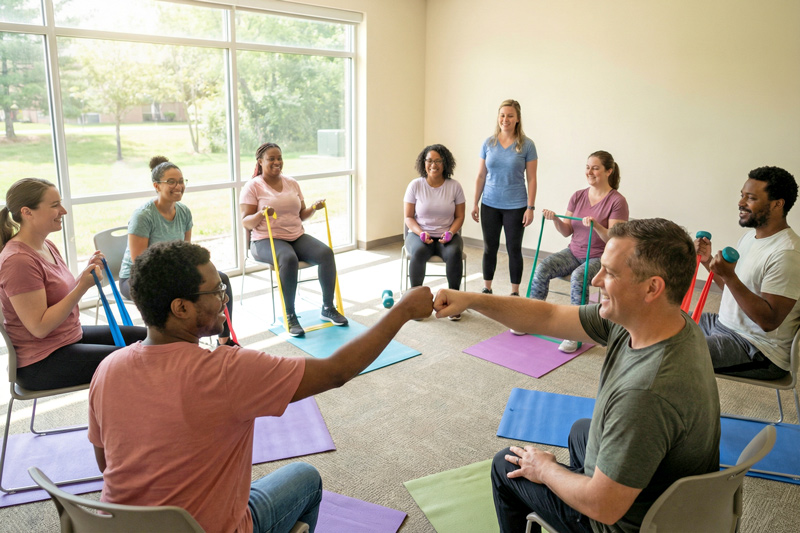
There are several aspects of this fitness program that are significant:
- It is being conducted in the very place where the participants receive therapy.
- It is open to all clients in the behavioral health clinic and brings together neurodivergent and neurotypical individuals to work together and support each other.
- The facilitators of the program are certified personal trainers who have additional certification in adaptive physical fitness paired with therapists. The facilitators have extensive experience of working with both differently abled and neurodivergent individuals.
Providing the fitness and exercise programming in the community mental health center that the participants are attending increases the likelihood that the individual will access the service (Rasmus et al., 2021). A 30-year-old participant with ASD and Anxiety told me, “There are only three places I feel safe: here (at the clinic), in my room at home, and at church.” It would be a herculean task to attempt to support this individual to go to a gym in the community. In addition, the gym itself often has negative connotations for individuals. One participant told me that “going to the gym is right up there with going to the dentist.” Even the most welcoming environment cannot fully escape the anxiety we project onto it.
For the participants in this program, they are sure they are stepping into a safe space in a safe environment, based on where they are physically and their trust in staff that we have put in place a program designed to meet their needs. In addition, before a client begins participating in this group, they meet with the program coordinator to learn about the group and its mission and to begin to identify what they would like to work on in terms of fitness. The coordinator and the client can also problem-solve any issues that the client views as being an obstacle to commitment.
There are different divisions within WJCS with expertise in treatment in particular challenges. For example, there is a Trauma division, a Substance Abuse and Co-Occurring Mental Health Disorders division, and a Developmental Disabilities division. In addition, as a Certified Behavioral Health Clinic, peer services, case management, and care coordination are provided. This fitness and exercise program is open to all clients at the clinic. This brings together a group of people who would not have had access to each other otherwise and maximizes the potential value of these relationships. For the autistic adults that we work with, there is the opportunity to work in tandem with neurotypical peers. In these interactions, there is the potential power of modeling and increased social interaction for individuals who often report a high level of isolation (Verkooijen et al., 2026). There have also been opportunities for mutual understanding and camaraderie between individuals who would not have engaged with each other outside of this forum. It is interesting to consider that the individual in recovery from substance abuse or mental health concerns can feel as misunderstood as an adult with autism, and in that commonality, find mutual understanding that supports them both.
To facilitate this program, WJCS has partnered with Breakthrough Fit Co which is a gym located in Hartsdale, New York. The program’s facilitators are certified personal trainers with additional certification in adaptive fitness training. Research indicates that professionals with this level of credentialing are a better match for clients with disabilities (Mehringer et al., 2025). There are two facilitators at each fitness class, coupled with a therapist, and the group does not exceed 10 participants. The facilitators provide general wellness, behavioral health, and fitness programming in a large conference room at one of the WJCS clinics. All participants engage in a general health and wellness curriculum that focuses on the benefits of physical movement, nutrition, and sleep hygiene in our lives and in behavioral health recovery.
In addition, each participant has a realistic and personally meaningful objective of their choice to work on that is reviewed weekly. These objectives have included increasing hydration, increasing movement throughout the week, decreasing the use of electronic resources, and improving mood and coping skills. One participant, an adult woman with ASD, excitedly reported recently that she incorporated movement in her life such that she was going on daily walks and having positive experiences because of this. The facilitators observe that the group itself has created a sense of community for the participants and very diverse individuals, who would not have met otherwise, are able to participate side by side, sharing the experience topped by a fist bump of encouragement and mutual support.


Kenn Mann, PsyD, is Director of Outpatient Services for the Developmentally Disabled and Massiel Farrell, LMHC, CASAC, is a Substance Use Disorder Intensive Outpatient Program Coordinator at Westchester Jewish Community Services. To learn more about the programs and services at Westchester Jewish Community Services, please visit www.wjcs.com.
References
Ashdown-Franks, G., Firth, J., Carney, R., Carvalho, A. F., Hallgren, M., Koyanagi, A., Rosenbaum, S., Schuch, F. B., Smith, L., Solmi, F., Vancampfort, D., & Stubbs, B. (2020). Exercise as medicine for mental and substance use disorders: A meta-review of the benefits for neuropsychiatric and cognitive outcomes. Sports Medicine, 50(1), 151–170. https://doi.org/10.1007/s40279-019-01187-6
Mehringer, J., Fodstad, J. C., & Ghuman, G. (2025). Exercise considerations for adults with disabilities: A systematic review. Journal of Developmental and Physical Disabilities, 38, 1–21. https://doi.org
Rasmus, P., Lipert, A., Pękala, K., Timler, M., Kozłowska, E., Robaczyńska, K., Sobów, T., Kozłowski, R., Marczak, M., & Timler, D. (2021). The influence of a psychosocial rehabilitation program in a community health setting for patients with chronic mental disorders. International Journal of Environmental Research and Public Health, 18(8), 4319. https://doi.org/10.3390/ijerph18084319
Verkooijen, M. H., Ketelaar, M., van Woerden, M., Staal, W. G., Tendolkar, I., & Zinkstok, J. R. (2026). Impact of peer‑support programs for individuals with autism: A systematic review. Autism, 30(2), 300–315. https://doi.org/10.1177/13623613251374971