This article bridges the gap between decades of research in the field of autism and the actual cognitive-motor mechanics that define an autistic learning profile. Our objective is to cleanly identify why traditional Augmentative and Alternative Communication (AAC) models often fail: they systematically misinterpret a physical, motor, or sensory breakdown as a lack of intellectual or language capacity.
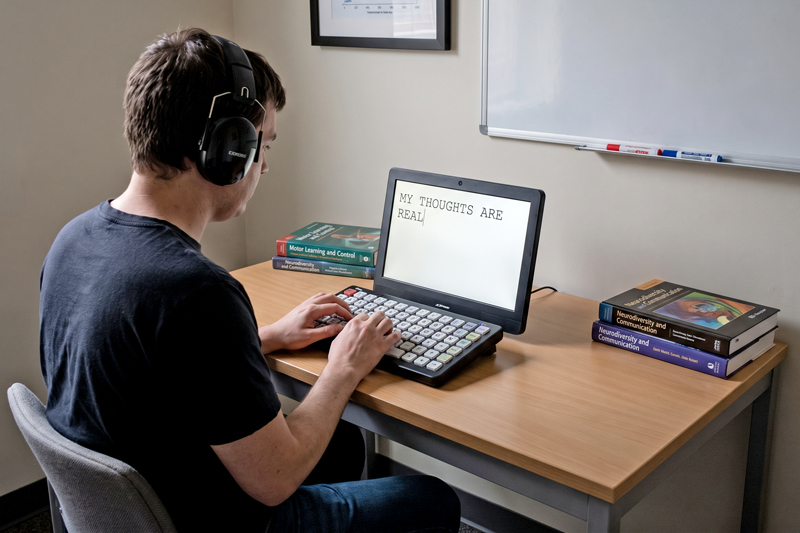
Typing is not a magical cure; rather, it is a motor-accessible alternative pathway specifically engineered to accommodate over-selectivity, dyspraxia, and context-bound learning. This approach aligns perfectly with modern developmental science. Non-speaking individuals do not lack language; they lack a reliable, accessible motor pathway to execute it.
As professionals in the field of autism for decades, we are acutely aware of the core characteristics that cut across autistic learners. Our combined years of clinical and research experience suggest that these features directly impact an individual’s ability to learn the process of typing to communicate, necessitating the widespread availability of these methods for non-speaking autistics.
The Autistic Learning Profile: Six Core Characteristics
- Over-Selectivity and Restricted Stimulus Control – The concept of stimulus over-selectivity remains a cornerstone of autistic attention research (Burke, 1991; Lovaas et al., 1971; Ploog, 2010). When presented with complex, multi-component stimuli, autistic individuals often process a limited number of components, leading to sensory overload or skewed comprehension.
Verbal speech is dynamic, ephemeral, and fleeting; it disappears the moment it is uttered and requires rapid, simultaneous processing of facial expressions, vocal tone, and acoustic shifts. By contrast, a physical keyboard provides a stable, invariant visual and tactile layout. It effectively isolates the target stimulus (the letter) and eliminates the fluid “sensory noise” of vocal demands, creating an optimized, predictable environment that accommodates monotropic focus.
- Apraxia, Dyspraxia, and Motor Planning Challenges – Modern neuroimaging and clinical motor studies demonstrate a massive overlap between autism and motor execution deficits. Research indicates that up to 80% of autistic individuals experience significant gross or fine motor impairments, with structural studies highlighting profound deficits in praxis (motor planning) and visual-motor integration (Ming et al., 2007; Mostofsky et al., 2006). In a key study of autistic preschoolers, Vivanti et al. (2025) presented data showing that approximately one-third of non-speaking autistic preschoolers do not develop functional speech across major intervention models like Early Intensive Behavioral Intervention (EIBI), Early Start Denver Model (ESDM), Treatment and Education of Autistic and Related Communication-Handicapped Children (TEACCH), or Naturalistic Developmental Behavioral Interventions (NDBIs). Their results showed that a severe deficit in baseline motor imitation skills was the primary predictor (Vivanti et al., 2025).
In traditional speech-language pathology, automaticity in verbal speech is driven by a consistent motor plan (Halloran & Halloran, 2006). While non-speaking individuals possess the cognitive capacity for language, the neurological “map” required for speech or complex signs is often broken. Typing bypasses these profound oral-motor barriers by allowing for a simplified, linear motor output.
- Prompt Fading, Agency, and the Reversal of Learned Helplessness – Learned helplessness occurs when an individual learns that their own behavior has no contingent effect on their environment (Seligman, 1972). After decades of failed interventions and compliance-based models, many non-speaking adults fall into this state. In traditional communication interventions, non-speaking individuals are frequently subjected to intensive, repetitive, compliance-driven training (e.g., repeating basic requests or hand-over-hand prompting). Research indicates that a lack of autonomous control over communication routinely results in passivity, situational apathy, and an absolute reliance on external prompts (Mirenda, 2008).
Typing flips this dynamic entirely by moving from a closed-loop system (selecting an icon for an item someone else chose) to an open-ended, generative medium. When paired with systematic prompt-fading — deliberately moving from physical or emotional co-regulation to independent execution — typing gives the individual the means to generate completely novel, unprompted thoughts. This transitions the communicator from a passive recipient of interventions to an active agent of self-advocacy and true conversational agency.
- Insistence on Sameness as a Regulatory Tool – In neurodivergent literature, insistence on sameness is increasingly understood not as an arbitrary behavioral deficit, but as a critical, adaptive mechanism for neurological and emotional regulation (Gomez de la Cuesta et al., 2015). When internal sensory modulation is unpredictable, an invariant external environment helps prevent cognitive overload and emotional distress. The predictable, unchanging nature of a keyboard provides the exact spatial structure many autistic individuals require to feel regulated enough to engage in the high-effort task of communication.
- Stimulus Generalization Artifacts – Difficulty with stimulus generalization across varied environments, tasks, and people has been a long-documented characteristic of the autism learning profile (Rincover & Koegel, 1975). Consequently, the fact that typers may demonstrate typing fluidly with specific communication partners or in specific settings is not evidence of invalidity; rather, it is a direct artifact of this characteristic.
- The Presumption of Competence – Contemporary AAC frameworks mandate that we separate an individual’s motor execution capabilities from their cognitive and linguistic potential (Biklen & Burke, 2006). By implementing systematic prompt-fading models that mirror standard occupational therapy and neurological rehabilitation protocols, we focus on building muscle memory and automaticity through spatial constancy (Schmidt & Lee, 2011).
The Methodological Flaw of Early Critiques
The historical skepticism toward typing methods (stemming from early 1990s literature on traditional Facilitated Communication) largely relied on an assumption of global intellectual incompetence and completely ignored the role of praxis. Those early studies routinely failed to control for severe motor anxiety, apraxia, and the complex mechanics of sensory co-regulation.
The Intellectual Short-Circuit:
When an autistic individual with severe dyspraxia is placed into a highly artificial, high-stakes testing environment, the neurological loop required to formulate an idea, locate it on a board, and physically execute the strike breaks down. Under intense stress, the motor system defaults to the nearest available external visual or physical cue (the facilitator’s gaze or subtle muscular tension).
What early researchers reflexively labeled “facilitator control” was frequently an involuntary motor manifestation of echopraxia (involuntary imitation of another’s movements) or stimulus-boundness triggered by an acute apraxic breakdown. Early studies did not disprove the user’s literacy; they inadvertently documented the severity of their neuromotor dysregulation under stress.
Moving the Science Forward
To continue relying on 1990s data to deny non-speaking individuals access to robust, alphabet-based communication channels is an indefensible clinical stance. Modern science demands that we transition from an era of testing to disqualification to an era of engineering to accommodate.
The empirical support for interventions across these areas is robust. By applying modern motor learning principles — focusing on spatial constancy, systematic prompt-fading, and proprioceptive scaffolding — typing shifts from a controversial historical artifact to a scientifically sound, neurodiversity-affirming mandate. We must move past the reflex to reject these methods based on outdated, flawed paradigms. Instead, our field must prioritize an understanding of modern neurobiology and commit to continued research in this crucial area.


Janie Burke, MA, MS, is Director of Clinical Services, and John Burke, PhD, BCBA-D, LBA, is Executive Director of Dr. John Burke and Associates, LLC. For more information, email [email protected] or [email protected], call (203) 208-8443, and visit https://drjohnburkeandassociates.com/.
References
Biklen, D., & Burke, J. (2006). Presuming competence. Equity & Excellence in Education, 39(2), 166–175. https://doi.org/10.1080/10665680500540376
Burke, J. C. (1991). Some developmental implications of a disturbance in responding to complex environmental stimuli. American Journal on Mental Retardation, 96(1), 37–52. nih.gov
Gomez de la Cuesta, G., Mason, O., & Bradley, E. (2015). Insistence on sameness in autism spectrum disorders: An adaptive mechanism for emotional regulation? Journal of Autism and Developmental Disorders, 45(12), 3951–3962.
Halloran, M., & Halloran, T. (2006). Motor planning and automaticity in Augmentative and Alternative Communication (AAC). Journal of Speech-Language Pathology and Applied Behavior Analysis, 1(3), 204–214.
Lovaas, O. I., Schreibman, L., Koegel, R., & Rehm, R. (1971). Selective responding by autistic children to multiple sensory input. Journal of Abnormal Psychology, 77(3), 211–222. https://doi.org/10.1037/h0031015
Ming, X., Brimacombe, M., & Wagner, G. C. (2007). Prevalence of motor impairment in autism spectrum disorders. Brain and Development, 29(9), 565–570. https://doi.org/10.1016/j.braindev.2007.03.002
Mirenda, P. (2008). A back to school message: Presuming competence in AAC. Augmentative and Alternative Communication, 24(1), 1–3.
Mostofsky, S. H., Burgess, M. P., Gidley Larson, J. C., Landa, R., & Denckla, M. B. (2006). Increased variability of motor execution in children with autism. Biol Psychiatry, 59(12), 1144–1150. https://doi.org/10.1016/j.biopsych.2005.10.013
Ploog, B. O. (2010). Stimulus overselectivity: Four decades of research in autism and related illnesses. Psychological Bulletin, 136(3), 387–419.
Rincover, A., & Koegel, R. L. (1975). Setting generality and stimulus control in autistic children. Journal of Applied Behavior Analysis, 8(3), 235–246. https://doi.org/10.1901/jaba.1975.8-235
Schmidt, R. A., & Lee, T. D. (2011). Motor control and learning: A behavioral emphasis (5th ed.). Human Kinetics.
Seligman, M. E. P. (1972). Learned helplessness. Annual Review of Medicine, 23(1), 407–412.
Vivanti, G., Lombardo, M. V., Zitter, A., Boyd, B., Dissanayake, C., Dufek, S., Flanagan, H. E., Iadarola, S., Kaiser, A., Kim, S. H., Levato, L., Lord, C., Plavnick, J. B., Robins, D. L., Rogers, S. J., Smith, I. M., Smith, T., Stahmer, A., . . . Watson, L. (2025). Proportion and profile of autistic children not acquiring spoken language despite receiving evidence-based early interventions. Journal of Clinical Child & Adolescent Psychology. Advance online publication. doi.org