For the longest time, I used the term non-speaking synonymously with non-verbal, having been taught ‘non-verbal’ in graduate school. Since that time, new terms and definitions have emerged with the advent of a variety of disability rights movements.
Person-First Language
Person-first language discouraged people from equating individuals with their illness or physical condition. For example, instead of “Tom is Schizophrenic,” ‘person-first’ turned it into “Tom has Schizophrenia.” Similarly, the “cardiac case in Room 302,” became a more respectful, “patient with heart disease in room 302.”
Person-first language was an integral part of the first Disability Rights Movements—civil and social advocacy campaigns that aim “to ensure accessibility, equal opportunities, and inclusion for persons with disabilities worldwide. The disability rights movement has long been focused on “breaking down social and physical barriers that otherwise prevent disabled individuals from engaging fully in employment and education and from living independently and enjoying freedom from discrimination” (Britannica Editors, 2024).
The Rights Movement in the Autism Community has more recently achieved visibility. Autism Rights is “a sociopolitical campaign that advocates for the social acceptance and inclusion of individuals on the autism spectrum. Known also as the Autistic Liberation Movement or the Autism Self-advocacy Movement, it emphasizes the concept of “neurodiversity,” which posits that variations in brain function and behavior should be recognized as part of human diversity rather than medical disorders needing treatment” (Autism Rights Movement | EBSCO, 2025).
Non-verbal Defined
Dictionaries define non-verbal literally as “conveying information without using words” (Definition of NONVERBAL, 2026). Non-verbal is an outdated term that wrongly suggests a lack of all communication ability, reinforcing outdated and harmful assumptions. “Non-speaking” … reflects what many individuals have said about their lived experiences…It’s not about what someone can’t do; it’s about how they communicate” (McRory, 2025).
Verbal vs Non-verbal Communication
It’s commonly accepted that about 80% of what we communicate is non-verbal, involving actions and gestures, while only 20% is conveyed using words (Cherry, 2025).
Non-speaking centers on communication strengths, rather than perceived deficits, in a way that reflects dignity, intelligence, and capability. Language shapes identity; not only reflecting how others see us, but how we see ourselves (McRory, 2025).
Communication In Non-speaking Autism
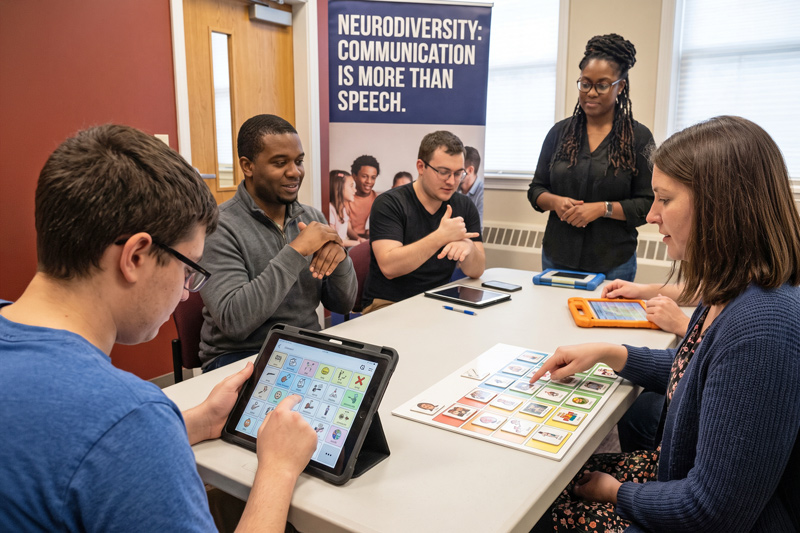
Many non-speaking individuals are highly capable of understanding and using language. They simply express it in ways other than the spoken word. “Language is a system of patterns and symbols used to communicate. It is defined as the comprehension and/or use of a spoken communication system (i.e., listening and speaking), written (i.e., reading and writing), and/or signed (e.g., American Sign Language). In some cases, individuals may use augmentative and alternative communication (AAC) to “replace or supplement spoken language” (ASHA, n.d.).
Even Aphasias [brain disorders] that affect how one communicates impact the ability to understand spoken and/or written language. “Aphasia usually happens suddenly after a stroke or a head injury. But… can also come on gradually from a slow-growing brain tumor or [a degenerative] disease that causes progressive, permanent damage… [Patients] with aphasia relearn and practice language skills [and/or] learn … other ways to communicate” (Mayo Clinic Staff, 2022).
Non-speaking
The term non-speaking has gained increasing acceptance over the past decade, and clinicians and advocates are coming to prefer it. “People [may also] use the terms non-oral, non-vocal, or minimally-speaking” (Riggs, MA, 2021).
The term non-verbal is becoming stigmatized because many people equate non-verbal with not having, or [lacking the ability to] understand language.
Referring to someone as non-verbal can lead to low expectations or incorrect assumptions about their intelligence or emotional depth, especially among those with developmental disabilities, while non-speaking validates their identity as a communicator, even if that communication doesn’t involve speech. A “person… labeled nonverbal may still communicate actively, just not through spoken language” (McRory, 2025).
Non-verbal communication includes:
- Facial expressions
- Gestures
- Paralinguistics (loudness or tone of voice)
- Body language
- Proxemics or personal space
- Eye gaze, haptics (touch)
- Appearance
- [Use of] artifacts (objects and images) (Cherry, 2025)
Many autistic self-advocates also reject the word “non-verbal” due to its implication that a person is “mute” or lacks the power of speech.
Confusing Language
There are very few conditions which entirely prevent humans from making sounds. What we call mutism is not a single condition—it can result from psychological, physical, or neurological causes. Even someone with vocal cord damage may be able to cough and laugh. In other cases anxiety prevents speech, even when the person is able to speak (“Selective mutism”). And people who cannot speak frequently communicate effectively using non-verbal methods like writing, sign language, or assistive technology (Can Mute People Make Sounds? The Science Explained, 2025).
Autistic Non-speakers
Non-speaking autism does not imply lack of intelligence or understanding. Non-speakers communicate differently. Daily communication is not just about words—it involves social understanding. Non-speaking individuals may have difficulty interpreting tone of voice, facial expressions, engaging in back-and-forth conversations, and building relationships. When a person has difficulty expressing their thoughts or needs, it may lead to issues like anxiety, frustration and emotional distress (Villines, 2021).
Changing the Narrative
Many advocates are urging a shift in terminology to better reflect current understanding of autism, communication, and neurodiversity.
Social media and personal blogs have created spaces for people to question outdated terms, share lived experience, and bring greater visibility to these issues. Advocates also encourage moving away from broad labels such as “high-functioning” and “low-functioning” and instead describing each person’s individual strengths, challenges, and support needs without attaching value judgments.
Creating Full Inclusion for Nonspeaking Autistics
In Ask the Expert: ‘Nonspeaking’ vs. ‘Nonverbal’ and Why Language Matters, Corrina Riggs, M.A., SLP-CCC, says, “[T]he acceptance of neurodivergent people is essential. The bigger umbrella piece to this conversation is embracing neurodivergence and not seeing it as a disability… but as a difference… education is always a big step towards change-making. Once you start understanding something more, then you’ll see change” (Riggs, MA, 2021).
Language Clarity
Clarity of terms is essential. I am diagnosed with ASD, ADHD and Nonverbal Learning Disability, (NVLD) which can co-occur with ASD. People presume it means I either don’t speak or cannot do so competently. But NVLD is a neurodevelopmental disorder affecting pattern recognition, concept learning, and organizing information, rather than language processing skills. Unfortunately, that distinction doesn’t eliminate discrimination or marginalization.
Violated Rights
All too often the rights of non-speaking autistics are violated. According to DJ Savarese, a 2017 Youth Exchange/Human Rights Initiative Fellow, “inclusion means having a voice in one’s life… Our silence makes some estimate us as incapable, and soon we are left out of anything meaningful. Before I learned to read and write, people thought I had no mind…Reading and writing are rarely taught to non-speaking autistics” (The U.S. Education System Is Failing Nonspeaking Autistic People, 2017).
There also needs to be greater understanding of literacy, language and the tools used to convey meaning. Some learners need visual bridges, such as photos and pictures, to become literate. Others need to touch the words, physically placing words in sentences like pieces in a puzzle. Others need to sign or draw concepts and words in order to capture their meaning. Still others may require the musical sounds and patterns of poetry to lure them into language (The U.S. Education System Is Failing Nonspeaking Autistic People, 2017).
“I’ve estimated there are as many as 750,000 nonspeaking autistics in America. The dominant culture’s production of autism is not my experience of autism.” We need teacher training programs that actually instruct teachers in literacy-based instruction for non-speaking people and other neurodiverse learners…We … need accommodations that can be used in inclusive settings to allow each student access to the regular curriculum. By linking strategies with specific kinds of non-speaking autistic learners… [we can] help teachers and parents identify the most efficacious strategies for their particular student or child” (The U.S. Education System Is Failing Nonspeaking Autistic People, 2017).
DJ Savarese’s words resonate with me, as does this quote from Albert Einstein: “I never teach my pupils. I only provide the conditions in which they can learn” (The Quotations Page: Quote from Albert Einstein, 2025).
Conclusion
When working with or supporting autistic non-speakers, advocates advise shifting the perspective away from the deficit-based medical model. “Instead of asking, “How can we fix this?” ask, “How can we support this individual to thrive?” (Mehta, 2026) My recommendation is: _Let well-being, autonomy, and dignity be your star—and support, not correction, shall light the way.

Annie Kent, MA, spent two decades working in public sector disability, mental health, and infectious diseases advocacy and education. Diagnosed with three closely related types of neurodiversity, a lack of awareness and understanding led to burnout and retirement from the field. She remains an active advocate, learning and engaging personally and remotely with several Autism and ADHD organizations and Forums. Contact Annie at [email protected].
References
ASHA. (n.d.-a). Language In Brief. American Speech-Language-Hearing Association; American Speech-Language-Hearing Association. Retrieved May 10, 2026, from https://www.asha.org/practice-portal/clinical-topics/spoken-language-disorders/language-in-brief/
Autism rights movement | EBSCO. (2025a). EBSCO Information Services, Inc. | Www.ebsco.com; EBSCO Publishing. https://www.ebsco.com/research-starters/political-science/autism-rights-movement
Britannica Editors. (2024a). Disability rights movement | Description, History, Equal Opportunity, & Disability Advocacy | Britannica. Encyclopedia Britannica. https://www.britannica.com/topic/disability-rights-movement
Can Mute People Make Sounds? The Science Explained. (2025a, November 26). Scienceinsights.org. https://scienceinsights.org/can-mute-people-make-sounds-the-science-explained/
Cherry, K. (2025a, January 30). Types of Nonverbal Communication. Very Well Mind; People Inc. https://www.verywellmind.com/types-of-nonverbal-communication-2795397
Definition of NONVERBAL. (2026). Www.merriam-Webster.com. https://www.merriam-webster.com/dictionary/nonverbal
DSM. (2026). 2013 Establishing the “Umbrella”. https://www.timetoast.com/timelines/history-of-autism-in-education
Greene, MFA, J. (2025a). Autism rights movement | EBSCO. EBSCO Information Services, Inc. | Www.ebsco.com; EBSCO Industries, Inc. https://www.ebsco.com/research-starters/political-science/autism-rights-movement
Mayo Clinic Staff. (2022a, June 11). Aphasia – symptoms and causes. Mayo Clinic; Mayo Foundation for Medical Education and Research (MFMER). https://www.mayoclinic.org/diseases-conditions/aphasia/symptoms-causes/syc-20369518
McRory, N. (2025, July 23). Nonverbal vs Nonspeaking: Are You Using the Right Term? Autism Parenting Magazine. https://www.autismparentingmagazine.com/nonverbal-vs-nonspeaking/
Mehta, L. (2026, April 30). What Neurodiversity-Affirming Care Looks Like | At Ease Counselling. At Ease Counseling; At Ease Counseling Canada. https://ateasecounseling.ca/what-neurodiversity-affirming-care-looks-like/
Riggs, MA, C. (2021, November 21). Ask the Expert: “Nonspeaking” vs. “Nonverbal” and Why Language Matters. Providers.org; Guild for Human Services. https://www.guildhumanservices.org/blog/ask-expert-nonspeaking-vs-nonverbal-and-why-language-matters
team, N. editorial. (2025, August 10). New Term for High-Functioning Autism: Why Language in the Autism Community Is Changing. NeuroLaunch.com; Neurolaunch.com. https://neurolaunch.com/new-term-for-high-functioning-autism/
The Quotations Page: Quote from Albert Einstein. (2025). The Quotations Page; QuotationsPage.com and Michael Moncur. https://www.quotationspage.com/quote/40486.html. Quotation #40486 from Michael Moncur’s (Cynical) Quotations.
The U.S. Education System Is Failing Nonspeaking Autistic People. (2017). Opensocietyfoundations.org; Opensocietiesfoundation.org. https://www.opensocietyfoundations.org/voices/qa-what-real-inclusion-nonspeaking-autistic-people-means
Villines, Z. (2021a, November 29). Nonverbal autism: Symptoms, diagnosis, and treatment. www.medicalnewstoday.com; Healthline Media UK Ltd, London, UK. https://www.medicalnewstoday.com/articles/non-verbal-autism