For many toddlers, some of the earliest joys are simple things: the playground, toy trains, building towers out of blocks. But one of the first things that truly captivated my son Matthew was something much quieter. It was crayons.
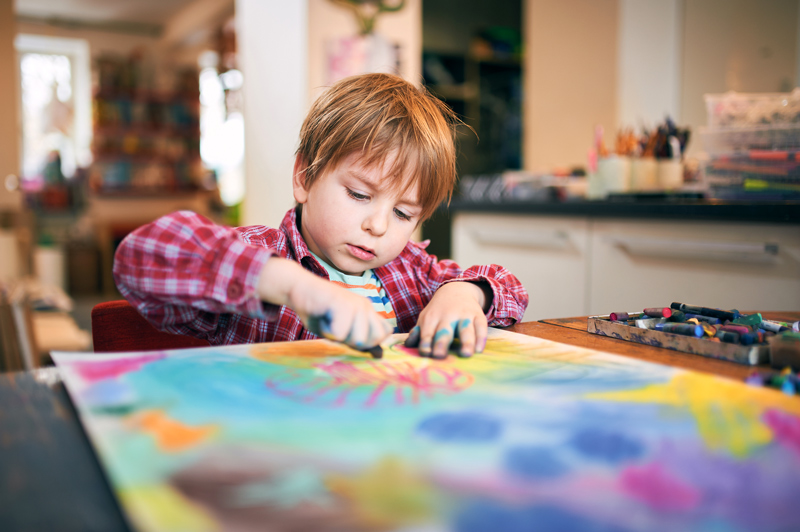
When Matthew was very young — before he was speaking much — he could sit for long stretches of time with a piece of paper and a small handful of crayons. While the world around him felt loud or overwhelming, he would lie on his stomach on the floor and draw. Again and again, he made large spirals that curled inward, then smaller spirals inside them. Sometimes he paused to study the colors in front of him as if choosing the one that felt just right.
I remember noticing something remarkable about those moments. When the environment around him became noisy or stressful, Matthew did not melt down or withdraw. Instead, he quietly returned to his drawings. The crayons, the colors, and the rhythm of the spirals seemed to calm him. Even before he could explain his feelings with words, he had discovered a way to regulate his own nervous system.
At the time, I did not yet have the insight to describe what I was witnessing. I only knew that art seemed to give my son something important — a place where he could organize his thoughts, soothe himself, and communicate in a way that felt natural to him.
Years later, both research and experience would confirm what many parents and educators have come to understand. For many children on the autism spectrum, art is not simply a hobby — it serves as an important way to foster emotional expression and regulation, communication, and social connection.
Artistic expression is much more than a leisure activity for many children on the autism spectrum. It functions as a natural form of communication. Art can assist children on the autism spectrum in expressing themselves in ways that do not rely on words. Society is largely structured around neurotypical norms, where verbal communication is often seen as the primary form of expression. Children who communicate differently may therefore be misunderstood.
Engaging in artistic experiences gives these children the opportunity to express aspects of themselves and their life experience that they cannot fully convey through words. Many are innately wired to think and express themselves visually, and art provides a meaningful outlet for this form of expression.
Children frequently experience emotions they cannot yet articulate. This is true for all children, but it can be especially difficult for those who struggle with verbal communication or social cues. Art offers a way to express feelings without needing to find the “right” words.
A child who cannot explain frustration might draw bold, energetic strokes across a page. Another child might choose soft colors or repeated patterns that reflect calm or comfort. Over time, these visual expressions can help caregivers and educators better understand a child’s emotional world.
Art therapy research has similarly shown that creative expression can support emotional regulation and communication for children on the autism spectrum (Malchiodi, 2015).
Emotional Regulation and Expression
Art can play a powerful role in supporting both emotional regulation and emotional expression for children on the autism spectrum. Many children experience the world in ways that can feel overwhelming, whether due to sensory input, social expectations, or difficulty communicating their needs.
The artistic process offers a natural outlet.
Through engagement in the artistic process, children are able not only to regulate their emotions, but also to express them. Colors, shapes, movement, and imagery can become a language of their own — one that allows children to communicate feelings that may be difficult to put into words.
Providing children with a safe, non-judgmental way to express emotions can reduce frustration and support emotional clarity. Over time, this can contribute to improved emotional well-being and a greater sense of internal balance.
Self-Confidence and Sense of Self
Participation in artistic experiences can also play a meaningful role in developing a child’s sense of self-confidence. For many children on the autism spectrum, traditional environments may not always highlight their strengths, which can lead to frustration or a sense of being misunderstood.
Art offers a different experience.
Through the artistic process, children are able to engage in something that feels natural to them. There is no single “right” way to create, and this allows children to explore their abilities without the pressure of comparison or judgment.
Over time, these experiences can help children begin to feel more secure in themselves. When a child sees that what they create is valued — whether by a parent, teacher, or peer — it reinforces a sense of capability and pride.
As self-confidence grows, children may become more willing to engage with others, try new activities, and express themselves in different ways.
Social Connection and Inclusion
Beyond emotional expression, art can also open doors to social inclusion. Many social interactions rely heavily on conversation. For children who find verbal communication challenging, this can make group activities intimidating.
Art changes that dynamic by allowing children to participate together without requiring constant verbal interaction.
One powerful example is collaborative art projects. In inclusive programs, children might work together on a group mural or shared artwork where each child contributes shapes, colors, or patterns. Some children may talk while painting; others may work quietly side by side.
Other simple activities can support this kind of connection:
- Emotion color mapping
- Story through drawing
- Shared visual journals
These activities reinforce an important idea: communication does not always have to be verbal.
Conclusion
Expanding access to artistic activities can have a crucial impact on the development of children with autism. When children grow up in environments that recognize and nurture their strengths, they develop confidence in their abilities. Artistic expression can play an important role in this process.
If children are given opportunities to communicate visually, explore their interests, and express themselves through art, they gain tools that can support them throughout their lives.
Art should not be seen as an optional extra. For many children on the autism spectrum, it is a meaningful form of communication and connection.
When we validate the importance of visual expression, we send a powerful message: every child has something valuable to share.

Laura Costello is an elementary educator with a Bachelor of Arts in Elementary Education and certification in both elementary education and English as a Second Language. She has spent decades working with children and families in public schools, supporting students from preschool through high school, particularly those with diverse learning needs.
As a mother of a son with autism, her work is deeply shaped by both lived experience and professional insight. She is the author of Tom’s True Colors, a children’s book that explores empathy, inclusion, and the social experiences of neurodivergent children.
Her work also reflects a growing focus on the role of art and creative expression in supporting emotional development, self-confidence, and social inclusion. She is currently pursuing certification in art therapy as part of her continued commitment to supporting children and individuals on the autism spectrum. For more information, email [email protected].
References
Grandin, T., & Panek, R. (2013). The Autistic Brain: Thinking Across the Spectrum.
Malchiodi, C. A. (2015). Creative Arts Therapy and Autism Spectrum Disorders.
American Art Therapy Association. (n.d.). Art Therapy and Autism.