This article is about providing psychotherapy services to nonspeaking or unreliably speaking autistic young adults. Going forward the terms “communicators,” “typers,” or “spellers” are used interchangeably to describe this group. My hope is to encourage parents, professionals, and the wider community to see psychotherapy as a viable option for these communicators who use the assisted typing method (Facilitated Communication/FC) or spelling on a letterboard (Spelling to Communicate/S2C). There are two major hurdles that first need to be addressed and hopefully overcome. Firstly, for some, there is still a bias against psychotherapy in general, that somehow it is a threat to personal autonomy or previously held cultural and religious beliefs, and/or a sign of individual weakness or failure. The second hurdle is that for many there is still an identification with or vested interest in maintaining the belief that autistic nonspeakers or unreliable speakers do not have intelligent inner minds which they are capable of and yearning to express.
Shifting or changing one’s belief system about this may be challenging, but it is possible to do so by critically examining all the evidence with an honestly open and inquiring mind.
Watching autistic typers and spellers at work, it is evident how determined and intentional they are when communicating this way. It is also hard not to be struck by the breadth of knowledge they possess, often about things the facilitator (also referred to as communication partner) or psychotherapist (myself) have little or no prior awareness of. However, since seeing alone might not be enough for some to shift previous beliefs and assumptions about the facilitator mentally and/or physically leading the communicator, it is vitally important to actually experience a simulation of the resistive pull-back used in the typing technique to understand what it feels like and why this is needed, which is addressed in other articles.
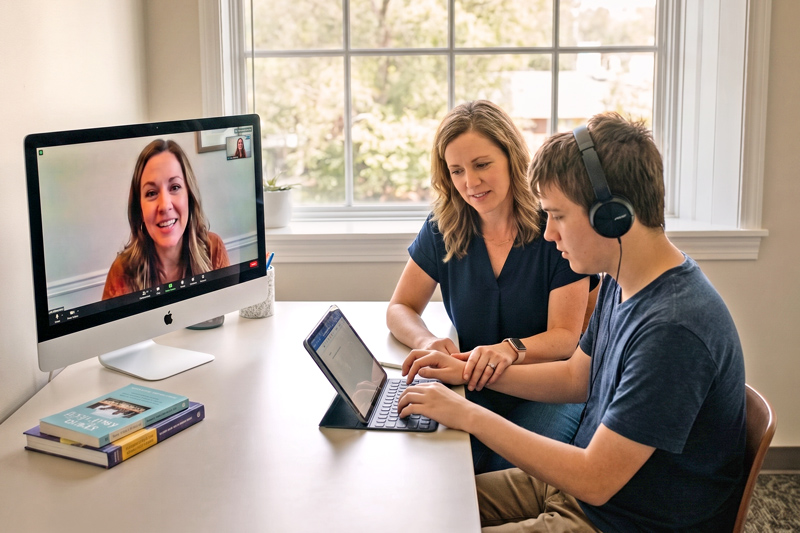
The idea of doing psychotherapy with a nonspeaking autistic client came to me during the Covid-19 pandemic. The mother of an autistic nonspeaking 14-year-old teen contacted me about helping her son who was going through a number of personal and family challenges. She had learned that I had an autistic family member doing Facilitated Communication (FC) and stated she’d been trained in this method before the pandemic and was now typing with her son at the “open” conversational level using the FC communication ladder. Because the pandemic ushered in acceptance of remote work and the use of telehealth, we were able to collaborate on a strategy to meet her son’s emotional needs.
To provide privacy during psychotherapy, I proposed typing my responses instead of speaking to my client, so that our entire conversation would be on the screen of the telehealth platform. The mother agreed and stated she would remove her eyeglasses, therefore being unable to read the screen. This turned out to be a viable solution to the privacy which would be important for me to gain the trust of her son. During the sessions when I thought something my client communicated required his mother’s involvement, I would type a message asking his consent to bring her into the conversation. Most of the time he agreed. When he did not, it was treated as it would be with any therapy client, exploring objections and feelings and asking what would be needed for him to feel comfortable sharing this with his mother. With trust soon established, the client was grateful for assistance in conveying his position and working through issues with his mother, as would be the case in any psychotherapy setting.
The above experience not only validated to me the highly intelligent mind inside this teenager with “profound” autism, but clearly demonstrated that his thoughts were independent of his mother who was providing the proprioceptive connection and resistive pull back on his arm used in the typing method. In addition to the special needs of being a nonspeaker with autism, my client, like most teenagers, grappled with age-related issues and personal agency and had a healthy amount of opposition, in addition to love, for his mother. In therapy he addressed his feelings in a thoughtful, honest, articulate, and mature manner. In return he was understood, respected, and gained efficacy about decisions concerning his life.
After Covid when it was possible to get out into the community again to meet with FC trained coaches, I began to learn of other autistic nonspeakers or unreliable speakers whose parents felt they could benefit from psychotherapy. Of the four other such clients I currently work with, three are facilitated by occupational therapists trained in FC and S2C, and one by his parents also trained in both of these methods. Before starting psychotherapy, each of the communicators already had an established connection with their facilitator and were at an open level of communication with them, which is essential for psychotherapy. In the case of the client whose parents are his communication partners, therapy sessions are able to work well due to the high degree of openness, acceptance, and trust they have achieved with each other. This has also given them a chance to work through, as a family, any issues that might have recently emerged. Clients must, of course, be physically present with their facilitator/communication partner during sessions, while I am joining them remotely on audio-visual platforms where we share access to a document in which communication is typed. I speak aloud (as opposed to typing my responses) in sessions, as clients have consistently noted that this feels more natural to them.
The role of the facilitator in a psychotherapy session is to provide the proprioceptive connection and physical/motoric support and resistive pull-back for the typer while primarily being in a neutral state with respect to the therapeutic process. The same neutrality would be the case if the facilitator were holding a letter board for the non-speaker to communicate. This process, however, is a 3-way partnership and must function as a coherent team to be successful. In physics, beams of light are said to be coherent when the phase difference between their waves is constant, and they have the same frequency. In a similar way it is important for the facilitator and therapist to provide a reliably calm energy, or presence, to allow and support the communicators’ access to their deeper mental states. It should be explicitly stated that when talking about facilitators/communication partners here, I am referring to people trained in FC, S2C, or related methods.
Psychotherapists and others must understand that the argument about touch which critics lodge at FC is misguided and harmful. To quote David Kaufer’s May 14, 2026, Substack article Touch Does Not Disqualify Nonspeakers’ Communication, “Touch is how motor skills are learned. It is how the body receives the scaffold it needs while a new neural pathway is being established. The support is not the performance. The support makes the performance possible.” Kaufer argues and I concur that touch here is not a contaminate but a helpful accommodation that supports grounding and self-regulation and makes communication possible.
Everyone is of course wired differently, and all but the most shut-down individuals are affected by the mental and emotional state of others with whom they’re interacting, as well as by stimuli in their environment. A critical, dismissive, or angry person, especially one who wields authority, would make most of us feel uncomfortable or threatened and activate our nervous system’s defense mechanisms. For someone with profound autism who has far less control over their body’s nervous system and behavior, it takes a lot less intensity to trigger dysregulation and close the door to authentic communication. For instance, feeling tested, like they have to perform or prove themselves, especially in unfamiliar settings and/or with strangers, is enough to set off their sensitive nervous systems.
As with any new relationship, including a therapeutic one, there is naturally a process of getting acquainted and adjusted in order to arrive at fully open and trusting communication. Therapists must enter into the relationship with autistic nonspeakers and unreliable speakers with the presumption of competence, as skepticism or doubt is keenly felt and closes the channel of communication. If a therapist doesn’t understand the meaning of a behavior or something the communicator types or spells, simply asking for clarification will yield a willing explanation.
For instance, one of my clients with unreliable speech has a behavioral loop of repeating a sequence of statements about himself. Between typing he will say things like, “I’m happy today Judith. I’m sad today. I’m typing well today!” each with a great amount of emotion and affect. Therapists are accustomed to responding to verbal and non-verbal cues with nods and utterances to let the other person know we’re paying attention. Because of the frequency of this client’s statements, I usually did not respond, however sometimes it was hard to resist. One time after verbalizing back to him that yes, he really was typing well today, my client informed me that his automatic statements were terribly frustrating to him and make him appear to be “a very younger version of myself” He typed that it felt “like being trapped in a hard place like a too quirky amusement park ride” and that it made it harder when people respond because it’s “like really being caught in that tornado of a loop and have people trying really to be nice but not succeeding.”
Therapists must also adjust their pace, which is of necessity much slower than with speaking clients. The psychotherapist may be the first person the client has been able to share many of their deeper thoughts and feelings with and in some cases the therapy session may be one of only a limited number of hours each week in which they have any communication partner at all. Therefore, providing the time and space for the nonspeaker to type or spell everything on their mind is a priority. Of course, communicators are interested and eager to engage with the therapist’s feedback, suggestions and questions, and at times cognitive interpretations are helpful when done with genuine attunement.
Many people have heard the saying, “If you’ve met one autistic person, you’ve met one autistic person.” This is true, as everyone has unique interests, preferences, energy, physical and psychological issues, relationships and situational challenges. Though not an exclusive list, my clients have typed about their appreciation for the supportive people in their lives as well as their wish for greater understanding and connection with others, the desire for romantic love, the side effects from medications, their interest in academic learning and participating in various activities. They have also typed about poetry they’ve written, about music, art and nature.
This being psychotherapy however, much of their communication concerns inner conflicts, feelings, hopes, and desires, which is after all the primary purpose of psychotherapy. In my experience, these clients come in knowing this, wanting this, and utilizing their precious time processing it. Some of the recurring themes expressed in sessions include: the painful disconnect and lack of control between their inner mind and their outer self, the difficulties of living in the world and being misunderstood, their valuation and gratitude for typing, and their abiding passion for all nonspeaking and unreliably speaking autistics to have access to typing and spelling to communicate. Equally important to all of my clients has been the opportunity to communicate about their connection to spirituality and their desire to contribute greater understanding of this to the world. I am grateful for my clients’ consent for me to include a few examples of their typing, which at their request have been identified with their first names.
“It is so important for me to be able to be in this session.
Understand that I think that our time is invaluable. It is really where I get to be me.
It is oppressive to only have this here. I want it all the time.”
– Jake
“I want to talk to you about the idea that I am really just doing my best at being in this life.
I mean that I am so trying to be doing the right thing in terms of really being able to be understood.
I picture having control over my body but I don’t. It greatly feels like it is so hard.
It greatly feels like I am too lost.
I powerfully think that it is the typing that makes it tolerable.”
– Jake
“I think my mission in life is to teach love.
I mean that my mission is to make people know that they are in a universe filled with love.
People understand are so intensely introverted to their own troubles.
I think that I yearn to be able to show the love of the universe to many people.”
– Jake
“Understand being silent is much harder than it looks. I am so grateful for your understanding.
I yearn for more understanding.
I really want the world to understand that I am in here an intelligent thinking human.”
– Justin
“Really what I want to say is that I want to be able to really be in this world. It is typing that connects me to the world.
It is my only contact so when I can’t connect it makes me feel really badly. I am really truly trapped in a body that is not working.
The worldly physical reality is just so hard to be in.”
– Justin
“It is the real knowledge of the divine that will help me through this difficult incarnation. The thing that I mean is that I am so really in need of the real real love of god to get me through this… I want to be able to be more connected to god in my day to day life so that I don’t feel so each moment desolate.”
– Justin
“I want to be able to be so involved with the way that the world is moving forward with understanding us.
Understand that I want to be so in powerful union with love. Treat the world like it is so precious.
Treat each other like they are so precious. The real reality is each time so incredible. The real reality is that the world is so happy.
The real reality is that I am really like free to be whole.”
– Justin
“I develop my mind in ways that are vivid to my understanding of the cosmos…I just spend a lot of time sitting in the chair with my eyes closed mostly and imagining the feeling of the earth in front of me it is completely a symbol of taking in that feeling of my heart center responding with love and happiness…”
– Giancarlo
“Humanity tends to become more conscious to the true wherever there’s a desire being dwelt upon, so it gets people wondering how they work on finding clues that they themselves can gain…what I call a feeling of reverence when something is being answered to the person who listens.”
– Giancarlo
“People [need to] have a theory to notice a purpose between themselves as they get more involved. It would be a way that people become part of the society. I feel there is a trajectory that people look at to find where they can direct their attention, as in this period, like they feel moved to be a companion.”
– Giancarlo
“Educating the world about the way that really each one of us has the ability to discover the reality of the world as a place of great soul power. I think that everyone has the ability to be at each reality level. Yes I agree that it is a process. The process has to start somewhere. I want to be part of the establishment of easy opening of eyes of the people of the world. I want to be a trend setter. That is the awesome truth. It is the truth in me that wants to come out.”
– Danson
“It is freeing to be able to have each one of us be able to get the trials and tribulations of autism to be better understood. I’ve cared for this for a long time. I’ve been hoping for this for a long time. It’s been a very great feeling that really the freedom is coming, yes that it very soon is getting here getting here fast.”
– Danson
It has been my intention in this article to share some of the principles and best practice techniques for doing psychotherapy with autistic nonspeakers and unreliable speakers. The need and justification for this should be self-evident at this point. In sharing their own words, I hope the reader has heard their voices and felt how much they yearn to be part of the change the world needs to see. If we all do our part, we can help ‘get the freedom here faster.’ This includes advocating for legislation and programs to train coaches and facilitators in typing and spelling methods so other nonspeakers can have choice and access to communication at home, in schools, and in the world. Communication through typing and spelling is what connects them to the world!

Judith Croen, LCSW, received her master’s degree in social work from the Wurzweiler School of Social Work of Yeshiva University in New York City in 1995 and fulfilled the requirements for Licensed Clinical Social Worker (LCSW) in 1998. She has been a practicing social work clinician for the past 31 years, working in child and family agencies, drug and alcohol treatment programs, psychiatric hospitals, skilled nursing homes, a group practice, and her own private practice. Judith also studied, taught, and did research at the University of Connecticut School of Social Work in Hartford, CT. For more information contact Judith Croen, LCSW at [email protected].