Halloween falls on Saturday this year, which means families still have time for a practice run at their own front door. Starting now gives parents of kids with autism, ADHD, or sensory differences time to address the parts that usually go wrong.
Meaghan Timko, MS, BCBA, Advisor on Behavior Analysis at the Special Needs Care Network, has spent more than 20 years in applied behavior analysis (ABA). Her advice is to rehearse the hard parts at home first instead of hoping kids adapt on the night.
Her quick checklist:
- Run a 10-minute costume trial at home this week
- Rehearse the knock at your own front door with the porch light off
- Walk the route in daylight and pick a turn-back corner
- Agree on a stop signal: a word, a hand squeeze, or a card
- Go at dusk and plan two or three houses
- Let a held-out bag or printed card replace “trick or treat”
The Costume Trial
Have your child wear the full costume, including shoes, for ten minutes while they watch a show or eat a snack. Watch for scratching, tugging, sweating, or a sudden mood drop. Cut tags, add a soft long-sleeve layer underneath, or swap a full mask for face paint or a hat. If the costume fails the test, switch to a favorite sweatshirt plus one themed piece like ears, a cape, or a light-up wristband.
“Most costume meltdowns are fabric problems, not Halloween problems,” says Timko. “A scratchy seam or tight shoe is much easier to fix in your living room than on the night itself.”
The Door Rehearsal
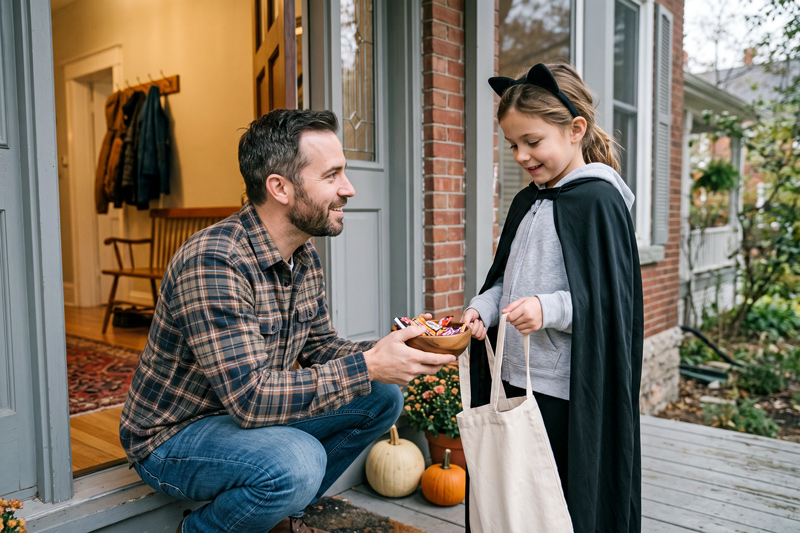
Practice at your own front door with the porch light off. Have your child stand on the path holding the bag: walk up, knock or ring, wait for the door to open, take one piece of candy, step back, and walk away. Repeat until it feels boring. Then have a family member answer while wearing a mask or hat, then add a spooky sound or flashing decoration. Also practice the door that never opens: count to ten, turn, and move on. End every run with one piece of candy and specific praise.
“The part that usually goes wrong isn’t walking up. It’s the door opening on a stranger in the dark, and the social pressure that shows up in the same second,” explains Timko.
Parents are the ones who run these practice runs. “You cannot generalize results if you don’t have the family as part of the treatment team,” Timko says.
The Real Door Test
Timko recommends moving one therapy or school session out of the usual room and onto a real front step during the week before Halloween. “A child who bolts out the front door, refuses to eat at the dining room table, or falls apart at bedtime isn’t going to show you those behaviors in a clinic,” she explains. “And a skill that only exists in the clinic isn’t really a skill yet.”
The Route and Stop Signal
Walk the exact route in daylight before Halloween. Pick the houses you’ll visit and identify a turn-back corner where you’ll head home regardless of progress. Agree on a stop signal that means “we’re going home now,” such as a specific word, a hand squeeze, or showing a card. For kids who tend to run off when overwhelmed, establish a meeting spot they can see, put a phone number on a tag inside the costume, and attach a glow stick or reflective tape to their outfit.
Timko suggests practicing the signal once when everyone is calm, well before the night itself. “A signal introduced for the first time on a loud, crowded street doesn’t mean anything to a child,” she notes. “The child has to learn it in a quiet moment.”
The Night Of
Go out at dusk before the streets fill with older kids and crowds. Plan to visit two houses, maybe three if things go smoothly. Let the child decide whether to continue after each house. When the stop signal comes out, go home without negotiating and praise them specifically for using it.
A short outing beats skipping the night entirely, in Timko’s view. “Say yes to the outings,” she says. “Say yes to keeping your kid part of the community because the more walled in that you get, the harder it becomes later on.”
Drop the Script
Stop drilling the phrase “trick or treat.” Being put on the spot to speak is often the hardest part of the interaction. A held-out bag counts as participation, as does showing a printed card that says “Trick or treat! Thank you!” or tapping a speech device.
“I always tell parents that the child who holds out a bag without speaking is participating perfectly,” Timko adds. “The demand for words is the part that breaks down, and adults can remove it simply by offering the bowl first.”
The Alternative Night
If trick-or-treating isn’t right for your child this year, hand out candy at your own door, take a short walk in daylight to look at decorations, or host a small Halloween celebration at home.
“Zero houses is still a real Halloween for a child,” Timko says. “Handing out candy at your own door or watching a movie in costume counts, because the goal is a night your child wants to repeat next year.”

Meaghan Timko, MS, BCBA, is an Advisor on Behavior Analysis at the Special Needs Care Network and has worked in ABA for more than 20 years.