For many adults with autism and/or I/DD, receiving healthcare can involve more than making an appointment and seeing a doctor.
There is getting to the appointment, navigating insurance, waiting in an unfamiliar or overwhelming environment, communicating symptoms and concerns, understanding what comes next, and coordinating care between providers. Too often, finding a healthcare professional who understands autism and/or I/DD may negatively shape the initial experience.

Person-centered healthcare begins with communication, trust and an understanding of individual needs and preferences.
For adults with profound autism, these barriers can be even more consequential. Individuals with profound autism may have significant intellectual disability, minimal or no spoken language ability, and require 24-hour support throughout their lifespan. Yet their health experiences and needs have historically been underrepresented in autism research.
The white paper of Laurel Tomlinson, MPA, 2025–2026 The Daniel Jordan Fiddle Foundation Adult Autism Public Policy Fellow titled Rethinking Systems: Effective Healthcare for Adults with Autism and/or Intellectual/Developmental Disabilities (I/DD) addresses this underrepresentation head on. (The fellowship is sponsored by First Place AZ and The Daniel Jordan Fiddle Foundation in partnership with the Morrison Institute for Public Policy at Arizona State University.)
Tomlinson cites research concluding that an estimated 26.7% of 8-year-old children with autism met criteria consistent with profound autism, yet only 6% of clinical autism research studies examined included participants with profound autism (Hughes et al., 2023; Stedman et al., 2019).
That gap matters. A healthcare system cannot be truly responsive to the autism community if people with the most significant support needs are absent from the conversation.
Research has documented healthcare barriers for autistic people across the spectrum of disability and across the lifespan, including challenges with communication and access to and the transition into adult care (Doherty et al., 2022; Malik-Soni et al., 2021). These challenges do not exist in isolation. Together, they can create a healthcare system that is difficult to navigate and unprepared to support adults with autism and/or I/DD.
That broader systems challenge is the focus of Tomlinson’s research. She examined healthcare for adults with autism and/or I/DD through three lenses: a review of current healthcare challenges; a historical review of disability and healthcare policy; and qualitative interviews with healthcare professionals, adults with autism and/or I/DD, families/caregivers, first responders, and systems specialists (Tomlinson, 2026). Importantly, the research and policy recommendations consider a range of support needs, including those of adults with profound autism.
Tomlinson’s white paper, “Rethinking Systems: Effective Healthcare for Adults with Autism and/or Intellectual/Developmental Disabilities (I/DD),” does more than identify barriers. It invites us to consider how healthcare systems can change.
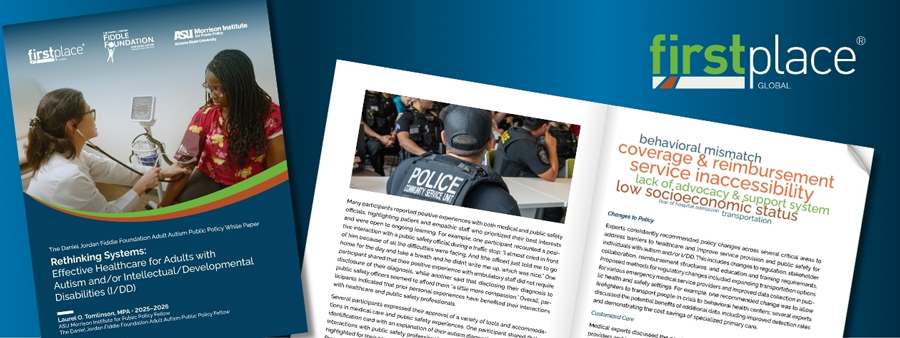
The Daniel Jordan Fiddle Foundation Adult Autism Public Policy White Paper, authored by Laurel O. Tomlinson, MPA, 2025–2026 Fellow.
What We Heard
One of the most important lessons from Tomlinson’s research is that there is no single healthcare barrier for adults with autism and/or I/DD.
Individuals with lived experience who participated in interviews described challenges with transportation, service availability, insurance coverage, communication, and healthcare environments. One participant put a common communication challenge simply: “I don’t always ask the right questions.” Others described long waits as frustrating, particularly when they did not understand the reason for the delay (Tomlinson, 2026).
Trust also emerged as a key concern. Some participants described fear that information shared with medical professionals could be used against them. One individual recalled being capable of making medical decisions independently, yet having a provider wait to speak with their medical power of attorney before moving forward with treatment (Tomlinson, 2026).
Participants also described providers unable to recognize or effectively interact with people with autism and/or I/DD because of limited training, particularly when serving patients with profound autism and/or those who do not use spoken language. They also described acute-care and psychiatric environments incompatible with individualized sensory, communication, and behavioral needs (Tomlinson, 2026).
These findings reinforce why a one-size-fits-all approach cannot work. Effective healthcare must preserve the autonomy of individuals to direct their own care while also being prepared to support others who require substantial assistance with communication, decision-making, daily living, and healthcare navigation.
Importantly, the research also identified what is working. Participants described positive experiences with patient and empathetic providers, preventive care, technology and accommodations that made healthcare easier to navigate (Tomlinson, 2026).
These observations offer an important roadmap. Improving healthcare does not always mean inventing something new. Sometimes it is a matter of taking practices that already work and making them easier to find, fund, and sustain.
Accessible, coordinated healthcare can help reduce reliance on emergency and crisis-based systems for adults with autism and/or I/DD.
Shifting Toward Better Care
Tomlinson’s research points toward a healthcare system designed around the person instead of expecting the person to navigate around the system. Below are four recommended approaches:
- From Fragmented Care to Coordinated Care – Bring more services together through integrated “one-stop-shop” models led by multidisciplinary teams. Better coordination across healthcare, crisis, and public safety systems, along with sensory-friendly environments, can help reduce the burden on individuals and families to piece together care themselves (Tomlinson, 2026).
- From Awareness to Preparedness – Knowing about autism and/or I/DD is not the same as being prepared to provide effective care. Medical education, licensing, accreditation, and experiential learning can better equip professionals to administer care and support across the spectrum, including individuals with profound autism and those who do not use spoken language. Tomlinson also recommends workforce incentives such as loan-repayment programs for healthcare professionals serving this population (Tomlinson, 2026).
- From One-Size-Fits-All to Individualized Support – Insurance and healthcare systems should recognize that support needs are not interchangeable. Recommendations in the white paper include coverage that better distinguishes between lower and higher support needs — including profound autism — while expanding access to services, therapies, accommodations, and reliable transportation across adulthood (Tomlinson, 2026).
- From Crisis Response to Crisis Prevention – Emergency departments (EDs) should not become the sole alternative to the shortcomings of other care systems. Stronger behavioral health crisis teams, alternative pathways to EDs, and programs that improve interactions with public safety can help build a system that responds earlier and more appropriately (Tomlinson, 2026).

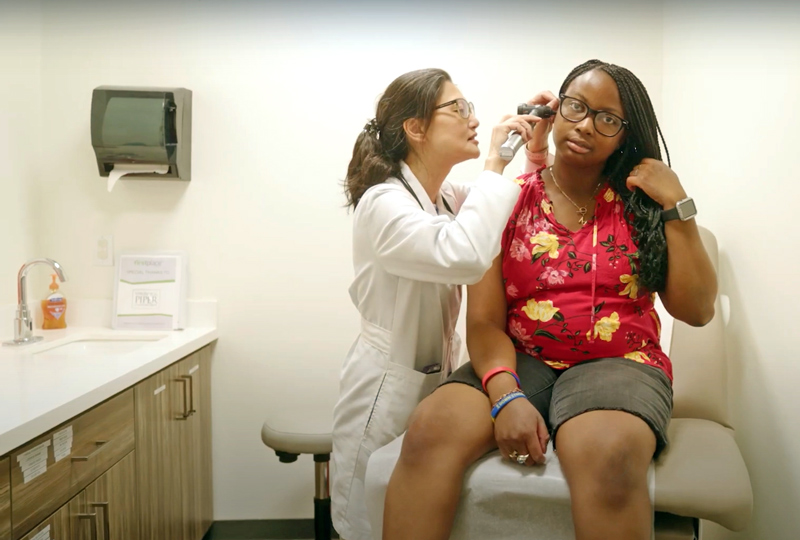
Hands-on healthcare training helps prepare future medical professionals to provide more responsive, individualized care for adults with autism and/or I/DD.
From Research to Action
Healthcare access is about more than finding a clinic or whether there’s an insurance card in someone’s wallet. It means having systems capable of responding to different communication styles, sensory needs, levels of independence, medical complexity, and support needs.
It also means being clear about whose voices must be heard.
Tomlinson notes an important limitation of the study: Adults with lived experience were relatively homogenous, primarily representing people with low and moderate support needs who had access to positive support systems. Their perspectives are valuable, but they are not intended to represent all adults with autism and/or I/DD (Tomlinson, 2026).
That makes the inclusion of profound autism in the white paper’s policy-focus framework particularly important while also underscoring the need for future research more representative of people with significant support needs and those who may communicate differently.
Work underway offers a glimpse into how greater attention to research can translate into practice. The Profound Autism Alliance funds ECHO Autism: Intense Behavior, a virtual training initiative developed to help clinicians strengthen assessment, diagnosis and treatment for people with autism experiencing intense behaviors, including severe emotional dysregulation, self-injury and physical aggression (Profound Autism Alliance, n.d.).
Efforts like these are part of a larger, much-needed shift. The goal cannot be a healthcare system designed for an “average” autistic adult/adult with autism — there is no such person.
We must respect the autonomy of adults who independently direct their healthcare. We must also respect those who require significant assistance navigating providers, environments, and systems — and reimagine how those systems can work better for everyone. This includes families and support providers who should not have to compensate for gaps that better policy, training, and coordination can fill.
Informed, coordinated, and individualized healthcare across the full spectrum of need should not be the exception. It should be the standard of care.

Joshua Munoz, Associate Director of Public Policy at First Place Global, leads initiatives that bridge lived experience with systems-level reform to improve outcomes for individuals with autism and/or I/DD. His work centers on inclusive employment, healthcare access, housing innovation, and civic engagement, with a focus on advancing public policy reflecting the needs and strengths of individuals across the spectrum and lifespan. Contact Joshua at [email protected].
References
Doherty, M., Neilson, S., O’Sullivan, J., Carravallah, L., Johnson, M., Cullen, W., & Shaw, S. C. K. (2022). Barriers to healthcare and self-reported adverse outcomes for autistic adults: A cross-sectional study. BMJ Open, 12(2), e056904. https://doi.org/10.1136/bmjopen-2021-056904
Hughes, M. M., Shaw, K. A., DiRienzo, M., Durkin, M. S., Esler, A., Hall-Lande, J., Wiggins, L., Zahorodny, W., Singer, A., & Maenner, M. J. (2023). The prevalence and characteristics of children with profound autism, 15 sites, United States, 2000-2016. Public Health Reports, 138(6), 971-980. https://doi.org/10.1177/00333549231163551
Malik-Soni, N., Shaker, A., Luck, H., Mullin, A. E., Wiley, R. E., Lewis, M. E., & Fombonne, E. (2021). Tackling healthcare access barriers for individuals with autism from diagnosis to adulthood. Molecular Autism, 12(1), 1–21. https://doi.org/10.1038/s41390-021-01465-y
Profound Autism Alliance. (n.d.). Intense behaviors. https://www.profoundautism.org/advancing-research-and-care/physician-training-for-intense-behaviors/
Stedman, A., Taylor, B., Erard, M., Peura, C., & Siegel, M. (2019). Are children severely affected by autism spectrum disorder underrepresented in treatment studies? An analysis of the literature. Journal of Autism and Developmental Disorders, 49(4), 1378-1390.
Tomlinson, L. O. (2026). Rethinking systems: Effective healthcare for adults with autism and/or intellectual/developmental disabilities (I/DD) [White Paper]. First Place AZ; The Daniel Jordan Fiddle Foundation for Adult Autism; the Arizona Board of Regents for and on behalf of Arizona State University and its Morrison Institute for Public Policy at the Watts College of Public Service and Community Solutions.