One night, I woke up for no obvious reason and found my young daughter near the door. She was getting ready to leave our apartment.
My daughter is autistic and does not rely on speech to communicate. At that moment, the danger was not theoretical. If she had reached the street, she might not have been able to tell a stranger her name, where she lived, or whom to call.
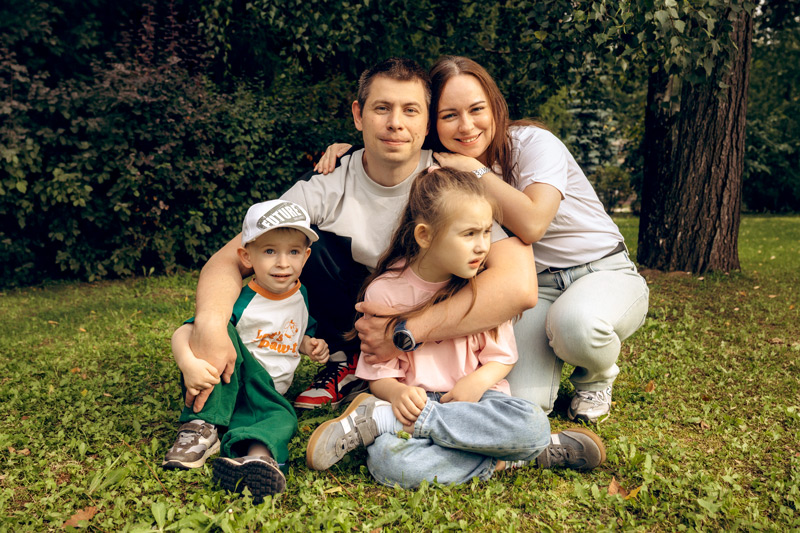
Nikita Babkin with wife Yulia, son Ivan, and daughter Varvara
What stayed with me was a very simple question: What if I had not woken up?
Families of autistic children are not imagining this risk. In a 2012 Pediatrics study involving 1,218 children with autism spectrum disorder, 49% of parents reported that their child had attempted to elope at least once after age four. Twenty-six percent had been missing long enough to cause concern. Among those who went missing, parents reported traffic and drowning among the major dangers.
The American Academy of Pediatrics has since emphasized that wandering should be addressed directly in care planning and has discussed measures including family emergency plans, identification, environmental safeguards, teaching safety skills, and, where appropriate, personal GPS devices.
But there is another risk that deserves attention. In trying to keep a nonspeaking autistic person safe, adults can build a system that watches everything, decides everything, and gradually leaves less room for autonomy.
Safety can become surveillance. Support can become control.
The goal should not be to choose between freedom and protection. It should be to build support that makes greater freedom possible.
Communication Must Come First
A person who does not use reliable speech is not a person without a voice.
Communication may happen through augmentative and alternative communication (AAC), gestures, facial expressions, body movement, pictures, typing, or other individualized methods. The American Speech-Language-Hearing Association (ASHA) describes AAC as tools and strategies that supplement or compensate for difficulties with spoken communication. Importantly, access to AAC should not depend on someone first proving a particular level of cognitive ability.
This becomes especially important in an emergency. A frightened person may communicate differently than they do at home, school, or another familiar environment. Their AAC device may be out of reach. A first responder may ask several questions quickly and mistake the absence of spoken answers for the absence of understanding.
Noise, flashing lights, physical contact, unfamiliar people, and fear can make communication even harder.
For that reason, a safety plan should also be a communication plan. How does this person communicate? How should an unfamiliar person approach them? Do they need additional time to process a question? Are there sounds, touches, or situations that may increase distress? Who knows their communication best?
In an emergency, those facts may matter just as much as a telephone number.
Autism Spectrum News has recently explored an important related idea: communication should not be reduced to compliance. A nonspeaking person should still be treated as someone participating in decisions about their own life.
Safety should follow the same principle.
Location Should Be a Tool, Not a Relationship
Location technology can be useful. For some families, knowing that a child has crossed a boundary or has not arrived where expected can save crucial minutes.
But a map cannot tell us whether monitoring is respectful.
The better question is not simply, “Can we track this person?” It is: “What level of location sharing is necessary for this person, in this situation, and who actually needs access to it?”
For a young child with a history of dangerous wandering, continuous location sharing may be reasonable. For an older teenager or an adult, the balance may be different.
The answer should also be allowed to change. Abilities change. Routines change. Risk changes. A person’s ability to participate in decisions can change. Safety settings should therefore be revisited rather than becoming permanent simply because they were configured years earlier.
Wherever possible, the autistic person should be involved in decisions about what is shared, with whom, and under what circumstances.
Technology should adapt to the person. The person should not have to surrender all privacy simply because technology makes that possible.
Design for the Moment When a Stranger Has to Help
Many safety tools are built around the caregiver’s screen: a location dot, an alert, a route history.
But a real emergency may involve someone outside the family. A stranger may find a lost child in a parking lot. A paramedic may encounter an autistic adult who cannot rely on speech after an injury. A police officer may meet someone who is frightened, pacing, or trying to get away from an overwhelming situation.
At that moment, the helper needs a small amount of accurate, actionable information. That information might be carried on an identification card, bracelet, phone emergency profile, QR code, or another format that works for that individual.
It should also be deliberately limited. A useful emergency profile does not need to expose an entire medical record. It may need only a preferred name or identifier, the person’s communication method, essential medical or sensory information, and a reliable way to contact someone they trust.
The purpose is not to speak instead of the autistic person. The purpose is to reduce the number of questions they must answer while distressed and shorten the path to someone who understands how to support them.
Communication-access guidance from ASHA makes an important point here: people with communication disabilities may be capable of understanding health information and making decisions when appropriate communication support is available. Emergency information should support that participation, not replace it.
Alerts Must Lead to Action
Many families already live inside a stream of notifications: school messages, medication reminders, door sensors, watches, cameras, phones, and location apps. If everything becomes an emergency, eventually nothing feels like an emergency.
A useful safety system should distinguish between information and action. A change in the usual route may deserve attention. Leaving a known high-risk area may require something more urgent. A low battery is important, but it should not compete for attention in exactly the same way as an immediate safety event.
Every important alert should help answer three questions: What changed? Why does it matter? What can I do now?
Reducing alert fatigue is not merely a matter of making an interface more pleasant. It helps preserve the human response for the moments when a response really matters.
Plan for Failure
No technology should ever be treated as a guarantee. Batteries die. Mobile networks fail. Devices get left at home. GPS can be inaccurate. A caregiver can be asleep, driving, or temporarily unreachable.
That means safety needs layers. Teaching skills where possible. Environmental safeguards. Communication access. Trusted backup people. Identification. An emergency plan. Technology where it adds value.
The best system is not necessarily the one with the longest feature list. It is the one that still leaves a path to help when one layer fails.
Safety Should Widen a Person’s World
As a parent, I understand the temptation to remove every possible risk. But zero risk is not a realistic human condition.
If the price of safety is that an autistic person can never have privacy, choice, exploration, or age-appropriate independence, then we have solved one problem by creating another.
A better measure is whether support allows that person to do more safely. Attend school. Go to a park. Spend time with relatives. Travel with a support person. Work. Participate in the community. Eventually, where possible, live with greater independence.
My daughter taught me the difference between being nearby and being prepared. That night, I was nearby. We were lucky.
Preparation is what we build so that safety depends less on luck. But preparation should never erase the person we are trying to protect.
For nonspeaking autistic people, the most humane safety system is not necessarily the one that watches most closely. It is the one that combines communication, dignity, proportional support, and a clear path to help — while preserving as much autonomy as possible.
Nikita Babkin is the Founder of Guardian Angel System, based in Kazan, Russia, and can be reached at [email protected] or through guardianangelsystem.ru.
References
American Speech-Language-Hearing Association. Augmentative and Alternative Communication (AAC). ASHA Practice Portal.
Anderson, C., Law, J. K., Daniels, A., Rice, C., Mandell, D. S., Hagopian, L., & Law, P. A. (2012). Occurrence and Family Impact of Elopement in Children With Autism Spectrum Disorders. Pediatrics, 130(5), 870–877. doi:10.1542/peds.2012-0762.
Corcoran, R., Facey, H., & Ackerman, S. (2026). “The Best Medicine Is Respect!” Creating a Supportive Healthcare Environment for Nonspeakers. Autism Spectrum News.
Gonzales, R. (2026). Communication Over Compliance: Promoting Assent, Autonomy and Self-Advocacy. Autism Spectrum News.
Hyman, S. L., Levy, S. E., & Myers, S. M. (2020). Identification, Evaluation, and Management of Children With Autism Spectrum Disorder. Pediatrics, 145(1), e20193447. doi:10.1542/peds.2019-3447.
National Joint Committee for the Communication Needs of Persons With Severe Disabilities. Communication Bill of Rights. American Speech-Language-Hearing Association.